
GMSL2 vs GigE Vision for Industrial Multi-Camera Systems
GMSL2 and GigE Vision solve different camera-ingress problems. GMSL2 uses dedicated point-to-point SerDes links and is well suited to short-reach, synchronized cameras on vehicles and robots. GigE Vision uses standard Ethernet networking, providing longer reach, broad camera interoperability and scalable switched topologies for industrial vision.
The right choice depends on cable distance, camera bandwidth, synchronization, topology, host architecture and whether the cameras move with the machine—not camera count alone.
.
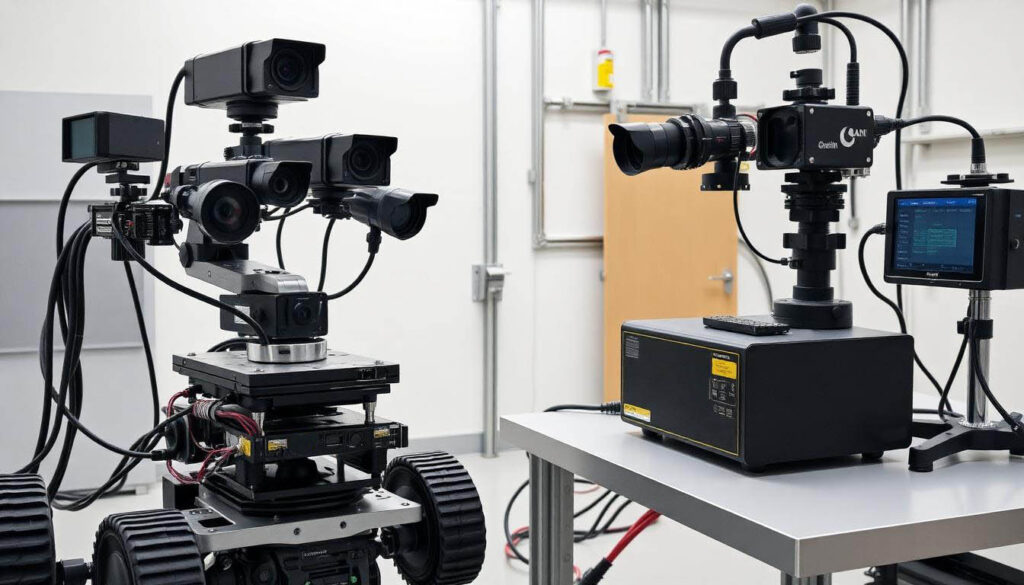
GMSL2 and GigE Vision solve the same problem from opposite directions. GMSL2 is an automotive-grade SerDes that carries up to 6Gbps over a single coax cable to 15m with sub-microsecond, deterministic latency, and it lives natively on NVIDIA Jetson. GigE Vision is an open Ethernet standard that reaches 100m over Cat5e/6, interoperates with hundreds of camera vendors, and runs on any x86 host.
The camera interface is one of the most consequential — and most under-analyzed — decisions in a multi-camera system. It sets your cable reach, your latency floor, your synchronization strategy, your host CPU budget, and which compute platform you’re allowed to use. Pick it late and you inherit constraints you didn’t choose.
What is the difference between GMSL2 and GigE Vision?
GMSL2 is a point-to-point SerDes (serializer/deserializer) link that streams uncompressed video over coax or shielded twisted pair straight into the host’s camera pipeline. GigE Vision is a networked standard that packetizes video over standard Ethernet.
The practical consequence: GMSL2 is short-reach, low-latency, low-CPU and hardware-deterministic; GigE Vision is long-reach, interoperable, and software-defined but carries more latency and host overhead. One is a cable; the other is a network.
The Fundamental Difference: Dedicated SerDes vs Networked Vision
GMSL2: dedicated camera links
Each camera uses a dedicated serialized point-to-point link. Multiple links are aggregated at the deserializer or capture stage.
GigE Vision: cameras as network devices
Standardized Ethernet transport and control support switched topologies, distributed deployment and a broad multi-vendor ecosystem.
How GMSL2 Camera Links Work
GMSL2 is a high-speed SerDes architecture, not a generic network protocol. Common implementations use 3 Gbps or 6 Gbps-class forward links depending on the serializer, deserializer and configuration; one universal bandwidth number does not describe every device.
Cable reach is a channel-design result. It depends on link rate, cable construction, connector quality and channel loss. Some 6 Gbps coax implementations are specified around the 15 m range, while other cable types may be shorter and selected lower-rate configurations may support longer distances.
Video integrity is monitored with mechanisms such as CRC. Automatic retransmission is primarily associated with lower-bandwidth control communication rather than the high-rate video stream.
With an appropriate Power-over-Coax design, camera power, high-speed video and bidirectional control can share one coaxial cable. PoC is a system design feature, not an automatic property of every GMSL2 installation.
How GigE Vision Camera Networks Work
GigE Vision combines standardized device discovery and control with Ethernet streaming and GenICam-compatible camera features. It supports ordinary or industrialized Ethernet infrastructure, switched topologies, broad camera interoperability and PoE where the hardware allows. Standard copper Ethernet offers 100 m-class reach, making distributed camera deployment a natural strength.
What GigE Vision 3.0 Changes
Older comparisons often assume traditional GVSP and UDP streaming where the host CPU and operating system participate heavily in packet handling. GigE Vision 3.0 adds GVRSP and an RDMA-based, RoCEv2-oriented streaming path designed to reduce host CPU involvement and memory-copy overhead. This narrows one traditional architectural difference between Ethernet vision and dedicated capture interfaces.
Support must still be validated as one system. Not every camera or industrial PC supports this path today; the camera, NIC, switch, driver and vision software must all be compatible.
Bandwidth and Cable Distance
Then account for protocol overhead, image packing, synchronization, compression and simultaneous streams. Four cameras can be a light workload or an extreme workload depending on resolution, frame rate and pixel format.
Distance must be evaluated against topology. GMSL2 is optimized for short embedded links; GigE Vision naturally supports longer and switched installations. Neither interface should be selected from camera count alone.
Latency Is Not the Same as End-to-End Vision Latency
GMSL2 provides a low and predictable transport-latency floor because each camera uses a dedicated serialized link. Total camera-to-inference latency also includes exposure, sensor readout, ISP, CSI transfer, memory movement, preprocessing and software scheduling.
GigE Vision latency depends on packetization, NIC behavior, switches, buffering, the operating-system and driver path, and RDMA support where applicable. Compare camera-to-decision latency—not transport latency in isolation.
Multi-camera synchronization: hardware trigger vs PTP
GMSL2
Hardware synchronization or trigger signals can be distributed across camera links. Actual exposure skew depends on sensors, SerDes configuration and trigger architecture.
GigE Vision
Systems can use IEEE 1588 PTP, Action Commands and hardware triggering. Performance depends on the camera, NIC, switch and complete configuration.
Camera Count Is Not the Sizing Specification
Camera count alone does not determine whether the host needs an embedded SoC, x86 CPU, NPU, RTX GPU or specialized capture hardware.
How to Size an Industrial PC for Multi-Camera VisionCPU Load and Memory Movement
Traditional GigE Vision
Packet handling, network-stack work, driver buffering and memory copies may involve the host CPU.
GigE Vision 3.0 / RDMA
Compatible systems can reduce CPU involvement, kernel data movement and memory-copy overhead.
GMSL2
Dedicated links can feed CSI-2 camera pipelines, embedded SoCs or specialized capture hardware.
The useful question is not “Which interface has lower CPU load?” It is “What is the complete camera-to-memory path in this system?”
GMSL2 Is Not Jetson-Only, and GigE Vision Is Not x86-Only
GMSL2 is commonly paired with NVIDIA Jetson because deserializers can feed MIPI CSI-2 into the SoC camera pipeline. It is not limited to Jetson: x86 systems can ingest GMSL cameras through PCIe capture hardware. GigE Vision can likewise feed x86 or an embedded SoC when the network and software path are suitable.
GMSL2 + Jetson
GMSL Cameras → Deserializer → MIPI CSI-2 → Jetson
GMSL2 + x86
GMSL Cameras → PCIe GMSL Capture → x86 IPC
GigE + x86
GigE Cameras → NIC or Switch → x86 IPC
GigE + SoC
GigE Cameras → Ethernet NIC → Embedded SoC
Camera transport and AI accelerator selection are related but separate architecture decisions.
GMSL2 vs GigE Vision Comparison Table
| Engineering Factor | GMSL2 | GigE Vision |
|---|---|---|
| Architecture | Dedicated point-to-point SerDes | Networked Ethernet vision standard |
| Typical link rates | Commonly 3 or 6 Gbps forward; device dependent | Ethernet dependent; 1, 2.5, 5 and 10 GbE widely used |
| Cable reach | Cable and rate dependent; typically short reach | Up to 100 m-class copper Ethernet deployments |
| Topology | Point-to-point links aggregated by a deserializer | Point-to-point or switched network |
| Camera power | PoC possible with an appropriate design | PoE possible where hardware supports it |
| Transport latency | Low and predictable dedicated link | Depends on network, buffering and transport architecture |
| Synchronization | Hardware trigger or dedicated sync paths | PTP, Action Commands or hardware trigger |
| Host CPU overhead | Low at the SerDes transport stage | Traditional GVSP may use more host processing; RDMA can reduce it |
| Camera ecosystem | Embedded, automotive and robotics focused | Broad industrial machine-vision ecosystem |
| Host integration | CSI-2 SoC or dedicated capture hardware | Standard NIC and compatible vision stack |
| Moving-platform fit | Strong | Possible with industrialized cabling and connectors |
| Long distributed installation | Less natural | Strong |
| Typical fit | Vehicle, AMR, robotics and mobile perception | AOI, inspection and distributed factory vision |
Latency, determinism and synchronization
For closed-loop control — a robot reacting to what it sees — the transport’s latency floor matters more than raw bandwidth. GMSL2 frames and forwards in hardware, giving sub-microsecond, jitter-free delivery into the host’s CSI pipeline. GigE Vision adds the Ethernet stack: packetization, buffering, and (without offload) interrupt handling on the host CPU, which raises both latency and jitter. GigE Vision is entirely capable of deterministic multi-camera capture, but you engineer that determinism with PTP, jumbo frames, a tuned NIC, and sometimes a dedicated switch — it is a configuration outcome, not a default.
Synchronizing exposures across cameras is where the two diverge sharply. A GMSL2 deserializer can drive a shared hardware trigger to all attached cameras, producing frame-level alignment with near-zero skew — ideal for stereo, surround-view, and sensor fusion where a few microseconds of misalignment corrupts the result. GigE Vision achieves synchronization through IEEE 1588 PTP and scheduled Action Commands: robust and standardized, but dependent on PTP-capable infrastructure end to end.
Cabling, robustness and platform fit
Cabling, power & mechanics
GMSL2 collapses the cable count: one thin, flexible coax carries power, uncompressed video, bidirectional control and the back-channel, terminated in locking FAKRA/HSD connectors built for vibration — a decisive advantage on anything that moves. GigE Vision uses familiar Cat5e/6 with PoE, moving to screw-locking M12 X-coded connectors industrially, at the cost of a bulkier cable but a 100m reach GMSL2 can’t match. Short and moving favors coax; long and fixed favors Ethernet.
Host CPU load & platform
The transport constrains the compute platform. GMSL2 ingests into a CSI-2 pipeline native to NVIDIA Jetson via a deserializer — a GMSL2 design is effectively a Jetson design, and it keeps the host CPU free because the SerDes and ISP do the heavy lifting. GigE Vision runs on any x86 host with a NIC — why fixed-station machine vision standardized on it — but sustained multi-camera capture consumes CPU unless a hardware-offload NIC or frame grabber absorbs the packet load. The interface and the platform are one decision, not two.
When Each Architecture Fits Better
GMSL2 often fits when
- Cameras move with the machine
- Short runs and low cable weight matter
- Tight hardware synchronization is important
- Embedded cameras aggregate into CSI-2
- Vehicle or robot integration drives the design
Typical uses include AMR, AGV, autonomous machinery, vehicle perception and robot vision. GMSL2 is not mandatory for these applications.
GigE Vision often fits when
- Cameras are distributed around a factory
- Long cable runs are required
- Multi-vendor camera flexibility matters
- Switched network topology is useful
- Existing software supports GigE Vision
Typical uses include AOI, OCR, dimensional inspection, electronics inspection and distributed vision cells.
When a Hybrid Architecture Makes Sense
A machine can use GMSL2 for mobile or embedded cameras, GigE Vision for fixed industrial cameras, USB3 for local short-reach cameras, and CXP or Camera Link for specialized capture. Real systems do not need one interface everywhere.
Choose camera transport for the topology. Choose the compute platform for the workload. Then validate the data path between them.
How BITECH Maps Camera Architecture to Compute Platform
| Workload | Camera / Interface | Compute Direction | BITECH Platform |
|---|---|---|---|
| Classical vision, OCR, in-line inspection | GigE Vision or USB3 | x86 CPU or integrated GPU | AX-130BT/AX-134BT |
| Compact AI defect inspection | Moderate embedded-camera workload | RK3588 NPU | AE-3588BT/AE-3588LBT |
| Multi-camera deep learning | High-bandwidth multi-camera | x86 plus discrete RTX MXM | AE-760EBT |
| Sustained high-load AI in airflow-constrained environments | Multi-camera, high bandwidth, continuous inference | x86 plus RTX MXM and liquid cooling | AE-960EBT |
| Robotics and mobile vision | GMSL2, GigE or sensor fusion | NVIDIA Jetson Orin | AE-NJ60BT |
| CXP or Camera Link | Frame grabber required | PCIe expansion | Engineering review |
| Multi-GPU or extreme bandwidth | Custom capture or fabric | Custom GPU platform | Contact Engineering |
Final sizing depends on resolution, frame rate, pixel format, model complexity, cycle time, storage, synchronization and concurrent workloads.
Verify your camera transport
Weighing GMSL2 vs GigE Vision?
Tell us the camera count, resolution and cable runs. Our engineers confirm the transport and host — GMSL2 on Jetson, GigE Vision on x86, or a hybrid — before you commit to hardware.
Send us the camera plan
- Camera count & resolution
- Cable runs / distance to the host
- Do cameras move with the machine?
- Synchronization requirement (stereo, sensor fusion)
- Required AI model & frame rate
- Existing vision software / SDK
We confirm and return
- GMSL2, GigE Vision or hybrid recommendation
- Jetson or x86 host direction
- Bandwidth & synchronization architecture
- Closest BITECH platform
- A sample configuration
Both ingress paths engineered and validated in-house · GMSL2 on Jetson · GigE Vision / 10GigE on x86
GMSL2 vs GigE Vision
FAQ
-
GMSL2 generally provides a low and predictable dedicated transport path, but end-to-end camera-to-inference latency also includes exposure, sensor readout, ISP, memory movement and application processing.
-
No. Cable reach depends on serializer/deserializer, link rate, cable type, connector and channel design.
-
High-rate video integrity is primarily protected by error-detection mechanisms such as CRC. Retransmission mechanisms are associated mainly with lower-bandwidth control communication.
-
No. Jetson is a common fit because of direct CSI-2 integration, but x86 systems can use GMSL through PCIe capture/deserializer hardware.
-
No. GigE Vision can also be used with embedded SoCs and Jetson systems if the Ethernet and software stack support the workload.
-
No. Traditional GVSP/UDP architectures may involve more host processing, but GigE Vision 3.0 introduces RDMA-oriented streaming that can reduce CPU involvement and memory-copy overhead.
-
There is no useful answer from camera count alone. The result depends on serializer/deserializer topology, CSI bandwidth, resolution, frame rate, pixel format and host ingest capacity.
-
It depends on per-camera payload, NIC bandwidth, switch fabric, memory path, CPU/GPU workload and whether the system also records or processes every frame.
-
GMSL2 is often attractive for short-reach synchronized cameras mounted on the moving platform, but GigE Vision may also fit depending on cable routing, camera ecosystem and system architecture.
-
GigE Vision is often a natural fit for fixed industrial inspection because of its camera ecosystem, cable reach and standardized networking, but the final choice still depends on bandwidth, synchronization and host architecture.
Both ingress paths, engineered for the field
Match the transport to a platform
BITECH builds both ingress paths into industrial enclosures — GMSL2 multi-camera capture on our Jetson Orin platform, and GigE Vision / 10GigE with frame grabbers on our x86 box PCs. Tell us the camera count, resolution and cable runs, and our engineers confirm the transport and host before you commit.