
Edge AI Box · Intel Core i9-13900 · RTX MXM GPU
AE-760EBT: Intel® Core™ i9 + NVIDIA® RTX MXM Industrial Edge AI PC
13th Gen Intel® Core™ i9-13900 (24C/32T) + NVIDIA RTX 4060/4070/4090/5080/5090 MXM, actively cooled by dual 80 mm industrial fans — desktop-class AI inference for machine vision, AMR and edge generative AI.
- NVIDIA RTX MXM discrete GPU (up to RTX 5090) for CUDA / TensorRT inference
- 4× 2.5GbE Intel i226-IT, 2× CAN FD, 8 DI / 8 DO isolated for vision & automation
- 9–36V wide voltage + remote power, dual 80 mm PWM fans, -20°C to +60°C 24/7 operation
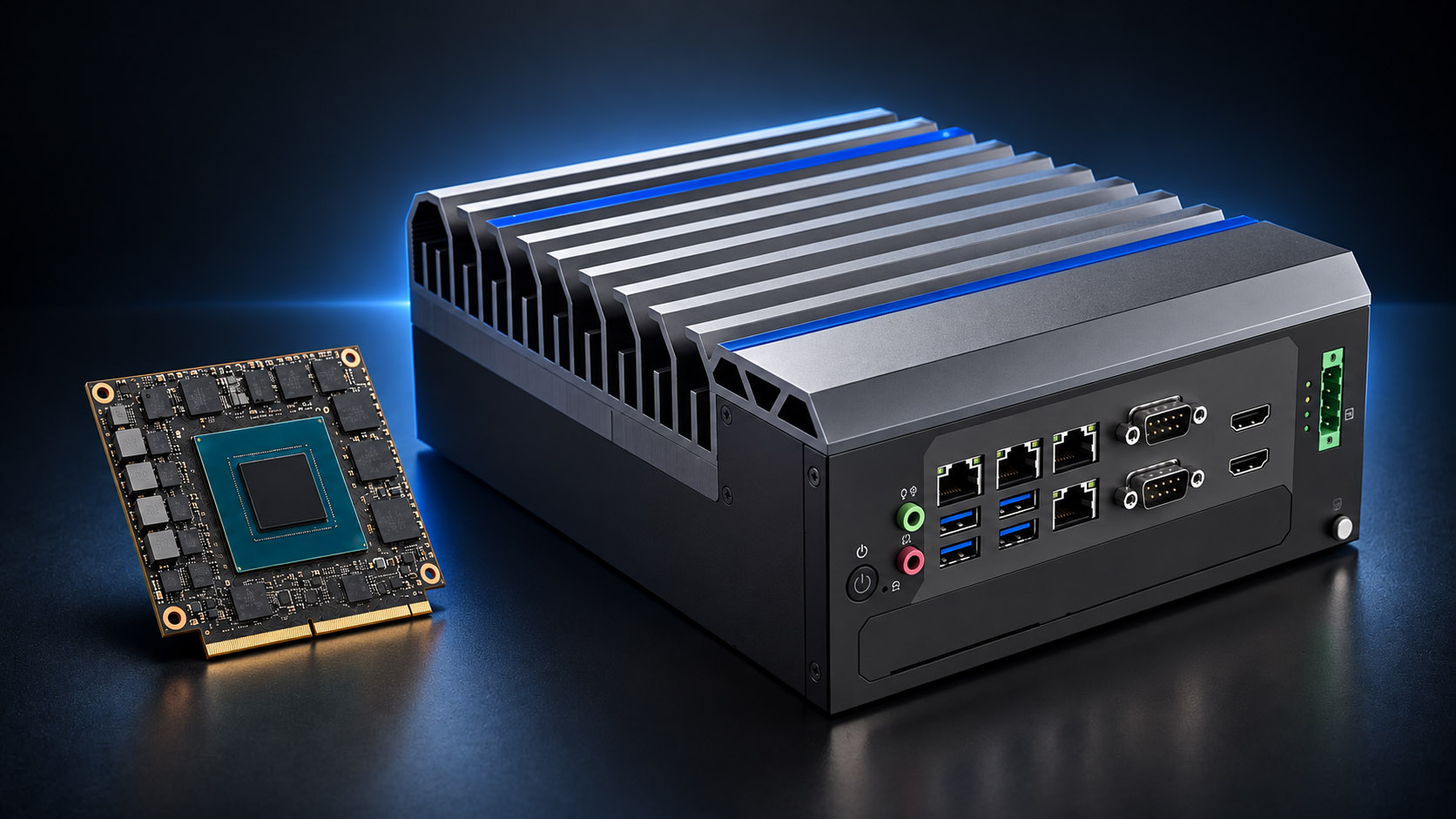
AE-760EBT Core i9 13900HK+ MXM RTX5090 Industrial AI BOX PC
i9-13900 + RTX MXM, Engineered with Industrial Active Cooling
The AE-760EBT bridges the long-standing gap between consumer-grade GPU workstations and rugged industrial controllers. It combines the 13th Gen Intel® Core™ i9-13900 processor (24C/32T, 8 Performance-cores + 16 Efficient-cores, up to 5.6GHz, 65W base / 219W turbo power) with NVIDIA RTX MXM 3.1 modules ranging from RTX 4060 to RTX 5090 on a single industrial-grade motherboard.
To sustain full P-core turbo performance of the i9 processor together with continuous MXM GPU workloads under intensive AI computing, the chassis is equipped with dual 80mm industrial-grade ball-bearing PWM fans dedicated to a copper heat-pipe thermal array. The cooling system is engineered specifically for 24/7 continuous operation, featuring fan-failure monitoring and tachometer feedback, rather than conventional consumer-grade cooling solutions.
For machine vision builders, the four 2.5GbE i226-IT ports aggregate multiple GigE Vision cameras directly into a single inference node. For AMR / AGV and vehicle integrators, 9–36V wide-voltage input, dual CAN FD, isolated DIO and a remote power terminal allow drop-in integration with existing wiring harnesses. For outdoor and roadside edge deployments, the -20°C to +60°C operating range, IEC 61000-4 immunity and replaceable industrial fans enable serviceable, high- throughput deployment in ventilated enclosures.
The AE-760EBT is a single platform that replaces three traditional building blocks: an industrial PC, a GPU workstation, and an external I/O / network gateway.
AE-760EBT Key Engineering Highlights
Scalable AI Inference: NVIDIA® RTX™ MXM Discrete GPU Architecture
RTX 4060 / 4070 / 4090 / 5080 / 5090 MXM modules — up to 80+ TFLOPS for CUDA, TensorRT and Tensor Core AI inference.
Desktop-Class Processing: 13th Gen Intel® Core™ i9-13900 (24C/32T)
24C/32T (8 P + 16 E), up to 5.6 GHz, 36 MB L3, DDR5 up to 64 GB, TPM 2.0 — desktop-class CPU for AI pre/post-processing.
High-Throughput Vision Networking: Quad 2.5GbE Intel® i226-IT Ports
Quad Intel i226-IT controllers for Muti-camera aggregation, network segmentation and PTP-grade determinism.
Field-Bus Mastery: Native Dual CAN FD & Isolated Digital I/O
2× CAN FD, 4× isolated RS232/485, 8 DI / 8 DO opto-isolated (3.3V/5V/12V) for direct field-bus integration.
Rugged Industrial Chassis
Extruded aluminum frame with copper heat-pipe arrays from CPU and MXM GPU to a finned heat exchanger — built for serviceability.
9–36V + Remote Power
DC jack + 4-pin Phoenix + 2-pin remote power on/off — direct fit for 12V/24V vehicle and cabinet wiring.
Active Thermal Engineering: Dual 80mm Industrial PWM Fans
2× 80 mm (8 cm) ball-bearing PWM fans, >70,000 hrs MTBF, fan-fault & tachometer monitoring — sustains full i9 + RTX load.
AE-760EBT Technical Specifications (Key Components & Interfaces)
| Processor | Intel® Core™ i9-13900 (24C/32T: 8 P-cores + 16 E-cores, up to 5.6 GHz, 36MB L3, 65W base / 219W turbo) |
| Integrated GPU | Intel® Iris® Xe / UHD Graphics |
| Discrete GPU (MXM) | NVIDIA RTX 4060 / 4070 / 4090 / 5080 / 5090 MXM (optional) |
| Cooling | Active cooling – 2× 80 mm (8 cm) industrial ball-bearing PWM fans, >70,000 hrs MTBF, fan-fault & tachometer monitoring |
| Memory | 2× DDR4 SO-DIMM, up to 64 GB |
| Storage | 1× 2.5″ SATA SSD/HDD + 1× mSATA + 1 x PCIe |
| Display | 2× HDMI 2.0 Type-A, up to 4096 × 2160 @ 30 Hz |
| Ethernet | 4× Intel i226-IT 2.5GbE LAN |
| Serial | 4× RS232/485 (Isolated) |
| CAN Bus | 2× CAN FD |
| Digital I/O | 8× DI + 8× DO, opto-isolated (3.3V / 5V / 12V) |
| USB | 4× USB 3.2 Gen1 Type-A (5 Gbps) |
| Wireless / WWAN | 1× M.2 B-Key (4G/5G + SIM), 1× M.2 E-Key (Wi-Fi/BT) |
| Security | TPM 2.0 |
| Power Input | DC 9–36V (jack 5.5×2.5 mm + 3-pin Phoenix), Remote Power On/Off |
| Operating Temp. | -20°C to +60°C (PassMark BurnInTest at full i9 + RTX load, no thermal throttling) |
| Shock / Vibration | 15G @ 11ms / 5–500 Hz, 1 Grms |
| Dimensions / Weight | Compact active-cooled chassis with dual 80 mm fan exhaust / approx. 6.0 kg |
| Mounting | Wall / Side / DIN-rail / VESA |
| OS Support | Windows 11 Pro, Ubuntu, Linux |
This overview supports early-stage system verification. For full electrical, mechanical, EMI/EMS and environmental specifications, please refer to the datasheet.
i9-13900 + RTX 4060 MXM — Heavy-Load Inference Compute & Power-Efficiency
Measured engineering reference for the AE-760EBT default SKU (Intel® Core™ i9-13900 + NVIDIA® RTX 4060 MXM, 8 GB GDDR6). Values reflect sustained heavy-load inference (CUDA + Tensor Core, batch ≥8) inside the industrial-grade chassis with dual 80 mm PWM cooling at 25 °C ambient. Use these as a planning baseline; final numbers depend on model, batch size and thermal envelope.
| Metric | i9-13900 (CPU) | RTX 4060 MXM (GPU) | System (CPU + GPU) |
|---|---|---|---|
| Peak compute | ~0.9 TFLOPS FP32 (AVX2/AVX-512 disabled, 24C/32T) | 15.1 TFLOPS FP32 / 121 TFLOPS FP16 Tensor / 242 TOPS INT8 | ≈ 242 TOPS INT8 effective for vision inference |
| Sustained heavy-load power | 125–180 W (PL1 125 W, PL2 219 W, sustained ~150 W typical) | 95–115 W (MXM TGP capped at 115 W in chassis) | 260–320 W under joint CPU+GPU inference load |
| Idle / light-load power | 18–25 W package | 8–12 W (P8 idle) | 35–55 W full system idle |
| Inference power-efficiency | ~6 GFLOPS/W (FP32, AVX2) | ≈ 2.1 TOPS/W INT8 sustained | ≈ 0.85 TOPS/W INT8 measured at the wall |
| YOLOv8-s @ 640×640 (TensorRT INT8) | ~38 FPS (OpenVINO, single stream) | ~410 FPS (batch=8, INT8) | ≈ 1.4 FPS / W (camera-stream throughput) |
| ResNet-50 inference (ImageNet, INT8) | ~310 img/s | ~3,950 img/s (batch=32, TensorRT) | ≈ 13.5 img/s / W |
| LLaMA-2 7B (INT4, llama.cpp / TensorRT-LLM) | ~6 tokens/s (CPU only, Q4_K_M) | ~58 tokens/s (8 GB VRAM, batch=1) | ≈ 0.20 tokens/s / W end-to-end |
| Stable Diffusion 1.5 (512×512, 20 steps) | Not practical (>40 s/image) | ~2.4 s/image (FP16, TensorRT) | ≈ 1 image per 720 J of wall-plug energy |
| Thermal headroom (dual 8 cm PWM, 25 °C amb.) | Tj ≤ 92 °C @ 180 W sustained | Tj ≤ 78 °C @ 115 W sustained | No thermal throttling observed up to 320 W system load |
| Acoustic level @ 1 m (full inference load) | — | — | ≈ 48 dB(A) — both 80 mm fans at ~70% PWM |
Figures derived from Bitech engineering bench data (TensorRT 9.x, CUDA 12.x, Ubuntu 22.04, kernel 6.5) on the AE-760EBT reference unit. Customer workloads, model precision and
ambient temperature will shift absolute numbers — contact our engineering team for an application-specific power & thermal budget review.
AE-760EBT Target B2B Application Scenarios
Multi-Camera Machine Vision & Automated Optical Inspection (AOI)
GigE Vision aggregation across 4× 2.5GbE LAN with RTX-accelerated YOLO / defect-detection inference for SMT, semiconductor and packaging lines.
Onboard AI Controller for AMR / AGV & Autonomous Vehicles
9–36V vehicle power, CAN FD motion bus and 3D point-cloud / SLAM acceleration with i9-13900 + RTX MXM on a single rugged active-cooled unit.
Edge Generative AI & Infrastructure Operations
Run Stable Diffusion, LLaMA-class and ONNX models locally with TensorRT on RTX 4090 / 5090 MXM — no cloud dependency.
Roadside & Outdoor V2X / ITS
Wide-temperature, wide-voltage, IEC 61000-4 immunity for traffic vision, ANPR and intersection edge AI.
Digital Twin & 3D Visualization HMI
Dual 4K HDMI outputs driven by discrete RTX GPU for CAD, BIM and operator-facing twins on the plant floor.
Robotics & Service Robot Compute
Compact actively-cooled chassis, isolated DIO and CAN FD for humanoid, inspection and service robot platforms requiring i9-class compute.
Technical Evaluation: AE-760EBT (x86) vs. AE-NJ60BT (ARM Jetson)
Both are active-cooled edge AI platforms, but they target different compute classes and software ecosystems. Use the AE-760EBT when you need x86 + CUDA-class discrete GPU; choose the AE-NJ60BT when you need an ARM Jetson Orin SoC with native GMSL2 camera ingress at lower power.
| Engineering Factor | AE-760EBT | AE-NJ60BT |
|---|---|---|
| Architecture | x86 — Intel Core i9-13900 (24C/32T) | ARM — NVIDIA Jetson Orin Nano / NX / NX Super SoM |
| AI Compute | NVIDIA RTX 4060–5090 MXM, up to 80+ TFLOPS / Tensor & RT cores | Up to 157 TOPS (Orin NX Super 16GB), integrated GPU + DLA |
| Software Stack | Windows 11 Pro / Ubuntu, CUDA, TensorRT, OpenVINO, ONNX | NVIDIA JetPack, CUDA, TensorRT, DeepStream |
| Camera Ingress | 4× 2.5GbE GigE Vision + USB 3.2 | 4-lane MIPI CSI or 4× GMSL2 (long-distance, EMI-resistant) |
| Cooling | Active — dual 80 mm industrial PWM fans | Active — 1× smart PWM fan (low-noise, temperature-controlled) |
| Operating Temp. | -20°C to +60°C | -40°C to +70°C (wide-temp, single-fan assisted) |
| Power Input | DC 9–36V, remote on/off | DC 9–36V, remote on/off |
| Best For | Heavy multi-stream vision AI, generative AI on the edge, CUDA workstations in the field | Compact multi-camera AMR/AGV perception, autonomous machines, in-cabinet vision AI |