
CAN Bus 60Ω Rule: How to Check Termination with a Multimeter
A properly terminated high-speed CAN bus typically measures about 60Ω between CANH and CANL with the network powered off. Two 120Ω termination resistors—one at each physical end of the bus—appear in parallel to a multimeter.
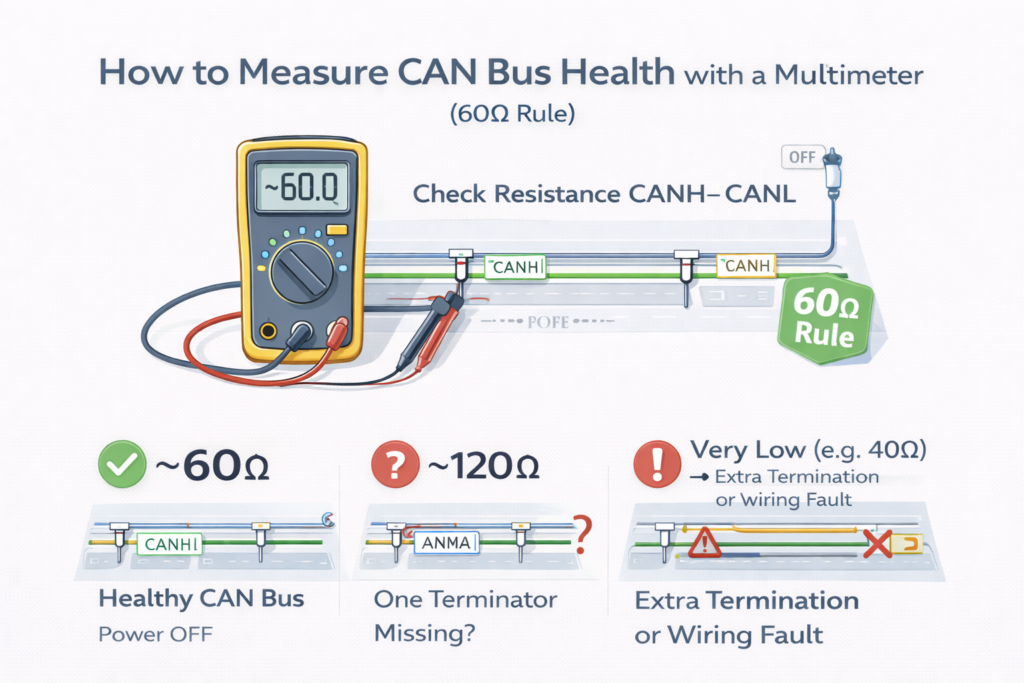
Two 120Ω terminators in parallel across CANH/CANL read ~60Ω on a powered-off bus — the fastest health check in the field.
BITECH Engineering Notes · ~4 min read
If you measure about 120Ω, 40Ω, near 0Ω or an open circuit, the resistance itself gives you a fast clue about missing termination, extra termination or a wiring fault.
Do this first. It takes 30 seconds and costs nothing.
Why Does a CAN Bus Measure 60 Ohms?
A high-speed CAN bus is a twisted pair with a 120Ω terminator at each physical end — they absorb the signal so it doesn’t reflect back and corrupt frames. Two terminators, one at each end, no more, no less.
Those two 120Ω resistors sit in parallel across CANH/CANL. Two 120Ω in parallel = 60Ω. So measuring resistance across the bus tells you whether both terminators are actually there.
How to Test CAN Bus Termination with a Multimeter
- Power off the system. Not optional — active transceivers skew the reading. On a vehicle, let the network sleep or disconnect the battery negative.
- Set the multimeter to resistance (Ω).
- Measure between CANH and CANL (on a vehicle: OBD-II pin 6 and pin 14).
- Compare the result with the resistance table:
Do not measure termination resistance on an energized network with a normal multimeter.
What do 60Ω, 120Ω,40Ω and 0Ω Mean?
| CANH–CANL Reading | Likely Condition | What to Check |
|---|---|---|
| ~60Ω | Two 120Ω terminators are present | Confirm they are at the two physical ends |
| ~120Ω | Only one terminator is visible | Check for a missing/open second termination or wiring break |
| ~40Ω | Three 120Ω terminators may be present | Look for an extra terminated node |
| ~30Ω | Four 120Ω terminators may be present | Check for multiple enabled terminators |
| Near 0Ω | Possible CANH–CANL short | Inspect wiring/connectors |
| Very high / open | No effective termination or open circuit | Check both terminators and harness continuity |
A 60Ω reading confirms the total termination resistance. It does not prove that the two 120Ω resistors are located at the physical ends of the trunk.
CAB Bus Reads 60Ω but Still Does Not Work — What Next?
- If CANH-to-CANL measures approximately 60Ω but communication is still unstable, check termination placement, trunk/stub topology, cable continuity, grounding and isolation, baud rate/bit timing, connectors and the actual CAN waveform.
What it does NOT tell you
This is where people get a false sense of safety. A resistance check confirms the total termination — nothing more:
- •It can’t confirm placement. ~60Ω could be two correct end terminators, or a single 60Ω resistor in the middle, or terminators on the wrong nodes. Only physical inspection confirms they’re at the true ends.
- •It can’t see software-switched terminators. Some devices enable termination after power-up — invisible to a cold resistance test. Check the manual.
- •It won’t reveal shorts to ground or supply — those need separate CANH/CANL-to-ground and -to-power measurements (should read megohms).
- •It won’t show the waveform. Bit timing and reflections still need a scope or CAN analyzer. The 60Ω check just tells you whether it’s worth reaching for one.
Why it’s worth the 30 seconds
A missing terminator is the classic trap: a bus with only one terminator often works temporarily, then turns unreliable and fails — usually after it’s already in the field. Catching it at 60Ω on install is a lot cheaper than catching it at 2 a.m. on a customer’s line.
And the rule travels: EV/BMS packs, AGVs and AMRs, robots, industrial controllers — anywhere CAN runs, 60Ω is the same first clue.
The takeaway
Before the oscilloscope, before the analyzer, before the logs: power off, measure CANH–CANL, check it’s near 60Ω. If it isn’t, you’ve found your problem before wasting an hour on software that was never broken.
At BITECH we build industrial and edge-AI computers with native, hardware-level CAN / CAN FD controllers — not USB-CAN bridges — and 4000V-isolated CAN where the deployment needs it, so the physical layer is sound before termination even enters the picture.
CAN Bus 60Ω Rule — Frequently Asked Questions
What should a healthy CAN bus measure with a multimeter?
About 60Ω between CANH and CANL, with the system powered off. A high-speed CAN bus has two 120Ω termination resistors, one at each physical end, and they sit in parallel — two 120Ω in parallel equal 60Ω. A reading within a few ohms of 60Ω is normal, since cable resistance, connector contact resistance and transceiver input impedance all shift it slightly.
Why does a CAN bus read 60Ω and not 120Ω?
Because the two 120Ω terminators are wired in parallel across the same CANH/CANL pair, and two equal resistors in parallel give half the value — 60Ω. If you measure ~120Ω, only one terminator is present; the second is missing or open.
What does it mean if my CAN bus reads 120Ω, 40Ω, or 0Ω?
| Reading (CANH–CANL, power off) | What it means |
|---|---|
| ~60Ω | Healthy — both 120Ω terminators present |
| ~120Ω | Only one terminator — the second is missing or open |
| ~40Ω | A third terminator is installed — remove the extra one |
| Near 0Ω | Short between CANH and CANL, or a wiring fault |
| Very high / open | No termination, or an open in the harness |
Only a reading close to 60Ω indicates both terminators are correctly present.
Do I have to power off the bus to measure termination?
Yes. Active CAN transceivers conduct current across the bus and skew the resistance reading, so the bus must be de-energised. On a vehicle, wait for the network to enter sleep mode after ignition off, or disconnect the battery negative terminal for an immediate result.
Does a 60Ω reading guarantee the CAN bus is wired correctly?
No. A resistance test only confirms the total termination resistance, not where the resistors are. A ~60Ω reading could be two correct end terminators, or a single 60Ω resistor placed wrongly in the middle, or terminators on intermediate nodes. It also can’t detect software-switched terminators or shorts to ground. Confirm placement by physical inspection, and use an oscilloscope or CAN analyzer for signal quality.
Can a multimeter replace an oscilloscope for CAN troubleshooting?
No — but it comes first. A multimeter checks termination and gross wiring faults in seconds and rules the physical layer in or out. It can’t show the waveform, bit timing, or reflections, which require an oscilloscope or CAN analyzer. The 60Ω rule tells you whether those tools are even needed.
Where do I measure on a vehicle?
At the OBD-II connector: pin 6 is CANH and pin 14 is CANL. You can also measure at any accessible connector or splice on the bus. Make sure the network is asleep or the battery negative is disconnected before taking the reading.
Does the 60Ω rule also apply to CAN FD?
For conventional high-speed CAN FD networks using 120Ω termination at both physical ends, a powered-off resistance measurement across CANH and CANL will also typically be about 60Ω. However, CAN FD places tighter demands on signal integrity at higher data-phase rates, so a correct resistance reading does not replace waveform, topology and timing validation.
Related
If the 60Ω check found something — here’s what to look at next
Six ways deeper: a platform with native CAN done right, a deployment scenario where the physical layer really matters, and four engineering guides that go beyond the multimeter.
AX-234BT Industrial Edge Computer
Native hardware CAN controller (not a USB-CAN bridge). Fanless 13th Gen i5, 9–36V wide DC input. 4000V-isolated CAN variant available for vehicle and high-EMI deployments.
View AX-234BT → SolutionAMR / AGV Controller Platforms
CAN is the motion-control backbone on mobile robots. See how BITECH platforms pair native CAN with isolated I/O, LiDAR/camera ingress and safety-rated stop circuits.
Explore AMR platforms → EngineeringCAN Bus Isolation Engineering
Why an unisolated CAN port fails in high-EMI floors, how galvanic isolation stops ground loops on long runs, and how BITECH implements it with native controllers — not USB bridges.
Read the guide → EngineeringIsolated vs Non-Isolated I/O
When 4000V isolation is worth the propagation delay and when it is not. A decision framework for CAN, RS-485 and DIO across cabinet, vehicle, and high-EMI deployments.
Read the guide → EngineeringAGV / AMR System Architecture
Where CAN sits in a mobile robot: perception on Ethernet, planning in ROS, motion and safety on CAN. The full stack view around which the 60Ω check fits.
Read the architecture → EngineeringPowering an Industrial PC in a Vehicle
9–36V wide input, ignition control, and ISO 7637-2 transient protection — the power engineering that lets a CAN-equipped controller ride on a truck without frying its own inputs.
Read the guide →CAN-Capable Industrial PC Platforms
If the 60Ω check is clean but the symptom persists, the hardware itself may be the gap — these platforms run a native CAN controller, not a USB-CAN bridge.
AX-130BT
2× CAN FD, compact fanless, 9–36V DC. For CAN-based motion control without GPU compute.
View product → CAN FDAX-134BT
2× CAN FD, general-purpose gateway platform, 9–36V DC. For protocol-gateway duty with native CAN.
View product → Isolated CANAX-234BT
Native hardware CAN controller, 4000V-isolated variant available. Vehicle-rated, fanless 13th Gen i5.
View product → Isolated CANAX-660EBT
Dual isolated CAN 2.0B, PCIe x4 for a GPU/AI accelerator. BITECH's primary AGV/AMR platform.
View product →⚠️ Internal note — remove before publishing: AX-660EBT's product URL is unconfirmed (flagged in two earlier files this session — the Industrial Box PCs category Schema pack and the Galvanic Isolation Related cards). Verify this slug against the CMS before this block goes live, same as those two.