
Vehicle-Mounted Industrial PC
Rugged in-vehicle computers engineered to survive what kills ordinary hardware — dirty power, vibration, EMI, and sub-zero cold starts. Built as the central control and telemetry unit for fleets, AGVs/AMRs, and specialized vehicles.
Why vehicles break ordinary computers
Four stress factors that kill standard hardware
A commercial — or even entry-level industrial — board passes a bench demo, then fails in the field weeks later. These are the four reasons why.
Dirty Power
Engine cranks, alternators, and inductive loads cause sudden voltage drops, spikes, and load dumps that reset or slowly degrade an unprotected board.
Electromagnetic Interference
Motors, pumps, and switching loads dump broadband noise onto wiring — corrupting the CAN bus that carries critical vehicle telemetry.
Continuous Vibration & Shock
Daily operation on real roads — and impact cycles from loading mechanisms — loosens connectors and destroys spinning drives.
Thermal Extremes
Hardware must cold-start reliably in sub-zero winters and tolerate sealed-cabin heat — without dust-pulling fans or failure-prone heaters.
How BITECH engineers for the vehicle
In-vehicle computing, engineered against all four
Design choices at the board and enclosure level — not raw performance — are what keep a computer running inside a truck.
Wide-voltage input, protection on board
A locking Phoenix-terminal $9\text{–}36V$ DC input with over-voltage and over-current protection absorbs the sags and load dumps of 12V/24V vehicle buses directly — no external voltage regulator, no extra failure point.
Isolated CAN protects telemetry
Optional galvanic isolation on CAN and RS-485 puts an electrical barrier between field wiring and logic, while strict $60\Omega$ CAN impedance matching prevents reflections — together ensuring zero data loss in high-EMI conditions. On x86 platforms, isolation is a configurable option you add when the deployment needs it.
Fanless, cableless, jumperless build
An extruded-aluminum unibody validated to $15G$ shock and $1Grms$ vibration removes the fans, cables, and jumpers that typically fail under vehicle vibration — with industrial SSDs on anti-vibration mounts.
Graceful shutdown on engine-off
Ignition (ACC) sensing triggers an orderly OS shutdown before power is cut — preventing the file-system corruption and SSD damage that abrupt engine-offs cause over time.
Streamlined cabin integration
Placing all interfaces on one edge of the board drastically simplifies cable routing in a cramped cab, reduces enclosure footprint, and cuts the disconnection risk that messy wiring creates over months of vibration.
Always-on fleet connectivity
M.2 B/E-Key with dual-SIM support integrates 4G/5G cellular and high-precision GNSS/GPS — with carrier redundancy for continuous telemetry across remote logistics routes.
Vehicle-ready hardware
Recommended platforms for in-vehicle deployment
Wide-voltage, isolated, and shock-validated industrial computers built for mobile control.
AX-234BT
13th Gen Intel® Core™ i5 · 9–36V · optional 4000V isolated CAN · 15G shock
The proven in-vehicle control unit — DDR5, dual 2.5GbE, CAN + multi-COM, 4G/5G + Wi-Fi, fanless and validated for mobile deployment. Deployed across Danish heavy-duty fleets.
View AX-234BTAX-134BT
4× LAN · dual CAN · high COM density
Higher CAN and serial port density for vehicles integrating many fieldbus devices, sensors, and legacy mechanical equipment.
View AX-134BTAX-422HBT
H-series CPU · discrete GPU option
For vehicles running heavy multi-camera vision or AI perception that needs discrete-GPU headroom beyond integrated graphics.
View AX-422HBTWhere vehicle-mounted PCs are deployed
In-vehicle & mobile applications
Fleet Telematics & Control
Central control and telemetry for milk-transport, waste-management, and logistics fleets — CAN data acquisition plus 4G/5G + GNSS connectivity.
AGV / AMR Mobile Robots
On-board control with shock/vibration validation, CAN motor/BMS communication, and wireless fleet connectivity for autonomous platforms.
Specialized & Service Vehicles
Rugged compute for construction, agriculture, mining, and municipal vehicles operating in harsh, high-vibration field conditions.
In-Vehicle Vision & ADAS Edge
Multi-camera capture and edge inference for vehicle recognition, driver monitoring, and on-route analytics with IP-camera bandwidth.
Environmental Verification
The three things that kill catalog IPCs on vehicles — and how we verify our platforms survive
Cold cranking, hot cabin, dirty CAN bus. Every vehicle-configured unit is verified against all three before it ships. Not a batch sample — every unit, on the bench, with a log against its serial number.
Cold cranking, hot cabin
The first winter morning, or the third August afternoon. Standard IPCs die between -20°C and +60°C. Vehicle-configured units are verified across -40°C to +80°C, from cold boot through sustained load, in a chamber before they leave Shenzhen.
Ground potential across the chassis
The chassis is not a single ground. Motor drives, high-current relays, and long CAN runs create ground potential differences that fry non-isolated interfaces. Vehicle configurations ship with CAN, RS-485 and DIO — verified at the interface, not just quoted on the datasheet.
Dirty power on the bus
Truck buses swing 8–32V under load. Cranking pulses hit -14V. Load dump can spike to +100V. Vehicle configurations accept 9–36V wide DC input with transient protection tested to ISO 7637-2 and ISO 16750-2 — and ignition control so the PC stops before the battery does.
01 · Cold cranking, hot cabin — verified in a chamber
Cold-soak boot at -40°C, then sustained full-load operation at +80°C. Every vehicle-configured unit. Not the datasheet number — the number verified on the bench.
Chamber verification on the AX-234BT vehicle configuration…
02 · CAN — verified at the interface
Ground loops and switching transients cascade into the CPU on non-isolated designs. On our vehicle configurations, every CAN port is exercised with a USBCAN protocol analyzer, frame-by-frame, on both channels, with the isolation barrier verified at the interface — not just claimed.
CAN FD verification with USBCAN and SSCOM. Native controllers, not USB bridges. Frames verified at the interface, not just “link OK.”
03 · Firmware-level engineering, at production and afterwards
Vehicle programs need more than a box that ships. They need a supplier who can update firmware after a bus protocol changes, respond to a fleet-wide field issue, or maintain a controller across a 5-year deployment. We do that at the STM32 microcontroller level, on our own bench, with the tools OEMs actually use.
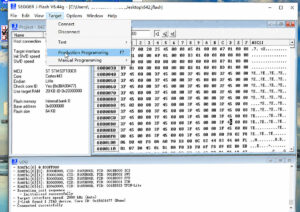 SEGGER J-Flash programming an STM32F103 vehicle gateway MCU on our bench — the same workflow used by automotive OEMs, run in-house for both production and field-update firmware. Customer project details redacted per NDA.
Proven in the field
In-vehicle computing for Danish heavy-duty fleets
A Danish system integrator deployed the AX-234BT as the central control unit across milk-transport and waste-management fleets — surviving dirty power, EMI, and continuous vibration with wide-voltage input and optional 4000V isolated CAN. The result: minimized field failures, fewer maintenance dispatches, and lower total cost of ownership.
9–36V
w/ OVP & OCP
4000V
optional isolated CAN/RS-485
-40°C to +70°C
burn-in tested
Vehicle-mounted industrial PC — common questions
What is a vehicle-mounted industrial PC?
Why can't I use a standard PC inside a vehicle?
What power input does a vehicle-mounted computer need?
How does it protect CAN bus telemetry from EMI?
How is data protected when the engine shuts off suddenly?
Building a vehicle-mounted or mobile edge platform?
Talk to a BITECH engineer about wide-voltage, isolated-CAN, and burn-in-validated hardware for your fleet — with OEM/ODM customization and a 10-year lifecycle.