
AE-3588BT vs AE-3588LBT: Rockchip RK3588 vs. RK3588J Edge AI Computer Comparison
An engineering analysis of Rockchip-based ARM embedded platforms. Evaluate the core differences between the AE-3588BT (58 TOPS field node with isolated dual CAN Bus) and the AE-3588LBT (32 TOPS cabinet inference terminal).
This page provides a technical comparison between AE-3588BT and AE-3588LBT. The focus is on AI scalability, network architecture, industrial interface robustness, and deployment environments. This comparison is intended for system architects, embedded engineers, and industrial integrators selecting an Edge AI platform.
Quick Engineering Conclusion
AE-3588BT is designed as an industrial field-level Edge AI system node, while AE-3588LBT is optimized as a cabinet-level or controlled-environment Edge AI inference terminal.
AE-3588BT provides up to 58 TOPS and triple LAN architecture, whereas AE-3588LBT is capped at 32 TOPS and dual LAN.”
If long-term scalability, electrical isolation, or multi-network architecture is required, AE-3588BT is the recommended choice.
RK3588 vs RK3588J: NPU Scalability (58 TOPS vs 32 TOPS) , Interface Isolation
Engineering specification comparison table between AE-3588BT (high-end field node) and AE-3588LBT (cabinet terminal).
| Engineering Decision Factor | AE-3588BT | AE-3588LBT | Engineer Rationale |
|---|---|---|---|
| Pictures | 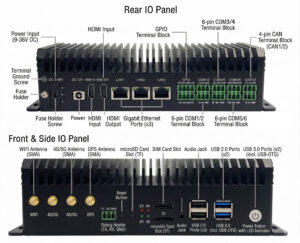 | 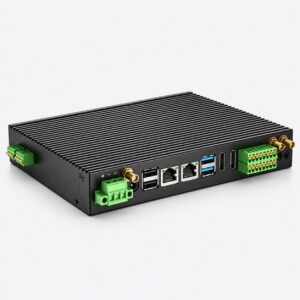 | |
| AI Compute Scalability | RK3588 built-in 6 TOPS NPU + dual PCIe M.2 NPU expansion, scalable up to 58 TOPS | RK3588 built-in 6 TOPS NPU + single PCIe M.2 NPU expansion, scalable up to 32 TOPS | Determines whether multiple AI models or future upgrades are possible. |
| NPU Expansion Architecture | Two PCIe M.2 NPU expansion slots | One PCIe M.2 NPU expansion slot | Slot count defines AI upgrade headroom and resource separation. |
| Ethernet Network Topology | Three Gigabit Ethernet ports | Two Gigabit Ethernet ports | Three LANs allow physical separation of camera, control, and uplink networks. |
| Industrial Interface Isolation | CAN and industrial interfaces are electrically isolated | Industrial interfaces are NOT electrically isolated | Isolation is critical for noisy environments, long cables, and field wiring. |
| CAN Bus Capability | Dual CAN bus with isolation | Single CAN bus without isolation | Required for dual CAN networks, redundancy, or vehicle systems. |
| Deployment Positioning | Industrial field-level Edge AI control node | Cabinet-level or controlled-environment Edge AI terminal | Defines acceptable EMI exposure and system risk level. |
How to Choose (Engineer View)
Choose AE-3588BT if:
- •Deployment is in an industrial field environment
- •Multiple AI models or cameras are expected
- •Direct connection to PLCs, vehicles, or field CAN devices is required
- •Electrical isolation is needed to prevent ground loop or EMI issues
- •Project lifecycle is 3–5 years or longer
LChoose AE-3588LBT if:
- •Installation is inside a control cabinet
- •System environment is electrically controlled
- •AI workload is fixed and limited
- •External isolation modules are already present
- •Cost optimization is a primary concern
Important Engineering Note on Interface Isolation
AE-3588LBT does not include electrical isolation on industrial interfaces.
For long cable runs, high-noise environments, vehicle systems, or direct field wiring, AE-3588BT is recommended to avoid instability, data corruption, or hardware damage.
Common Engineering Misjudgments
- Assuming isolation is optional in all deployments
- Underestimating EMI in real industrial environments
- Selecting hardware only for current requirements without future margin