
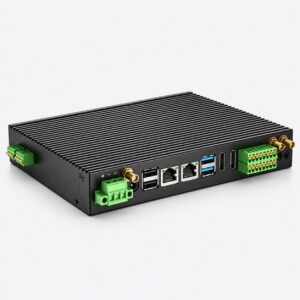
Rockchip RK3588
AE-3588NBT
AI: Integrated 6 TOPS NPU
Cooling: Fanless passive cooling
Camera / Network: MIPI / HDMI input / GbE
Industrial I/O: RS-232
OS: Linux / Android
Best fit: AI gateway and lightweight vision
RK3588 · NVIDIA Jetson Orin · RTX MXM
RK3588, NVIDIA Jetson Orin and x86 + RTX MXM platforms for machine vision, robotics, video analytics and local AI — with industrial I/O, wide-range DC power options, lifecycle support and OEM/ODM customization.
Low-power NPU for gateways, lightweight vision and embedded AI.
CUDA / TensorRT for multi-camera vision, robotics and autonomy.
Discrete GPU for AOI, local LLM and Windows/Linux AI workloads.
Start from workload, not TOPS. Match the model, software stack, camera topology and sustained thermal requirement together.
| Workload | Recommended Platform / Model | Why |
|---|---|---|
| AI gateway / 1–2 cameras / lightweight inference | AE-3588NBT / AE-3588LBT | Low-power RK3588 platform for embedded inference |
| Factory AI with isolated field interfaces | AE-3588BT | Isolation options for CAN, serial and GPIO integration |
| Multi-camera vision / GMSL2 / robotics | AE-NJ60BT | Jetson CUDA / TensorRT with camera connectivity |
| Heavy AOI / Windows AI / local LLM | AX-760EBT | x86 software compatibility with RTX MXM acceleration |
| Sealed or airflow-constrained high-GPU system | AE-960EBT | CPU/GPU cold plates move heat to a remote radiator |
Compare the platform details that determine deployment fit. Confirm final interfaces and environmental limits on each product page.
Rockchip RK3588
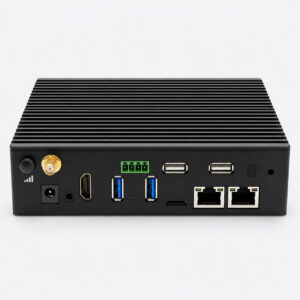
Rockchip RK3588
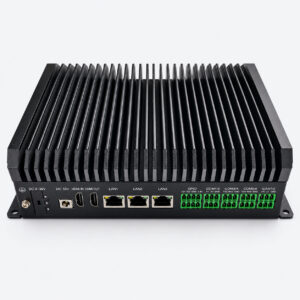 Rockchip RK3588J
 NVIDIA Jetson Orin NX
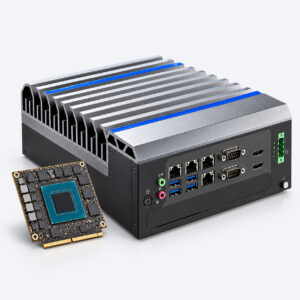
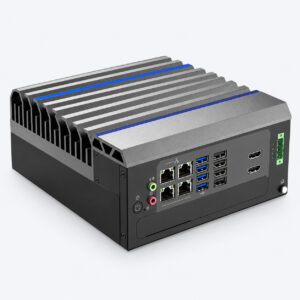
Intel Core + NVIDIA RTX MXM
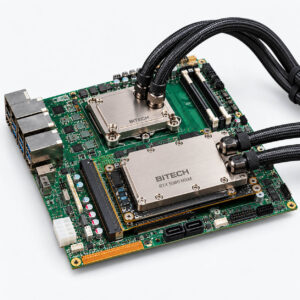
Intel Core + NVIDIA RTX MXM
| Model | Compute | Cooling | Camera / Network | Industrial I/O | OS | Best Fit |
|---|---|---|---|---|---|---|
| AE-3588NBT | Rockchip RK3588 | Fanless passive cooling | HDMI input / GbE | RS-232 / RS-485 | Linux / Android | AI gateway and lightweight vision |
| AE-3588LBT | Rockchip RK3588 | Fanless passive cooling | Multi-LAN / MIPI / USB | CAN / serial I/O | Linux | AOI, AMR and distributed vision |
| AE-3588BT | Rockchip RK3588J | Fanless passive cooling | Multi-LAN / MIPI / USB | Isolated CAN / serial / GPIO | Linux | Factory AI, energy and field systems |
| AE-NJ60BT | NVIDIA Jetson Orin NX | Fanless passive cooling | GMSL2 / MIPI / 4× GbE | CAN FD / DIO | Ubuntu / JetPack | Multi-camera vision and robotics |
| AE-760EBT | Intel Core + NVIDIA RTX MXM | Active industrial air cooling | Multi-LAN / PCIe expansion | CAN / COM / isolated DIO | Windows / Linux | AOI, local LLM and GPU inference |
| AE-960EBT | Intel Core + NVIDIA RTX MXM | Liquid cold plates + remote radiator | Project-specific | Project-specific | Windows / Linux | Sealed, airflow-constrained high-GPU systems |
Final interfaces, accelerator configuration, environmental limits and software support are confirmed against the selected product specification and project configuration.
Three AI compute classes, each with a different software, camera and thermal profile. Select by workload and sustained performance — not TOPS alone.
| Category | RK3588 | Jetson Orin | x86 + RTX |
|---|---|---|---|
| Compute class | Integrated NPU | CUDA / Tensor Core | Discrete GPU |
| Software | RKNN | JetPack / CUDA / TensorRT | CUDA / ONNX / Windows / Linux |
| Power class | Low | Medium | High |
| Camera architecture | MIPI / USB / Ethernet | GMSL2 / MIPI / Ethernet | GigE / USB3 / PCIe frame grabber |
| Best workload | Gateway / light vision | Robotics / multi-camera | AOI / LLM / heavy AI |
Industrial readiness is established through the selected electrical, thermal, validation and lifecycle configuration—not through a single feature claim.
For low-to-medium power RK3588 and selected Jetson platforms.
For high-power x86 + RTX MXM systems requiring sustained GPU performance.
For airflow-constrained systems where CPU/GPU heat moves to a remote radiator.
AE-960EBT: the compute chassis uses liquid cold plates on the CPU and MXM GPU. Coolant transports heat to an external radiator, where external fans dissipate it.
| Feature | Edge AI Computer | Standard Industrial PC |
|---|---|---|
| AI acceleration | NPU / GPU | CPU / iGPU |
| Main workload | Sustained inference | Control / HMI / gateway |
| Vision interface | Camera-oriented | General-purpose I/O |
| AI software | RKNN / JetPack / CUDA | Windows / Linux applications |
| Typical use | Vision / robotics / local AI | Automation / control / data acquisition |
OEM / ODM Engineering
BITECH can review custom I/O, camera topology, enclosure, mounting, system image and lifecycle requirements after the workload and program constraints are defined.
Review OEM / ODM engineeringTalk to an engineer
Most edge AI projects are oversized or undersized because the platform is chosen before the workload is defined. Send us your models, cameras and site conditions — a hardware engineer will recommend the smallest BITECH platform that runs them reliably, and tell you when a CPU-only industrial PC is enough.
An engineer — not a sales bot — replies within 24 hours. Sample units, thermal test data and 18-hour burn-in records available on request.
No AI model, just control, HMI or networking? A CPU-only platform is usually cheaper — view industrial box PCs →
How to select between RK3588, Jetson Orin, and RTX MXM for your inference workload.
Match the silicon to your compute class and power budget. RK3588 (6–58 TOPS, 8–25W fanless) suits lightweight vision and cost-sensitive edge nodes. Jetson Orin (40–275 TOPS, 15–60W) fits multi-camera vision and AMR with the CUDA/TensorRT ecosystem. RTX MXM (80+ TFLOPS, 120–450W, active cooling) is for heavy inference, LLMs, and training-class workloads. Power envelope and operating temperature usually decide the boundary between them.
For AMR perception, the AE-NJ60BT (Jetson Orin NX, up to 157 TOPS) is the strongest fit — it offers MIPI CSI / GMSL2 camera ingress, 4x GbE, dual CAN FD, and -40C to +70C fanless operation. For lighter-cost AGV nodes, the AE-3588LBT (32 TOPS RK3588) provides low-latency fieldbus I/O at a lower price point. See our AMR controller solution →
For high-throughput multi-camera vision, the AE-NJ60BT (Jetson Orin) handles parallel camera streams with GMSL2/MIPI ingress and the DeepStream pipeline. For maximum inference performance — high-resolution AOI or model ensembles — the AE-760EBT (Intel i9 + RTX MXM) delivers GPU-class throughput. The AE-3588BT covers cost-sensitive single- or few-camera inspection.
All three are RK3588-based. The AE-3588BT scales to 58 TOPS and adds 4000V isolated CAN/serial/GPIO for harsh environments like energy and semiconductor. The AE-3588LBT scales to 32 TOPS with non-isolated low-latency I/O for AOI and AGV. The AE-3588NBT is a cost-effective 6 TOPS gateway with 8K HDMI out and 4K HDMI in for vision automation and infrastructure.
Choose a discrete RTX MXM GPU (the AE-760EBT) when you need the full CUDA/PyTorch/TensorRT stack, run large models or LLMs at the edge, or require training-class throughput. NPU platforms (RK3588, Jetson) are more power-efficient and fanless, but a discrete GPU delivers far higher raw compute when your workload demands it — at the cost of higher power and active cooling.
Yes. Beyond the standard models, BITECH offers custom baseboard design, enclosure sizing, and branded chassis modification (the AE-NY series) down to PCB level. This lets you match a specific compute module, camera interface, I/O layout, and form factor to your product, with batch deployment from low MOQ. See our OEM/ODM customization →
Yes, depending on the model. The AE-3588BT provides 4000V galvanic isolation on CAN, RS232/RS485, and GPIO for high-noise environments, and the AE-760EBT includes isolated DIO/COM. Isolation level and interface count can be specified at the project level. How interface isolation works →
Send your model type, target framerate, camera count and interface, power/thermal limits, and environment through our RFQ form. You talk directly to our hardware engineers, who will recommend the right silicon and configuration and arrange evaluation samples — typically within a 1–3 month cycle.
Related Engineering Resources
The design questions behind choosing an edge-AI platform — thermal path, isolation, lifecycle, and validation.
Engineering guides
Where it deploys