
Industrial ODM: From Customer Requirement to Production Hardware
A case study — the AP-AW1S 10.1-inch IP65 panel PC, developed for a municipal garden alarm system where no catalog product fit.
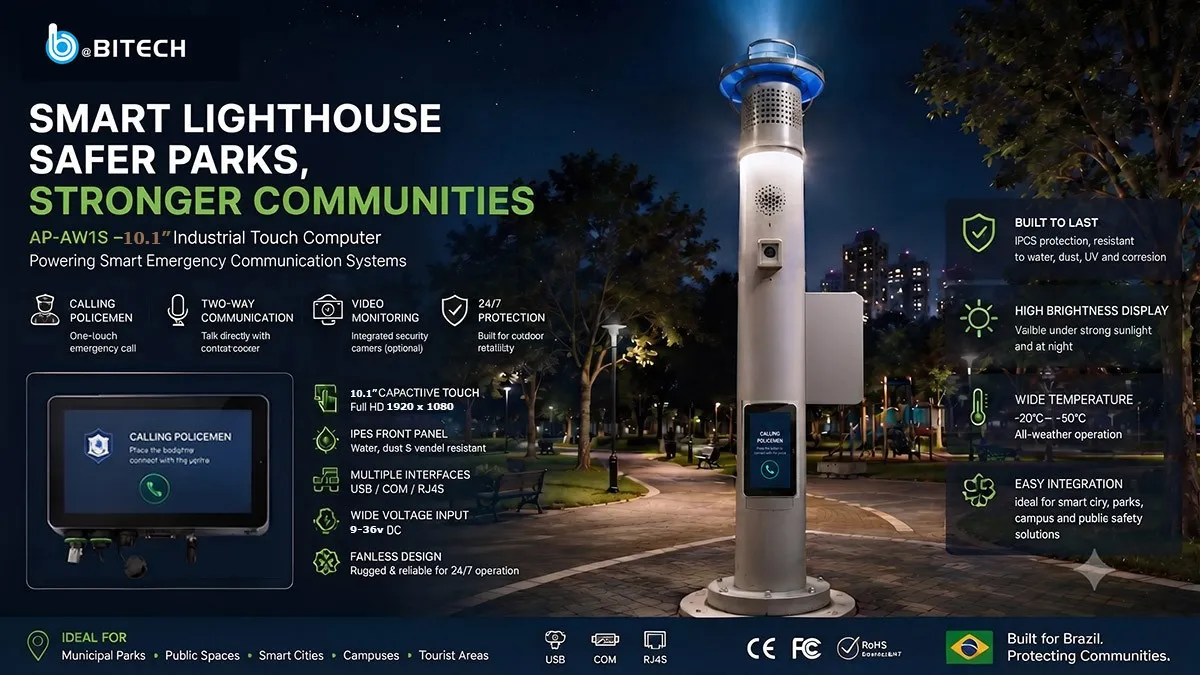
When the environment breaks every catalog product, the deployment — not the datasheet — drives the design.
Table of Contents
Industrial ODM means we design and manufacture a product to your specification — not a catalog unit with a sticker on it. When a customer needed a 10.1″ panel PC for an alarm system deployed in public gardens in a city center, no standard product fit: it needed an IP65-sealed front panel for outdoor exposure and aviation (circular locking) connectors instead of standard ports, because standard I/O can’t hold a seal or survive public-space handling. The result was the AP-AW1S, developed from requirement to production hardware.
What “industrial ODM” actually means
The terms get used loosely, so let’s be precise:
| Model | What it means | Who designs it |
|---|---|---|
| Off-the-shelf | You buy a catalog product as-is | Us — for the general market |
| OEM | Our design, your branding, minor configuration changes | Us |
| ODM | A product designed to your requirements — mechanics, I/O, sealing, form factor | Us, to your spec |
| Joint development | Co-engineered; you contribute design input alongside our team | Both |
ODM is the path when no catalog product fits your deployment — not because the compute is exotic (usually it isn’t), but because the environment imposes constraints that standard hardware ignores: sealing, connectors, mounting, temperature, power, cable exit direction, panel cutout. The AP-AW1S is a clean example.
The requirement: an alarm terminal in a public garden
The customer was deploying an alarm and monitoring system in public gardens in a city center — an environment that breaks most panel PCs:
- Outdoors, unprotected — rain, dust, temperature swings, humidity.
- Public space — the terminal is touched, leaned on, and occasionally abused by people who don’t work there.
- Distributed installation — units in the field, cabled to sensors and the network, not sitting in a clean control cabinet.
Their requirement was specific: a 10.1″ panel PC, IP65-rated front panel, deployable outdoors and serviceable in the field. No standard product met it. The gap wasn’t the processor — it was the enclosure sealing and the I/O.
The engineering problem: standard ports break the seal
A panel PC can be sealed at the front bezel to IP65 — dust-tight, protected against water jets. But the moment you put standard connectors on it — USB Type-A, RJ45, DB9 — you’ve created ingress paths. Those connectors cannot maintain an IP65 seal, have no locking mechanism, and are exposed to tampering in a public space. For an outdoor, public-facing terminal, the connector is the weak point. So the AP-AW1S uses aviation connectors (circular, threaded, locking) instead:
| Standard connectors | Aviation connectors |
|---|---|
| No seal at the interface — ingress path | Threaded coupling + gasket maintains the IP seal |
| Unlock and unseat under vibration/strain | Screw-locking; stays mated |
| Easy to unplug (tampering) | Requires deliberate action to disconnect |
| Indoor, cabinet-protected use | Outdoor, field, mobile, public-space use |
The half-solution that fails in the field: sealing the front bezel while leaving standard ports on the back. The customer’s requirement for IP65 implied an I/O redesign whether they’d specified it or not — which is exactly the kind of constraint an ODM program is meant to catch.
The solution: AP-AW1S
| Specification | AP-AW1S |
|---|---|
| Display | 10.1″ industrial LCD |
| Touch | Resistive or PCAP — specified per deployment (resistive for outdoor gloved/wet operation) |
| Front panel protection | IP65 — dust-tight, protected against water jets |
| I/O connectors | Aviation (circular locking) connectors — sealed, vibration-resistant, tamper-resistant |
| Cooling | Fanless — no vents, no dust intake, no moving parts to fail outdoors |
| Mounting | Wall / pole / panel-cut — configured as deployed |
| Power | Wide-range DC input — specified per site |
| Application | Outdoor alarm & monitoring terminal, municipal gardens |
The ODM process, end to end
Requirement review
The customer brings the deployment, not a datasheet. We ask what the unit connects to, where it lives, who touches it, and what has already failed.
Specification
We translate the deployment into engineering requirements — here, IP65 front sealing plus an I/O architecture that doesn’t compromise it.
Mechanical & electrical design
Enclosure, sealing, connector selection and placement, thermal path, panel cutout, mounting.
Prototype & validation
Bare-board bring-up (CAN, serial, display, storage), then sealed-unit environmental and thermal testing.
Customer sample & sign-off
Real hardware in the customer’s hands before commitment.
Production
With BOM control and lot traceability.
Lifecycle
A 10-year availability commitment, so a municipal rollout isn’t orphaned when a component goes end-of-life.
Why customers come to us for ODM
- The environment drives the design, not the catalog. We start from the deployment.
- Sealing and I/O are engineered together. An IP rating that stops at the bezel isn’t an IP rating.
- Isolated, industrial I/O where the application needs it — CAN, RS-485, DIO.
- Fanless, wide-temperature construction as the default for outdoor and dusty deployments.
- A real lifecycle commitment — 10-year availability with BOM control.
- Sub-4-week lead times on production, with traceable QC.
FAQ
Q: What is the difference between OEM and ODM?
A: With OEM, you take our existing design and apply your branding and configuration. With ODM, we design and manufacture a product to your requirements — the mechanics, I/O, sealing, form factor and mounting are engineered for your deployment. ODM is the right path when no catalog product fits the environment your hardware has to survive.
Q: Why use aviation connectors instead of standard USB or RJ45 ports?
A: Standard connectors cannot maintain an IP seal, have no locking mechanism, and are easy to unplug — three problems in an outdoor or public installation. Aviation (circular, threaded) connectors keep the seal at the interface, stay mated under vibration and cable strain, and resist tampering. If a panel PC is IP65 at the front but has standard ports at the rear, the seal is incomplete.
Q: Can you develop a custom panel PC for outdoor use?
A: Yes — that’s the AP-AW1S case. For outdoor deployment we engineer the sealing (IP65 or higher), select connectors that maintain that seal, use fanless construction so there are no vents or moving parts, and specify the display brightness and temperature range for the environment. Tell us where the unit will live and what it connects to, and we’ll spec it.
Q: What is the minimum order quantity for an ODM project?
A: MOQ varies with project complexity and the degree of custom tooling involved. For configuration-level changes it can be low; for a fully bespoke enclosure and I/O it is higher to cover engineering and tooling. Share your target volume and we’ll give you a straight answer for your specific project.
Q: How long does an ODM project take?
A: Timeline depends on how much of the mechanics and I/O are custom. Configuration-level programs move fastest; a fully bespoke enclosure with new connectors and sealing takes longer through prototype, environmental validation and sample sign-off before production. We give a committed schedule after the requirement review.
Q: Do you support long-term availability for public infrastructure projects?
A: Yes. We commit to a 10-year availability window with BOM control and lot traceability. For municipal and infrastructure deployments — where re-qualifying hardware is expensive and slow — this protects the rollout from component end-of-life surprises.
Related products & solutions
An ODM conversation usually starts from a catalog platform and a deployment. Below are the BITECH products and engineering resources that anchor a custom program.
Platforms we build ODM from
Industrial Panel PCs
The fanless panel PC family — the AP-AW1S starting point.
Rugged Touch Devices
Sealed operator terminals for harsh and public spaces.
Industrial Box PCs
Wide-temp fanless compute for custom enclosures.
Engineering & OEM services
OEM / ODM Engineering
How we run bespoke motherboard, enclosure and thermal programs.
Lifecycle Management
10-year availability and BOM control for infrastructure rollouts.
Panel PC Selection Guide
IP rating, touch, mounting and screen size — the four axes.
Interface Isolation Guide
When CAN, RS-485/232 and Ethernet need galvanic isolation.