
Industrial PC Lifecycle Management: Fixed BOM, PCN, EOL & Long-Term Supply
Control change across hardware, software and supply
Industrial computer lifecycle management keeps a validated platform predictable over years of production. The complete configuration—not only the CPU—needs controlled sourcing, revision traceability, impact assessment and migration planning.
ON THIS PAGE
Quick answer
Why Industrial PC Lifecycle Management Matters
Long lifecycle does not mean nothing ever changes. It means changes are monitored, assessed, documented, validated and introduced under control.
Industrial systems in factory automation, robotics, machine vision, transportation, medical equipment, kiosks, energy and infrastructure often remain deployed much longer than consumer electronics.
A hardware change can trigger driver, BIOS and OS-image validation, EMC and thermal retesting, mechanical verification, application regression and customer approval. The cost of an unexpected change can exceed the price difference between components.
BITECH uses controlled BOMs, approved vendor lists, supplier lifecycle monitoring, revision traceability and migration planning to reduce unexpected variation and unplanned requalification risk. Exact availability is defined by platform and project.
Fixed BOM vs Controlled BOM + AVL
Fixed BOM Control means the released production configuration and Approved Vendor List are controlled after validation. Components are not substituted outside the approved BOM and AVL without engineering review, compatibility assessment and change notification.
The goal is not
Every component remains identical forever.
The goal is
No uncontrolled substitution.
Qualified alternates require engineering evidence
Electrical behavior, timing, thermal characteristics, firmware, driver compatibility, mechanical fit, EMC impact and lifecycle status are reviewed before an alternate enters the AVL.
Multi-source strategy protects continuity only when alternates are qualified and revision-controlled.
What Must Be Frozen Before Mass Production?
The lifecycle baseline should be defined before mass production, not reconstructed after a component change occurs.
Lifecycle stages
EVT
Engineering Validation
Validate architecture, interfaces and early component choices.
DVT
Design Verification
Verify thermal, environmental, EMC and configuration behavior.
PVT
Production Validation
Release manufacturing process, BOM, AVL and test baseline.
MP + Sustainment
Platform-specific lifecycle plan
Monitor supply, control revisions and plan alternates or migration.
Lifecycle duration is defined per platform from its silicon roadmap, BOM risk, supplier availability and project commitment.
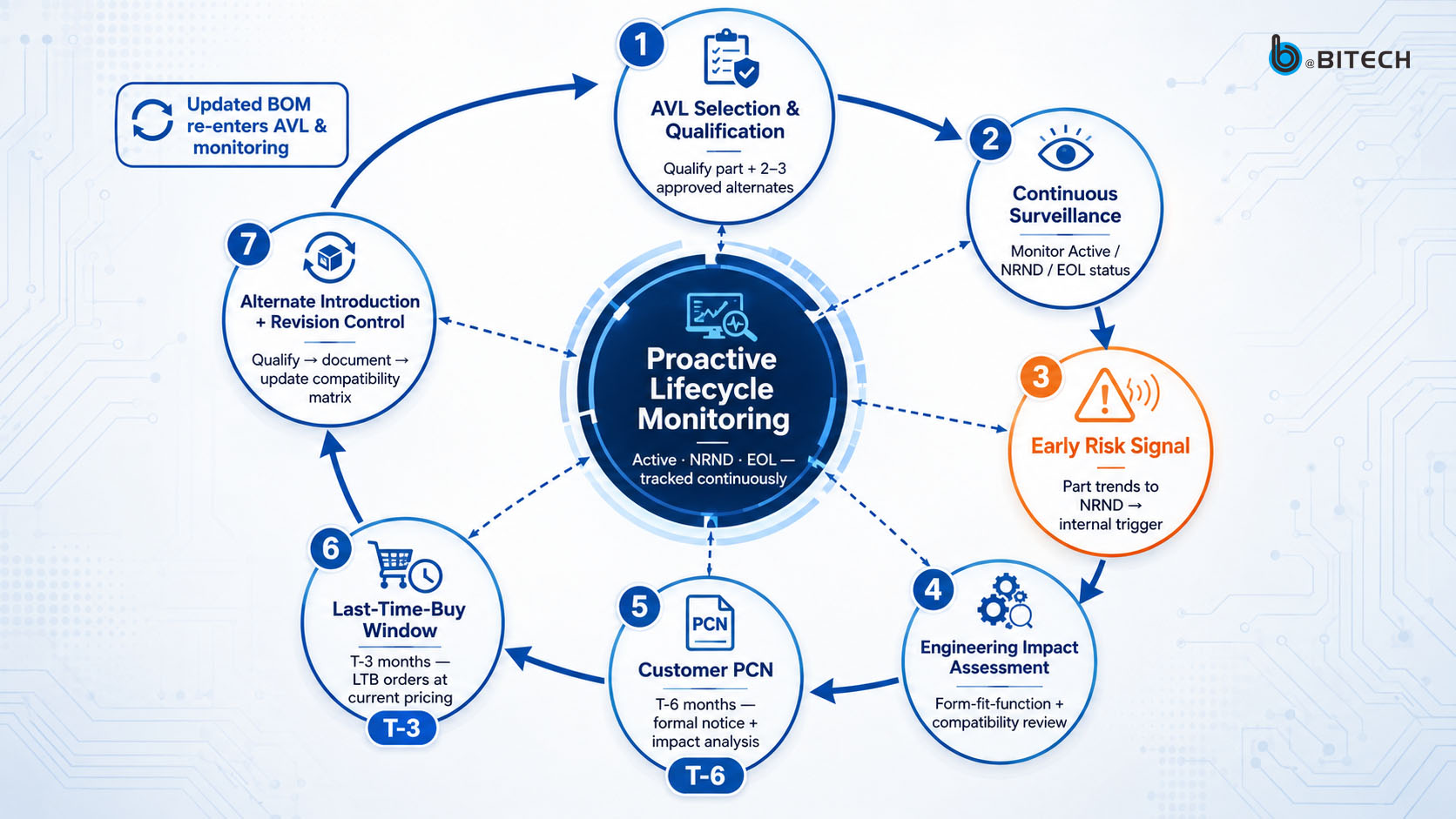
How Component Lifecycle Is Monitored
AVL governance
The production BOM maps each controlled item to approved manufacturer part numbers and qualified alternates.
Lifecycle surveillance
Active, NRND and EOL status is monitored so risk review can begin before supply becomes critical.
Roadmap and supply inputs
Planning uses published vendor roadmaps, supplier and distributor lifecycle data, and project-specific sourcing agreements.
Controlled alternate introduction
A replacement is assessed, validated, documented and communicated before production release.
PCN vs PDN / EOL vs LTB vs LTS
| Term | Meaning | Typical Customer Action |
|---|---|---|
| PCN | Product or process change notification | Assess form, fit, function, software and qualification impact |
| NRND | Not recommended for new design | Begin lifecycle risk review |
| PDN / EOL | Planned discontinuation | Decide last-time-buy or migration |
| LTB | Last-time-buy deadline | Calculate bridge stock |
| LTS | Last-time-ship date | Complete final shipment planning |
J-STD-046A addresses product or process change notification; J-STD-048A addresses product discontinuance notification. A PCN can change a product without ending it, while a PDN or EOL phases out supply.
A process, not a universal countdown
For planned BITECH-controlled changes, the target is at least six months customer notice where practicable. Supplier-forced EOL timing remains subject to upstream notice windows.
How BITECH Evaluates Change Impact
Datasheet equivalence alone is not sufficient. A proposed change is assessed across the system.
Form
Dimensions, connector position, mounting and enclosure fit
Fit
Pinout, electrical compatibility, power behavior and interfaces
Function
Performance, I/O behavior, timing and thermal behavior
Software
BIOS, firmware, drivers, BSP, kernel and OS image
Regulatory / validation
EMC, safety, vehicle, environmental and certification impact
Change classification and revalidation
| Change Class | Example | Required Assessment |
|---|---|---|
| Documentation / traceability | Label or documentation update | Traceability review |
| Qualified source change | Approved alternate component | Engineering confirmation |
| FFF-neutral component change | Equivalent passive or component | Validation and PCN where applicable |
| Software-visible change | NIC, storage controller or BIOS | Driver, BSP and image regression |
| Electrical / mechanical change | PCB, connector or power design | System revalidation |
| Platform migration | CPU or SoC generation | Full compatibility review |
Validation effort is proportional to the actual change impact.
Last-Time-Buy and Bridge-Stock Planning
Customers receive the applicable LTB window, quantity-planning guidance and commercial terms based on upstream supply conditions.
The calculation uses the customer forecast, supplier lead time, EOL and LTB dates, alternate qualification duration, service tail, MOQ and agreed safety stock. It is not a universal inventory period.
Hardware Availability Is Not Software or Service Availability
Hardware availability
Board, CPU / SoC, memory, storage, I/O and chassis
Software maintenance
BIOS, firmware, BSP, kernel, drivers, OS baseline and security updates
Service availability
Spare parts, repair, replacement units and RMA support
Long hardware availability reduces forced migration, but software support is defined by platform, BSP or kernel branch, OS baseline and silicon-vendor support window.
Each project should define its approved OS and image version, kernel branch, BIOS baseline, driver and firmware set, and update policy.
Lifecycle by Platform
Selected BITECH platforms support long-term supply programs. Exact availability follows the production configuration, silicon roadmap and project commitment.
| Platform | Lifecycle Basis | Program Wording |
|---|---|---|
| AE-3588 / RK3588 | BITECH supply program plus SoC and component sourcing | Long-term supply program; exact commitment available per project |
| AE-NJ60BT / Jetson Orin NX | NVIDIA lifecycle for the exact module SKU | Module availability and JetPack/software windows managed separately |
| AX Series | Modular compute plus controlled carrier BOM | Designed to reduce redesign during CPU migration; lifecycle defined per configuration |
| AE-760EBT | x86 compute platform plus MXM GPU | Compute-board and GPU lifecycle managed separately |
| AE-960EBT | x86, MXM GPU and qualified liquid-cooling parts | Compute, GPU and cooling service components managed separately |
| AP Panel PC | Display, touch and compute platform | Panel and compute lifecycle tracked separately |
AX modular architecture: can reduce carrier-board and mechanical redesign when the CPU generation changes. Electrical, thermal, BIOS, software and regulatory impact still require review.
AE-760EBT: compute and MXM GPU are separate lifecycle items. GPU substitutions require power, thermal, BIOS and workload validation.
AE-960EBT: lifecycle planning includes the x86 platform, MXM GPU, pump, cold plate, tubing, fittings, radiator and external fans. Substitutions require compatibility validation before production release.
Revision Traceability and Migration
Each production lot should be traceable to its released configuration. Migration aims to preserve dimensions, mounting, I/O positions, connector type, power input, BIOS behavior, software image and communications where practical.
Mechanical compatibility does not automatically guarantee electrical, software or regulatory equivalence.
Revision Traceability and Migration
Each production lot should be traceable to its released configuration. Migration aims to preserve dimensions, mounting, I/O positions, connector type, power input, BIOS behavior, software image and communications where practical.
Mechanical compatibility does not automatically guarantee electrical, software or regulatory equivalence.
Lifecycle Evidence Package for OEM Programs
Lifecycle confidence comes from traceable configuration data—not only a marketing statement about years of availability.
What Customers Should Ask Before Selecting an Industrial PC
| Question | Why It Matters |
|---|---|
| Is the BOM controlled after validation? | Prevents uncontrolled substitutions |
| Is there an AVL? | Defines qualified alternates |
| How are PCNs handled? | Controls product and process changes |
| How are EOL and PDNs handled? | Defines discontinuation response |
| Is LTB support available? | Helps bridge supply gaps |
| What is the software baseline? | Prevents driver and BSP surprises |
| Are revisions traceable? | Supports field and RMA analysis |
| Is lifecycle defined per SKU? | Avoids vague platform-wide promises |
| How are alternates validated? | Determines requalification risk |
| Can lifecycle records be provided? | Converts claims into evidence |
LIFECYCLE REVIEW
Plan a 10-Year Deployment Without Surprise Requalification
Share your platform, volume and deployment period. A BITECH engineer will review lifecycle risk and confirm the supply terms for your exact SKU.
- Controlled BOM, AVL and component lifecycle status
- PCN / EOL notification process and LTB planning
- BIOS, BSP and OS image baseline for your project
- Migration path for your next CPU or SoC generation
Engineer response within 1 business day · sales@bitechipc.com
ENGINEERING FAQ
Industrial PC Lifecycle Management FAQ
What is industrial PC lifecycle management?
Industrial PC lifecycle management is the process of keeping a validated computer configuration buildable and predictable for the full length of a deployment. It covers controlled BOM and AVL, supplier PCN/PDN monitoring, revision traceability, alternate qualification, last-time-buy planning and software baseline control — not only CPU availability.
What does Fixed BOM mean for an industrial PC?
Fixed BOM means the released production BOM and Approved Vendor List (AVL) are locked after validation, and no component is substituted without engineering review and change notification. It does not mean parts never change; it means there is no uncontrolled substitution. Any alternate must pass electrical, thermal, firmware, driver, mechanical and EMC review before entering the AVL.
What is the difference between PCN, PDN, EOL, LTB and LTS?
A PCN (Product Change Notification) announces a change to a product or process that continues to be supplied. A PDN or EOL notice announces planned discontinuation. LTB (Last-Time-Buy) is the final order deadline, and LTS (Last-Time-Ship) is the final shipment date. PCNs follow J-STD-046A; discontinuance notices follow J-STD-048A.
How much notice does BITECH give before a product change?
For planned changes that BITECH controls, the target is at least six months of customer notice where practicable. When an upstream supplier forces an EOL, timing depends on that supplier's notice window, so BITECH monitors NRND status continuously to start alternate qualification or LTB planning before the formal notice arrives.
How long is the lifecycle of a BITECH industrial PC?
Lifecycle is defined per platform and per SKU, not as one number for every product. It is based on the silicon vendor roadmap, BOM risk, supplier availability and the project commitment. Selected platforms, including AE-3588 (RK3588/RK3576) and the AX modular series, support long-term supply programs with exact terms confirmed per project.
What happens when a component in my industrial PC reaches EOL?
BITECH follows a six-step process: receive the supplier PCN or PDN, assess impact, notify the customer, qualify an alternate or plan a last-time-buy, support customer validation when required, and release a controlled transition. The response depends on the change class, from a documentation update to a full platform migration.
How is last-time-buy or bridge stock quantity calculated?
Bridge stock = forecast demand during transition + service spares + qualification buffer + safety margin. Inputs include the customer forecast, supplier lead time, EOL and LTB dates, alternate qualification time, service tail, MOQ and agreed safety stock. There is no universal inventory period; each program is calculated separately.
Does long hardware availability include software and BSP support?
No. Hardware availability, software maintenance and service availability are separate commitments. BIOS, BSP, kernel, drivers, OS image and security updates depend on the platform, kernel branch and silicon vendor support window. Each project should define its approved OS image, BIOS baseline, driver set and update policy before mass production.
Does a CPU or component change require full system requalification?
Not always. Validation effort scales with the change class: an approved alternate needs engineering confirmation, a NIC, storage or BIOS change needs driver and image regression, and a CPU or SoC generation change needs full compatibility review. The AX modular architecture reduces carrier-board and mechanical redesign, but electrical, thermal, software and regulatory impact is still reviewed.
How is lifecycle managed for Jetson, MXM GPU and liquid-cooled systems?
These platforms are managed as multiple lifecycle items. For AE-NJ60BT, the NVIDIA Jetson Orin NX module and JetPack windows follow NVIDIA's lifecycle for the exact SKU. AE-760EBT tracks x86 compute and MXM GPU separately. AE-960EBT also tracks pump, cold plate, tubing, fittings, radiator and fans, each validated before substitution.
What lifecycle documents can an OEM request from BITECH?
OEM programs can request a lifecycle evidence package: controlled BOM ID, AVL status, board revision, BIOS and firmware baseline, BSP/kernel and OS image baseline, PCN history, component lifecycle status, qualified alternate status, migration plan, LTB/LTS information and validation records.
RELATED
Continue Your Lifecycle Planning
Future-Proofing Industrial Computing
Platform choices that reduce forced migration and redesign over a long deployment.
Read guide → Engineering ServiceProject Kickoff Checklist
Define the SKU, BOM, BIOS and OS baseline before mass production — not after a change.
View checklist → ValidationDVT Validation Lab
Thermal, environmental and EMC testing used to qualify alternates and revisions.
Explore lab → QualityHow We Test Every Unit
Production test baseline that keeps each lot traceable to its released configuration.
See process → OEM / ODMIndustrial PC OEM / ODM
Custom mainboards and carrier designs with controlled BOM and long-term supply.
Learn more → Modular PlatformAX-234BT vs AX-238BT
How the AX modular architecture handles CPU generation changes with less redesign.
Compare →