
Jetson Orin vs RK3588 vs x86 — How to Choose Your Edge AI Platform
An engineer-led selection framework across BITECH’s three edge-AI classes: RK3588 (AE-3588, 6→58 TOPS), Jetson Orin NX Super (AE-NJ60BT, 157 TOPS), and x86 + RTX MXM (AE-760EBT). Start from the workload, not the datasheet.
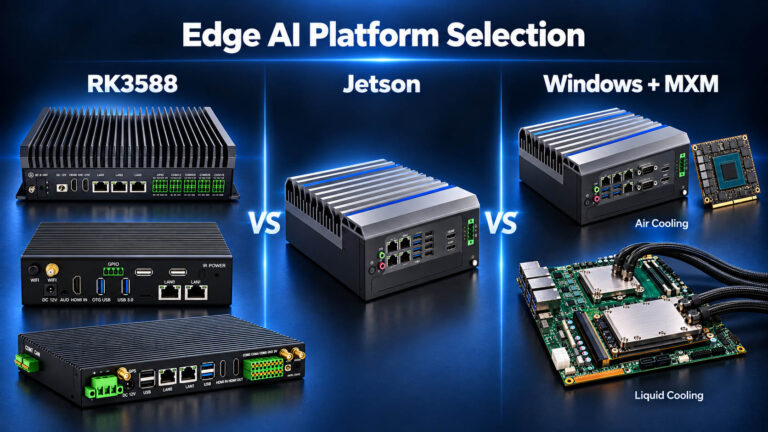
Choose RK3588 when power, cost and fanless embedded deployment dominate. Choose Jetson Orin when CUDA/TensorRT, robotics or multi-camera perception dominate. Choose x86 + RTX when Windows compatibility, PCIe expansion, larger GPU memory or higher compute headroom dominate.
Do not choose between them by TOPS alone. Published figures use different architectures, precisions and assumptions; real performance depends on the model, software stack, memory bandwidth and sustained thermal envelope.
Which Edge AI platform should you choose?
| Main requirement | Recommended platform / model |
|---|---|
| Lowest-power compact AI gateway | RK3588 / AE-3588 series |
| Cost-sensitive 1–2 camera inference | RK3588 / AE-3588 series |
| CUDA / TensorRT / ROS 2 | Jetson Orin / AE-NJ60BT |
| Multi-camera perception / GMSL2 | Jetson Orin / AE-NJ60BT |
| Windows / legacy x86 compatibility | x86 + RTX / AE-760EBT or AE-960EBT |
| Heavy AOI / large vision models | x86 + RTX / AE-760EBT |
| Local LLM / higher VRAM requirement | x86 + RTX / AE-760EBT or AE-960EBT |
| PCIe / GigE Vision / frame grabber | x86 + RTX / AE-760EBT |
| High GPU load with normal chassis airflow | x86 + RTX / AE-760EBT |
| High GPU load with restricted internal airflow | x86 + RTX / AE-960EBT |
| Dust or oil mist around compute electronics | x86 + RTX / AE-960EBT, subject to enclosure review |
| Move CPU/GPU heat away from the compute enclosure | x86 + RTX / AE-960EBT |
Platform comparison matrix
| Engineering factor | RK3588 | Jetson Orin | x86 + RTX |
|---|---|---|---|
| Software stack | RKNN / Linux / Android | CUDA / TensorRT / JetPack / ROS | CUDA / ONNX / Windows / Linux |
| Power class | Low | Low to medium | Medium to high |
| Cooling | Typically fanless | Fanless possible by module and system design | Active air or liquid cold-plate architecture |
| Camera architecture | MIPI / USB / Ethernet | MIPI / GMSL2 carrier or adapter / Ethernet | GigE / USB3 / PCIe frame grabber |
| Expansion | Limited | Carrier-board dependent | Strong PCIe, storage and GPU flexibility |
| Best-fit workload | Gateway / light vision | Robotics / multi-camera perception | AOI / local LLM / heavy concurrent AI |
| Representative BITECH hardware | AE-3588 series | AE-NJ60BT | AE-760EBT / AE-960EBT |
These are architecture-level selection characteristics. Exact operating range, interfaces, isolation and cooling depend on the selected BITECH system configuration.
A seven-step Edge AI decision workflow
Work through the constraints in order. Record the first requirement that eliminates an architecture.
Lock the software stack
RKNN, Android or embedded Linux points to RK3588. CUDA, TensorRT, DeepStream or ROS points to Jetson Orin or x86 + RTX. Windows or legacy x86 applications require x86.
Define the workload
Lightweight gateways and 1–2 camera inference fit RK3588. Multi-camera robotics fits Jetson Orin. Heavy AOI, larger local LLMs and concurrent pipelines point to x86 + RTX.
Map the camera topology
MIPI CSI fits RK3588 or Jetson. GMSL2 requires Jetson with a suitable carrier, adapter and deserializer path. PCIe frame grabbers favor x86; GigE Vision and USB3 Vision depend on count and workload.
Define the thermal environment
Low-power fanless designs favor RK3588; controlled embedded GPU envelopes favor Jetson. For sustained RTX loads, use AE-760EBT where industrial airflow is available, or AE-960EBT where airflow around compute electronics is constrained.
Define industrial I/O
Specify CAN or CAN FD, RS232/RS485, DIO/GPIO, PLC integration, PoE, isolation, cellular, Wi-Fi, GMSL2, MIPI and PCIe. These are system-level requirements, not processor-family guarantees.
Check the power architecture
Specify input range and source, including 12 V, 12–24 V, 9–36 V or vehicle BAT/IGN/GND. Treat surge, transient, cold crank, load dump and graceful shutdown as separate validation requirements.
Check lifecycle and change control
Verify the exact module lifecycle, GPU availability, controlled BOM, PCN/EOL process, OS or BSP support, migration path and re-validation cost before platform lock.
Review lifecycle managementPlatform deep dives: where each architecture fits
RK3588: efficient embedded AI
RK3588 integrates a 6 TOPS NPU and fits low-power Linux or Android systems where RKNN is acceptable. Selected BITECH configurations add M.2 AI accelerators, but onboard and expansion compute remain separate engines with their own model-support and integration considerations.
Choose it when: power and cost matter, fanless deployment is preferred, workloads are moderate, and industrial I/O matters more than maximum GPU headroom. Representative hardware: AE-3588NBT, AE-3588LBT and AE-3588BT. Their I/O and isolation capabilities differ.
Jetson Orin: CUDA-centric robotics and perception
JetPack, CUDA, TensorRT, DeepStream and Isaac ROS make Orin a strong fit for robotics and multi-camera perception. NVIDIA headline TOPS may include structured-sparsity assumptions; dense throughput depends on the model, precision, engine utilization and optimization, so benchmark the actual network.
Camera note: GMSL2 is implemented through carrier-board, adapter and deserializer architecture rather than being a native Jetson module connector. The AE-NJ60BT uses a camera adapter architecture to expose multiple GMSL2 inputs.
x86 + RTX: compatibility, expansion and higher headroom
A Core i7/i9-class platform with a discrete RTX MXM GPU is the strongest fit when a project requires Windows or legacy x86 software, larger GPU memory, PCIe expansion, heavy multi-stream AOI, or larger local LLM and generative-AI workloads. Jetson can also run generative-AI workloads where embedded power and size matter more than maximum model capacity.
Choose the compute architecture first, then the cooling architecture: AE-760EBT uses active industrial air cooling; AE-960EBT uses liquid cold plates and remote heat rejection.
AE-760EBT vs AE-960EBT: choose the thermal architecture
AE-760EBT — Active industrial air cooling
For machine vision, AOI, local LLM, GPU inference and PCIe vision where conventional industrial airflow is available around the chassis.
View active-cooled RTX MXM systemAE-960EBT — Liquid cold plates + remote radiator
CPU and MXM GPU cold plates carry heat to an external radiator, where external fans reject it. The compute zone is fanless; the overall cooling system is not fully fanless.
Use as an architecture direction for constrained internal airflow. Final GPU, I/O, power, temperature and enclosure details remain subject to engineering validation.
View remote-radiator Edge AI computerWhy TOPS does not compare cleanly
TOPS is useful within one accelerator family, but it is not a reliable cross-platform purchasing metric. Precision, sparsity, accelerator type, Tensor Core utilization, memory bandwidth, preprocessing, decode, camera pipelines, software frameworks and sustained thermals all affect delivered performance.
| Platform | AI compute description |
|---|---|
| RK3588 | Integrated 6 TOPS NPU; selected BITECH configurations can add M.2 AI accelerators |
| Jetson Orin | NVIDIA-rated AI compute varies by module and power mode; published figures may include structured sparsity |
| x86 + RTX | Discrete-GPU performance depends on the selected MXM module, precision, model and TensorRT workload |
Benchmark the real model on the target software stack whenever possible.
Five workload examples
Two-camera industrial inspection
2 × 1080p cameras, YOLO detection, Linux, no recording, low power
Recommended: RK3588 / AE-3588 series
AMR with four GMSL2 cameras
Object detection, SLAM, ROS 2, CAN and a 24 V battery
Recommended: Jetson Orin / AE-NJ60BT
Eight-camera heavy AOI
GigE cameras, high-resolution inspection, Windows, PLC, database and PCIe expansion
Recommended: x86 + RTX / AE-760EBT
Local LLM
7B–14B model, higher system RAM and VRAM, Windows or Linux, continuous local inference
Recommended: x86 + RTX / AE-760EBT or AE-960EBT
Enclosed high-GPU industrial AI
Sustained RTX load, limited clean airflow, contamination risk and a remote heat-rejection location
Recommended: x86 + RTX / AE-960EBT
Industrialization beyond the processor
Picking the silicon is only part of the decision. A deployable platform also requires thermal, electrical, validation and lifecycle engineering.
Thermal
Passive fanless, active air, liquid cold plates, sustained performance and throttling
Air vs liquid cooling →Electrical
Wide-range DC, CAN/RS485, DIO, isolation and surge/transient requirements
Galvanic isolation →Edge AI Platform Selection
Frequently Asked Questions
Should I choose RK3588, Jetson Orin, or x86 for edge AI?
There is no single best platform — only the one that fits your workload, software toolchain, power and thermal envelope, I/O and lifecycle, in that order. Choose RK3588 for cost-sensitive, fanless, wide-temperature gateways and light vision at or below 32 TOPS. Choose Jetson Orin for multi-camera perception, GMSL2 ingress and the CUDA/TensorRT toolchain. Choose x86 (optionally with an RTX GPU) for Windows or legacy compatibility, edge LLM and generative AI, or heavy multi-stream AOI.
Why shouldn't I choose an edge AI platform by TOPS alone?
Because TOPS does not compare cleanly across these platforms. Jetson's headline figures are sparse INT8 — roughly half once you run dense models. RK3588's 6 TOPS is a dedicated NPU, x86 "platform TOPS" sums CPU, iGPU and NPU, and a discrete GPU is quoted in TFLOPS. Peak figures also assume the model maps cleanly to the accelerator and the thermal budget holds. Profile your own model rather than ranking by the datasheet number.
When is RK3588 the right edge AI platform?
RK3588 wins when cost, power budget and a long fanless ARM-Linux lifecycle dominate, and the workload sits at or below about 32 TOPS — field gateways, HMI plus light vision, and control-plus-AI nodes. Its onboard 6 TOPS NPU can be extended to 32–58 TOPS with an M.2 accelerator, and the industrial RK3588J runs fanless from -40°C to +80°C.
When should I use NVIDIA Jetson Orin?
Choose Jetson Orin for multi-camera perception, AMR/AGV autonomy and GMSL2 camera ingress, especially if your team already targets JetPack, CUDA, TensorRT, DeepStream or Isaac. The Super-mode lineup runs up to 67, 157 and 275 TOPS (Nano, NX 16GB, AGX 64GB), and NVIDIA has committed Orin availability through 2032. Budget for a real thermal solution — Super mode throttles without adequate cooling.
When does an x86 platform make sense for edge AI?
Use x86 when you need Windows or legacy x86 compatibility, the full PyTorch/CUDA/TensorRT/OpenVINO stack, GigE Vision over PCIe, edge LLM and generative AI, or SCADA-plus-AI on one box. A modern Core Ultra carries an integrated NPU for media-heavy analytics with no discrete card; pairing an i7/i9 with an RTX MXM GPU adds 80+ TFLOPS at the cost of 120–450W and active cooling.
Match the Platform to BITECH Hardware
The specific models behind each architecture tier covered in this guide.
RK3588 — ARM efficiency
AE-3588NBT — 6 TOPS RK3588 Gateway
The entry point of the RK3588 tier — fanless, wide-temperature AI gateway for light vision and field control.
View product → ProductAE-3588LBT — 32 TOPS Scalable RK3588
M.2-accelerator-extended RK3588 for AOI, AMR and distributed vision workloads up to the ~32 TOPS ceiling this guide flags.
View product → ProductAE-3588BT — 58 TOPS, 4000V Isolated
The top of the RK3588 range — 4000V-isolated I/O for factory AI, energy and field systems exposed to electrical noise.
View product →Jetson Orin — CUDA perception
x86 — Compatibility + Ceiling
AE-760EBT — Core i9 + RTX MXM, 242 TOPS INT8
Actively air-cooled x86 platform for Windows/legacy compatibility, edge LLM and heavy multi-stream AOI.
View product → ProductAE-960EBT — Liquid Cold Plates + Remote Radiator
The sealed/airflow-constrained alternative to AE-760EBT's active cooling — same x86 + RTX MXM class, different thermal architecture.
View product → CategoryAX-Series Box PCs — Modular x86 Control
4th–14th gen Intel modular control-layer platforms for SCADA-plus-AI and general-purpose x86 industrial control.
View category →Engineering references
Air vs Liquid Cooling for Edge AI Computers
The full thermal-architecture comparison behind this guide's "AE-760EBT vs AE-960EBT" section.
Read the guide → EngineeringIndustrial PC Galvanic Isolation Guide
Behind the "4000V isolated" spec on AE-3588BT — how isolation is engineered into these platforms.
Read the guide → EngineeringIndustrial PC Lifecycle Management: Fixed BOM, PCN, EOL & Long-Term Supply
The "check lifecycle and change control" step in this guide's seven-step decision workflow, explained in full.
Read the guide →Edge AI Platform Selection
Still deciding between RK3588, Jetson Orin, and x86?
Send us your workload, toolchain, thermal environment, and I/O requirements — our engineers will map it against the platform matrix in this guide and confirm the right fit before you commit to hardware.
Send us:
Workload & toolchain
- Model type & software stack (CUDA/TensorRT, OpenVINO, Windows/Linux)
- Camera count & interface (GMSL2, GigE, MIPI CSI)
- Thermal environment & enclosure constraints
- Industrial I/O and lifecycle requirements
We return:
- A platform recommendation — RK3588, Jetson Orin, or x86 — with model-level configuration
- Thermal and lifecycle commitment for your program