
AE-3588LBT: Fanless Industrial Edge AI Computer | RK3588 32 TOPS
A high-performance, fanless industrial AI box specifically engineered for harsh environments. Powered by the flagship Rockchip RK3588 processor, serving as a robust gateway for machine vision, deep learning inference, and complex industrial automation.
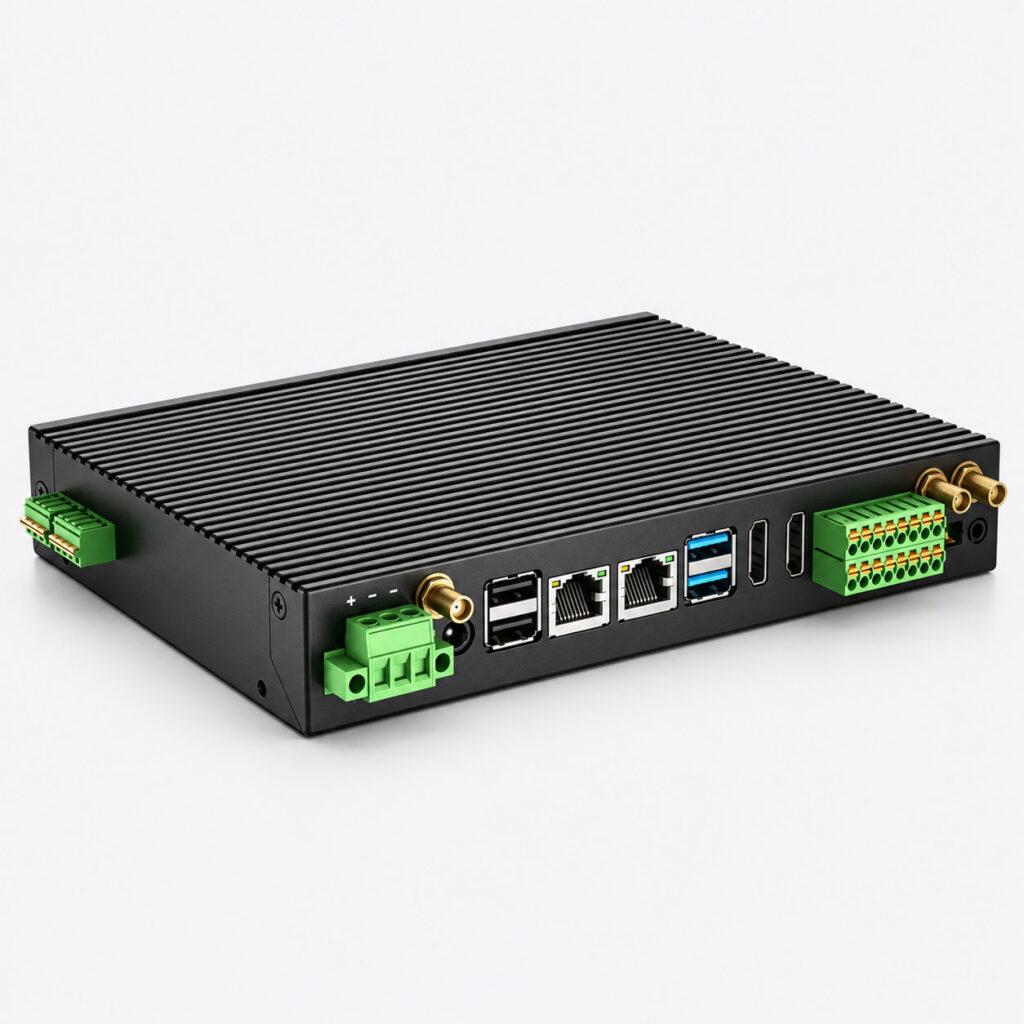
AE-3588LBT — 32 TOPS RK3588 Industrial Edge AI Box
Production-Ready Edge AI & Machine Vision Applications
The AE-3588LBT transforms the raw power of the RK3588 into a production-ready tool for demanding industrial AI and machine vision applications.
Automated Optical Inspection (AOI) & Semiconductor Defect Detection
Perfect for semiconductor wafer inspection where 4K camera streams are captured via HDMI-In, analyzed using 32 TOPS of AI power for microscopic defects, and displayed in 8K for operator review.
Autonomous Mobile Robots (AMR / AGV) Navigation & SLAM
Acts as the primary controller for warehouse robots, utilizing the CAN Bus to manage motor drivers and the NPU for real-time SLAM and obstacle avoidance.
Intelligent Edge Sensing & Smart City Traffic Infrastructure
Deployed in outdoor traffic cabinets to monitor vehicle flow and illegal maneuvers in real-time, relying on the -40°C to +80°C wide-temp range for 24/7 reliability in any climate.
High-End Medical Imaging & Real-Time Surgical Video Processing
Integrated into diagnostic equipment to enhance surgical videos or medical scans in real-time using high-speed AI inference.
Scalable Edge AI Inference & Model Deployment
Built-in 6 TOPS NPU with PCIe M.2 expansion slot for up to 32 TOPS total AI performance.
Deep Learning Model Scaling Performance
| Built-in NPU | 6 TOPS (INT8 / INT16 / FP16) |
| AI Expansion | 1× PCIe M.2 (M-Key) for NPU accelerator |
| Maximum Performance | Up to 32 TOPS (6 + 26) |
| Precision Support | INT4 / INT8 / INT16 / FP16 mixed-precision |
| Supported Frameworks | TensorFlow, ONNX, Caffe, MXNet, Darknet |
| AI Toolkit | RKNN-Toolkit2 for model conversion and optimization |
AI Performance Scaling
Supported AI Frameworks & Toolkits
Deploy current YOLOv8 models today while remaining fully compatible with next-generation deep learning architectures.
Advanced Video Processing Pipeline
Uniquely equipped with HDMI Input and Output for real-time capture and ultra-high-definition display, creating a seamless hardware loop for AI-driven visual analysis.
Display Interfaces
| HDMI Output | 1× HDMI 2.1 (8K@60Hz output) |
| HDMI Input | 1× HDMI 2.0 (4K@60Hz input) |
| Additional Display | Supports eDP, LVDS, MIPI display interfaces |
| Multi-Display | Independent multi-display output supported |
Video I/O Capabilities
- HDMI 2.0 Input (4K@60Hz) for real-time camera stream capture
- HDMI 2.1 Output (8K@60Hz) for ultra-high-definition operator display
- Closed-loop system: capture 4K frame grabber or industrial camera streams, AI labeling, output 8K visuals
- Critical requirement for semiconductor inspection and high-end medical diagnostics
Low-Latency Industrial I/O & Networking Integration
The AE-3588LBT integrates dual Gigabit Ethernet, high-speed RS232 serial ports, and a 4-bit GPIO block. By deploying a cabinet-optimized, non-isolated hardware topology, this platform deliberately bypasses the propagation delays typically induced by heavy isolation circuitry. This architecture maximizes raw data throughput and guarantees sub-millisecond signal latency, making it the ideal processing node for high-speed local device coordination and vision-guided cabinet automation.
Industrial I/O Interfaces
| RS232 | 4x RS232, 2× RS232/485 |
| GPIO | 4-bit GPIO |
| CAN | 1x CAN (option) |
| USB | 2× USB 3.2 Gen1, 2× USB 2.0 |
Network & Wireless
- 2× Gigabit Ethernet (1000Mbps)
- WiFi 6 (optional) + Bluetooth 5.2
- Mini PCIe for 4G/5G modules with GPS/BeiDou
Cabinet-Optimized Grounding Note
The onboarding RS232 and GPIO interfaces share a unified ground plane with the system’s power input. This non-isolated design is specifically engineered to minimize transmission bottlenecks within a controlled control cabinet or machinery enclosure.
If your system infrastructure requires deployment across long-distance cable runs, faces high electromagnetic interference (EMI), or lacks a unified ground plane, please select the BITECH AE-3588BT, which features native 4000V optical isolation across all industrial I/O pathways.
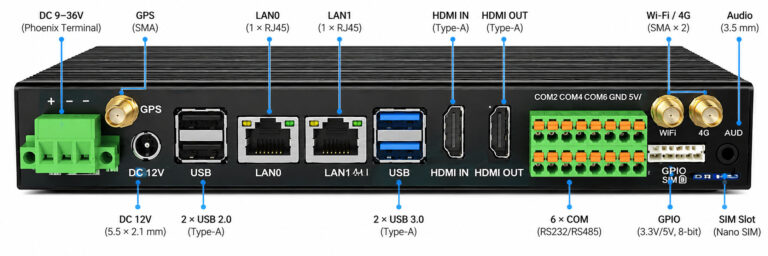
AE-3588LBT RK3588 Edge AI Box I/O Port Layout
Hardened Software Platform & Unattended Field Operations
Designed for 24/7 unattended deployment with comprehensive remote management capabilities.
Open-Root Android & Linux BSP Customization
Native Android 12 with full root access for deep system-level customization and proprietary driver integration.
Secure Over-The-Air (OTA) Fleet Management
Over-the-air system and application upgrades simplify the journey from system integration to global mass-market deployment.
Continuous Remote Connectivity via 4G/5G Modules
Mini PCIe slots for 4G/5G modules with GPS/BeiDou support for reliable remote connectivity.
System Reliability Features
100% 18-hour power-on burn-in test under load
AE-3588LBT BITECH Edge Computing Platform Evaluation Photos
Real photos to verify ports, mounting, and enclosure design.
AE-3588LBT Industrial Edge AI Computer Front IO
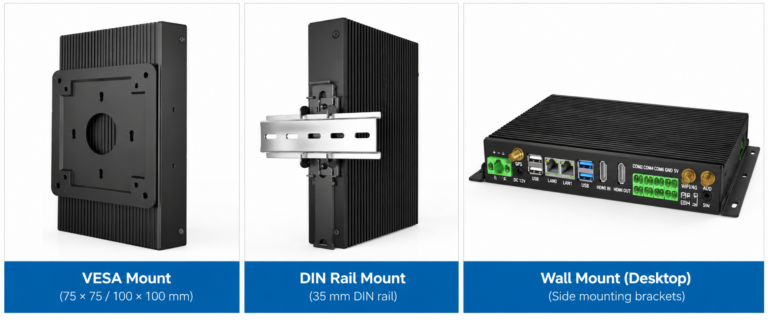
AE-3588LBT Industrial Edge AI Computer Rear IO
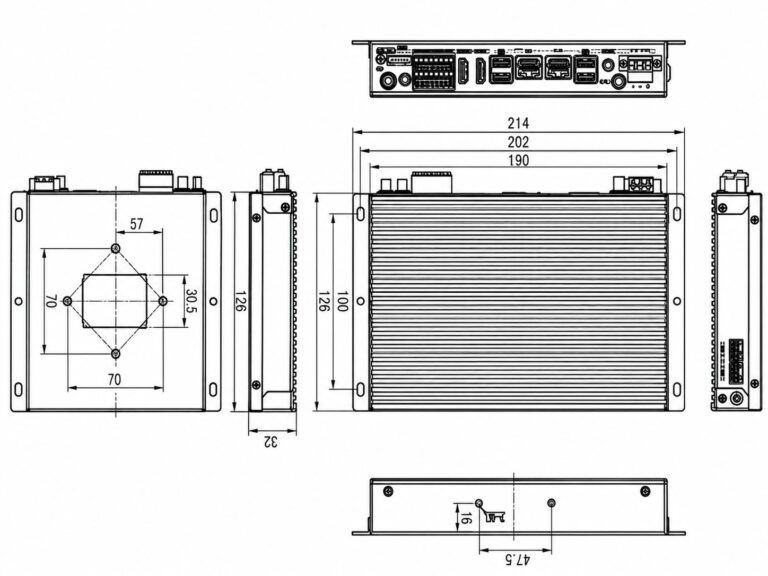
AE-3588LBT Industrial Edge AI Computer Overall Dimensions
AE-3588LBT Complete Hardware Specifications
Core Processing & Memory Subsystem
| Processor | Rockchip RK3588, Octa-core (4× A76 + 4× A55), up to 2.4GHz |
| AI Architecture | 6 TOPS (onboard) + 26 TOPS (expansion) = 32 TOPS total |
| Memory | 8GB LPDDR4 (options: 16GB / 32GB) |
| Storage | 128GB eMMC (option: 256GB) |
Device OS, Firmware & System Stability
| Operating System | Android 12 (native, full Root), Debian 11, Ubuntu 20.04 |
| Development Support | Full BSP, kernel source, driver SDKs provided |
| Stability | Built-in hardware/software Watchdog and RTC with backup battery |
Video Pipeline, Physical Interface Layout,Networking, Wireless & Mechanical Dimensions
| Video Output | 1× HDMI 2.1 (8K@60Hz output) |
| Video Input | 1× HDMI 2.0 (4K@60Hz input) |
| Additional Display | eDP, LVDS, MIPI DSI |
| Industrial Bus | 4× RS232,2x RS232/485, 1x CAN BUS option |
| GPIO | 4-bit GPIO |
| Network | 2× GbE LAN (1000Mbps) |
| Wireless | WiFi 6 (optional), BT 5.2, Mini PCIe for 4G/5G with GPS/BD |
| Dimensions | 190 × 126 × 32mm |
This overview highlights decision-level specifications. For full electrical and mechanical details, refer to the datasheet.
Technical Comparison: BITECH AE-3588LBT vs. AE-3588BT
| Criterion | AE-3588LBT | AE-3588BT |
|---|---|---|
| AI Scalability | 6 TOPS core computing power + single PCIe M.2 expansion (up to 32 TOPS) | 6 TOPS core computing power + dual PCIe M.2 expansion (up to 58 TOPS) |
| Network Topology | 2× GbE LAN | 3× GbE LAN (camera / control / uplink separation) |
| Industrial Interface Isolation | Industrial interfaces are NOT electrically isolated | 4000V optical isolation on all industrial I/O |
| Deployment Environment | Industrial control automation cabinets and equipment with built-in AOI vision inspection units | ESS sites, substations, harsh field environments |
Engineering Note
AE-3588LBT is ideal for cabinet installations where electrical isolation is handled externally. For ESS sites, substations, long cable runs, or environments with high EMI/ground loop risk, choose AE-3588BT with 4000V isolation.
OEM & System Customization Support for System Integrators
Designed for system integrators and OEMs who require platform customization and long-term supply chain stability for industrial AI and machine vision projects.
Tailored Hardware layout & Deep OS Configuration Services
Requirements Alignment & Scope Definition (1-2 Weeks)
1-2 weeks
I/O, OS, and integration scope definition
Functional Prototype Validation & Sample Evaluation (2-4 Weeks)
2-4 weeks
Hardware validation and software integration
Out-of-Tree Driver Integration & Custom BSP Compilation (4-8 Weeks)
4-8 weeks
BSP, drivers, and system configuration
Hardware-in-the-Loop Quality Testing & Production Ramp-Up (2-4 Weeks)
2-4 weeks
Quality validation and volume production
BITECH Edge Computing Platform Advantages
32 TOPS Scalable AI Headroom
Choosing BITECH AE-3588LBT means investing in a platform with 32 TOPS of scalable AI headroom, allowing you to deploy current YOLOv8 models today while remaining fully compatible with the next generation of complex deep learning architectures without costly hardware swaps.
Simultaneous 4K Input & 8K Output Pipeline
By leveraging BITECH’s unique HDMI Input/Output synergy, engineering teams can easily implement a closed-loop system that captures 4K frame grabber or industrial camera streams for millisecond-level AI labeling and outputs ultra-HD 8K visuals, a critical requirement for semiconductor inspection and high-end medical diagnostics.
Fanless Industrial Reliability with -10°C to +60°C Wide Temperature Operation and 15G Shock Resistance
BITECH’s commitment to a fanless, unibody extruded aluminum design ensures that the AE-3588LBT maintains peak performance under extreme temperature fluctuations from -10°C to +60°C and high-vibration conditions, guaranteeing zero-failure operation in remote or hazardous field deployments.
10 Year Long-Term Supply Commitment with Open-Root SDK and Deep OS Customization Services
As a dedicated B2B partner, BITECH provides a 24-month warranty and a guaranteed 10 year product lifecycle, supported by open-root SDKs and deep OS customization services that simplify the journey from initial system integration to global mass-market deployment.