
Medical Edge AI Architecture for Local Patient Data Processing
Reduce unnecessary movement of sensitive clinical data while keeping AI close to the systems, workflows, and people that generate and use it.
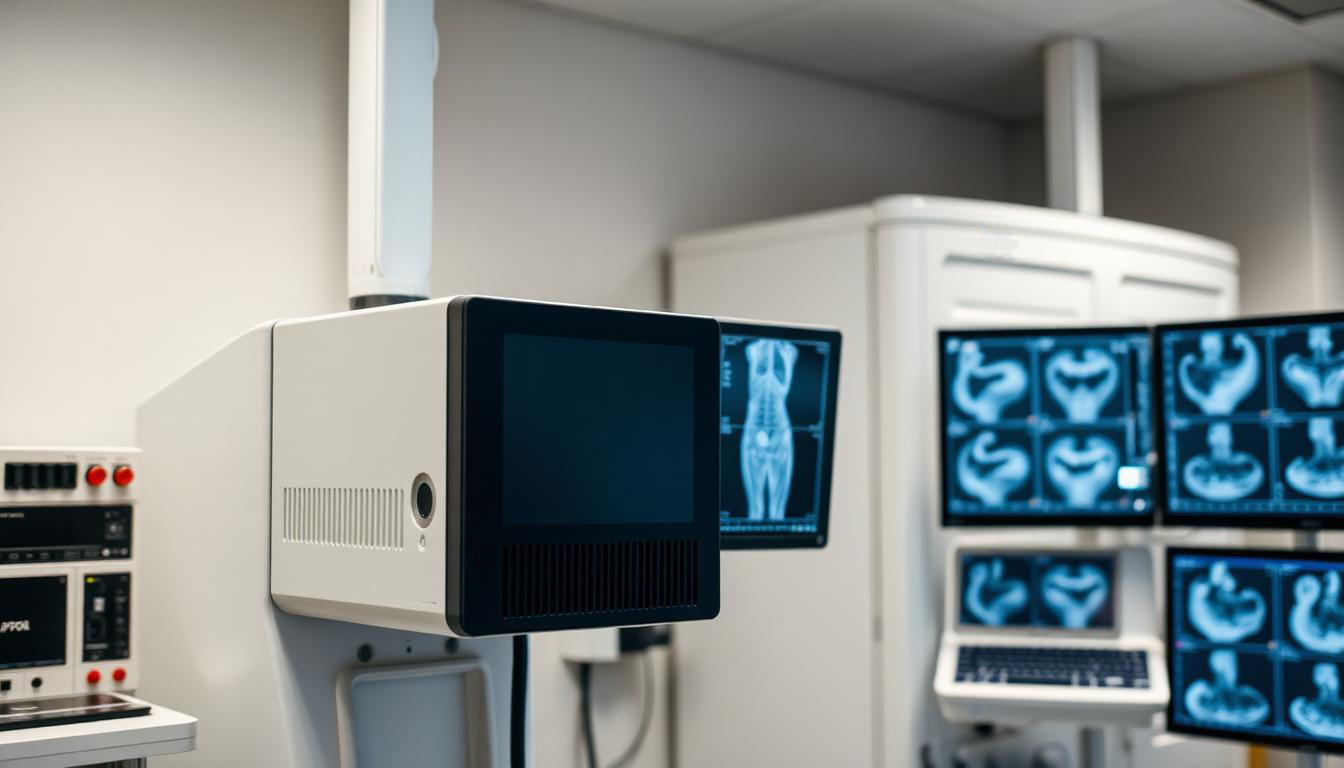
The design question is not which GPU — it is what should be processed locally, what can leave the site, and how AI fits the existing clinical workflow.
Table of Contents
Medical edge AI is not mainly about putting a GPU next to a scanner. It is about reducing unnecessary movement of sensitive clinical data while keeping AI close to the systems, workflows and people that generate and use that data. Three boundaries hold throughout this guide, and none of them can be blurred:
- Local processing does not automatically mean HIPAA compliance.
- AI assistance does not mean autonomous diagnosis.
- Medical edge AI does not mean replacing PACS, EHR, or existing medical equipment.
With those fixed, medical edge AI becomes a system-design problem: put processing closer to the source of clinical data while keeping security, interoperability, workflow and human responsibility inside the same design.
1. Medical AI starts with the data path, not the model
Do not begin with TOPS, GPU class, or model size. Begin with the data. The sources are familiar to anyone who works in a hospital: CT and MRI, X-ray, ultrasound, endoscopy, patient monitors, pathology imaging, the EHR/EMR, clinical notes, laboratory systems, medical reports, and cameras and sensors. Each has its own format, its own owner, and its own access rules. The AI is one stop on a path that already exists.
The clinical data path already exists — AI inserts a step, not a new chain
A typical path runs from the medical device to clinical data, into PACS/EHR/local storage, then to AI processing, to an AI output, and finally into the clinician’s workflow. AI doesn’t replace any link in that chain; it inserts a step and has to hand its result back to the workflow the clinician already uses.
Cloud path vs edge path: the difference is visible in the hops
Cloud AI path
Device → hospital network → Internet/WAN → cloud AI → Internet/WAN → hospital workflow
Every hop is a system and a boundary. Data leaves the site twice.
Edge AI path
Device → hospital network → edge AI computer → result → PACS/EHR/clinician
The raw data never leaves the site; only the result moves onward.
Neither path is automatically right, and cloud is not inherently unsafe — the choice is architectural, not moral. The rest of this article is how to choose between them for a given workload.
2. Every additional system expands the data-handling boundary
Start from a neutral principle, not a claim that cloud is dangerous: when clinical data leaves its original environment, more systems become involved — network paths, servers, cloud accounts, APIs, logs, backups, third-party services and service credentials. Each has to be secured, monitored and accounted for. That’s not an argument against cloud; it’s an argument for moving data with intent.
Process locally when there is no operational reason to move the raw data elsewhere.
Move the result, not the raw dataset
The pattern for high-value, high-volume clinical data is to reduce it at the source. A medical image goes to a local AI, which produces a structured result — findings, measurements, structured output, alerts, metadata — and it’s that lower-volume result, not necessarily the entire source dataset, that moves onward. The HHS HIPAA Security Rule governs how such data must be protected wherever it lives; the design goal is to keep the protected raw data close and let only what needs to travel, travel.
3. Running the model on site does not make the system HIPAA compliant
The misunderstanding this section exists to correct: “if the AI model runs locally, the system is HIPAA compliant.” That is not a valid conclusion, and it’s a common one — a clinician asking whether a local LLM for notes “handles HIPAA” is asking a real, reasonable question that deserves a precise answer.
HIPAA looks beyond where the model runs
Compliance is a property of the whole environment, not the inference location. A compliant system still has to address access control, authentication, audit logs, data storage, encryption, backups, device security, transmission security, physical access, incident response, and policies and procedures. Where the model executes is one detail inside that list.
Local AI still needs a security architecture
Running AI locally is not automatically secure. A local deployment still needs access control, encryption, authentication, audit logs, network segmentation, a controlled update process, physical security and backups.
Local inference is a data-location decision. Security and compliance remain system-level responsibilities — and an actual HIPAA determination requires qualified specialists, not a hardware vendor.
4. Privacy is already driving real medical local-LLM experiments
The interest isn’t hypothetical. A family physician described wanting a local LLM to summarize a patient’s historical medical reports before an appointment, with one hard requirement: the data must not leave the local computer.
Historical medical reports → local LLM → structured summary → doctor review. The AI drafts; the clinician reviews and remains responsible.
5. The safe starting point is a narrow task a clinician can check
The safest practical starting point for many medical edge AI projects is a narrow task with a clearly defined input, a clearly defined output, and a human-review step. Ambition comes later; the first deployment should be something a clinician can check.
Medical record summarization
Medical reports → local LLM → summary draft → clinician review
The value is saved reading time before an appointment; the safeguard is that a person approves the summary.
Clinical documentation assistance
Bullet points or notes → local language model → structured draft → clinician verification
AI helps with formatting, summarization and draft generation. It does not get the last word — scribes can introduce incorrect information, so review is the control that makes the workflow safe.
Imaging workflow assistance
Study → edge AI → preprocessing / measurements / prioritization → radiologist
Assistance and prioritization, not diagnosis. Where software influences clinical decisions, FDA Clinical Decision Support guidance defines when a tool is regulated as a medical device — check that boundary early, not after deployment.
6. PACS and DICOM are part of the AI architecture, not an integration detail
Medical imaging AI cannot be designed around GPU performance alone. DICOM — the medical imaging standard maintained by the DICOM Standards Committee — defines how images and metadata move, and the AI node has to speak it.
A workable DICOM flow: in from PACS, back to the reporting system
CT/MRI/X-ray → DICOM → PACS → edge AI computer → AI processing → structured result → back to PACS or the reporting system
How does the AI node enter and leave the DICOM workflow? Answer that before choosing hardware. A fast GPU that can’t cleanly receive a study from PACS and return a result to the reporting system is not a medical imaging solution.
7. Medical edge AI is an interoperability problem as much as an inference problem
Imaging is only part of the picture. Connecting AI to patient, order, and result data means additional interfaces: HL7 v2, FHIR, vendor APIs, and hospital interface engines. A medical image arrives over DICOM; the patient, order, and result context arrives over HL7 or FHIR; the edge AI sits in the middle and feeds the clinical system. The model might be the easy part — getting the right study, matched to the right patient and order, and returning a result the clinical system will accept, is where these projects succeed or stall.
FHIR improves interoperability but does not solve security
Adopting FHIR does not eliminate security requirements. A real implementation still has to handle TLS, authentication, authorization, audit, consent, provenance, and security labels — HL7 publishes FHIR security guidance for exactly this reason.
Standards make data interoperable. They do not eliminate the need for a security architecture.
8. Auditability and provenance matter when AI touches clinical data
When AI participates in a clinical workflow, the system has to answer basic questions after the fact: who accessed the data, which model version processed it, when inference occurred, what output was generated, whether it was reviewed, and whether the result was changed. That implies a recorded chain: input → model version → inference → output → human review → audit record. FHIR’s Provenance resource is designed to capture exactly this lineage.
Auditability isn’t paperwork; it’s what lets a hospital trust — and investigate — an AI-assisted result.
9. Hospital networks are segmented, restricted, and often offline by design
Medical AI hardware often runs inside VLANs, restricted networks, isolated departments, PACS networks, device networks, and networks with no direct Internet access. A medical edge computer may need dual LAN, network segmentation, firewall rules, a static IP, a no-Internet mode, controlled update paths, local administration, PACS access, and hospital-VLAN compatibility.
Medical edge systems should not assume unrestricted or continuous Internet connectivity. A design that only works when it can reach the cloud is the wrong design for a segmented hospital network.
Edge processing keeps high-volume imaging traffic off the WAN
CT, MRI, pathology images, ultrasound, endoscopy video and continuous monitoring data generate enough volume that moving all of it strains the network for no clinical benefit. Processing locally and forwarding a measurement, metadata or a result keeps high-volume traffic near the source.
10. Local processing survives an Internet outage — and has its own failure modes
A local AI system can keep doing useful work when external connectivity is down: preprocessing, local summarization, device-side inference, local alerts and local workflow assistance. That resilience is a genuine advantage for a hospital that can’t depend on the Internet.
But local systems have their own failure modes — power loss, SSD failure, a software crash, network failure, hardware failure, backup failure. Moving inference on site improves availability against one class of failure and exposes it to another.
A serious design balances all three security properties — confidentiality, integrity, and availability — rather than optimizing one. The HIPAA Security Rule frames protection in exactly those terms.
11. Edge AI removes some dependencies and makes you own the rest
Moving inference from cloud to edge removes some dependencies and creates others. Owning the box means owning its security surface: OS patches, GPU drivers, the AI runtime, network services, credentials, SSH/RDP access, USB access, storage encryption, BIOS and firmware, Secure Boot, and a recovery process.
None of that is a reason to avoid edge AI. It’s a reason to budget for it. FDA digital-health guidance and medical-device cybersecurity expectations make clear that security is a lifecycle responsibility, not a one-time setup — and that responsibility moves to the operator when the compute moves on site.
12. Every workflow this article endorses ends with a person
The endorsed workflow: patient data → edge AI → AI-generated draft → human review → accepted clinical output. The rejected framing removes the clinician: patient → AI → diagnosis.
| Workflow | Edge AI role | Human role |
|---|---|---|
| Medical record summary | Create draft summary | Review / approve |
| Clinical note assistant | Draft / format note | Verify / edit |
| Imaging preprocessing | Prepare image / data | Interpret clinically |
| Segmentation | Generate candidate region | Validate |
| Workflow prioritization | Flag / categorize | Decide action |
| Device monitoring | Detect pattern / anomaly | Clinical / technical response |
Medical edge AI means assisting data processing and clinical workflows — not replacing qualified healthcare professionals.
13. On-prem, edge, and cloud are four different deployment shapes
“On-prem” and “edge” get used interchangeably, but they describe different placements. Most medical deployments fit one of four shapes — and hospitals can mix them. The right mix depends on the workload, not a preference.
Architecture A — device-side AI
Medical device → embedded AI → local result
Best for: Narrow workloads, very low latency, limited compute needs, device-level control.
Architecture B — edge AI computer
Medical device → edge AI computer → PACS/EHR
Best for: GPU workloads, legacy-equipment integration, multiple interfaces, local data processing, department-level deployment. This is where a general-purpose industrial edge AI computer lives.
Architecture C — hospital on-prem GPU server
Multiple departments → hospital LAN → central GPU server
Best for: Shared compute, multiple users, centralized IT, hospital-wide workloads.
Architecture D — hybrid edge + cloud
Raw data → local edge AI → sensitive processing on site → selected or de-identified context → cloud AI
Best for: Local data control combined with cloud model capability, selective escalation, hybrid hospital architectures.
14. There is no universal winner — match the requirement to the placement
| Requirement | Device | Edge PC | On-prem server | Cloud |
|---|---|---|---|---|
| Very low latency | Best | Excellent | Good | Variable |
| Raw data stays near source | Best | Excellent | Good | Depends |
| High GPU performance | Limited | High | Very high | Very high |
| Offline operation | Excellent | Excellent | Excellent | Poor |
| Shared hospital workloads | Poor | Medium | Best | Excellent |
| Easy elastic scaling | Poor | Poor | Medium | Best |
| Legacy device integration | Medium | Best | Medium | Low |
| Central IT management | Low | Medium | Best | Excellent |
This is an architectural guide, not a compliance determination.
15. Seven question sets decide the platform before any spec sheet does
Define the workflow, the data, and the constraints before choosing hardware. The questions below usually decide the platform.
Clinical workflow
What task does the AI perform? Who reviews the result? Where does the result appear? Does the output return to PACS or the EHR?
Data
DICOM? HL7? FHIR? Video? Medical reports? Sensor data?
AI
LLM, VLM, CNN/vision model, segmentation? How many models and concurrent workloads?
Hardware
GPU, VRAM, CPU, system RAM, NVMe capacity?
Network
One LAN or segmented LAN? Is Internet permitted? Static IP? PACS access? Hospital VLAN? Is remote administration allowed?
Deployment
24/7? Acoustic requirements? Ambient temperature? Embedded enclosure? Rack, wall, or desktop mount? Lifecycle target?
Security
TPM? Secure Boot? Drive encryption? User authentication? Audit logs? Remote-access policy? A controlled software-update process?
For the memory side specifically, see How Much VRAM Do You Need for a Local LLM?, and for form factor, MXM vs Desktop GPU for Edge AI Computers.
Matching the workload to an edge AI platform
- Narrow, low-compute inference or preprocessing → an RK3588-class platform such as the BITECH AE-3588 family — fanless, low-noise, wide-temp.
- Vision preprocessing and mid-size inference with unified memory → a Jetson-class module such as the AE-NJ60BT.
- GPU-heavy imaging or local LLM work needing discrete VRAM → an x86 + RTX MXM platform such as the AE-760EBT, with dual/segmented LAN, low acoustic output, sustained-load cooling and a multi-year lifecycle.
These are general-purpose industrial edge AI computers used for workflow assistance with human review. Where a project requires a certified medical device, medical-device certification (for example IEC 60601-1) and the associated regulatory validation are separate requirements to confirm for that deployment.
Bottom line: move only what needs to move — and keep a person at the end
Don’t conclude that medical data should never enter the cloud. Conclude something more precise: medical edge AI gives system designers the option to process sensitive or high-volume data closer to where it is created, while sending only the information that genuinely needs to move elsewhere.
The right architecture may be device-side, edge, on-prem, cloud, or hybrid. What matters is that data movement, security, clinical workflow, and human responsibility are designed together — not bolted on after a model is chosen.
Decide the data path first. Choose the hardware second. And keep a qualified person at the end of every workflow.
Edge AI · Medical
Frequently asked questions
-
Running AI processing close to where clinical data is created — in a hospital, imaging center or device — instead of sending raw data to the cloud. It reduces unnecessary data movement while keeping AI near the systems, workflows and people that use it. It does not replace PACS, EHR, existing equipment, or clinicians.
-
No. Local processing is a data-location decision, not compliance. The whole environment still needs access control, authentication, audit logs, encryption, backups, physical security, incident response and policies. Locality is separate from security and from compliance, and a HIPAA determination requires qualified specialists.
-
No. It assists — summarization, documentation drafts, image preprocessing, segmentation candidates, measurements, prioritization — and every workflow ends with human review. The clinician remains responsible. Software that influences clinical decisions may be regulated as a medical device.
-
It's an interoperability problem, not just a GPU one. A practical flow: CT/MRI/X-ray → DICOM → PACS → edge AI computer → structured result back to PACS/reporting. The design question is how the AI node enters and leaves the DICOM workflow, and whether the result returns into the clinician's existing environment.
-
DICOM moves images; patient/order/result data flows over HL7 v2, FHIR, vendor APIs and interface engines. FHIR improves interoperability but doesn't remove security requirements — TLS, authentication, authorization, audit, consent, provenance and security labels still apply.
-
Dual LAN, network segmentation, firewall rules, static IP, a no-Internet mode, controlled updates, local administration, PACS access and VLAN compatibility. It shouldn't assume continuous Internet, and it should keep processing locally when connectivity is down.
-
The platforms referenced are general-purpose industrial edge AI computers for workflow assistance with human review. Where a certified medical device is required, medical-device certification (e.g. IEC 60601-1) and regulatory validation are separate requirements to confirm per deployment. The hardware is a platform in the architecture, not a cleared medical device by default.
This content is for architecture and infrastructure planning only. It is not legal, compliance or clinical advice; HIPAA compliance and medical-device certification must be confirmed by qualified specialists for each deployment.
Related
Hardware Plastforms for Medical Edge AI Evaluation
General-purpose industrial edge AI platforms sit in Architecture B — the edge computer between medical devices, local AI and PACS/EHR, used for workflow assistance with human review. Certified medical devices require separate certification (e.g. IEC 60601-1) per deployment.
Edge-AI platforms (general-purpose industrial)
Solutions
Engineering & guides
Regulatory, legal, and standards points reference official sources: the U.S. HHS HIPAA Security Rule; U.S. FDA guidance on Clinical Decision Support software and digital health; the DICOM standard; and HL7 FHIR, including FHIR security and provenance. Clinician and PACS-administrator discussions (r/LocalLLM, r/Residency, r/PACSAdmin) are cited as real-world questions and pain points — community signals, not legal guidance or benchmark data. Nothing here is a compliance determination or clinical advice; medical-device certification and HIPAA compliance must be confirmed by qualified specialists for each deployment.