
AE-NJ60BT: NVIDIA Jetson Orin NX Industrial Edge AI Computer (157 TOPS)
Fanless industrial Edge AI platform with 4× GbE, 4× GMSL2 camera ingress, 2× CAN FD and DC 9–36V wide input — engineered for autonomous vehicles, AMR/AGV, smart factory and energy AI workloads.
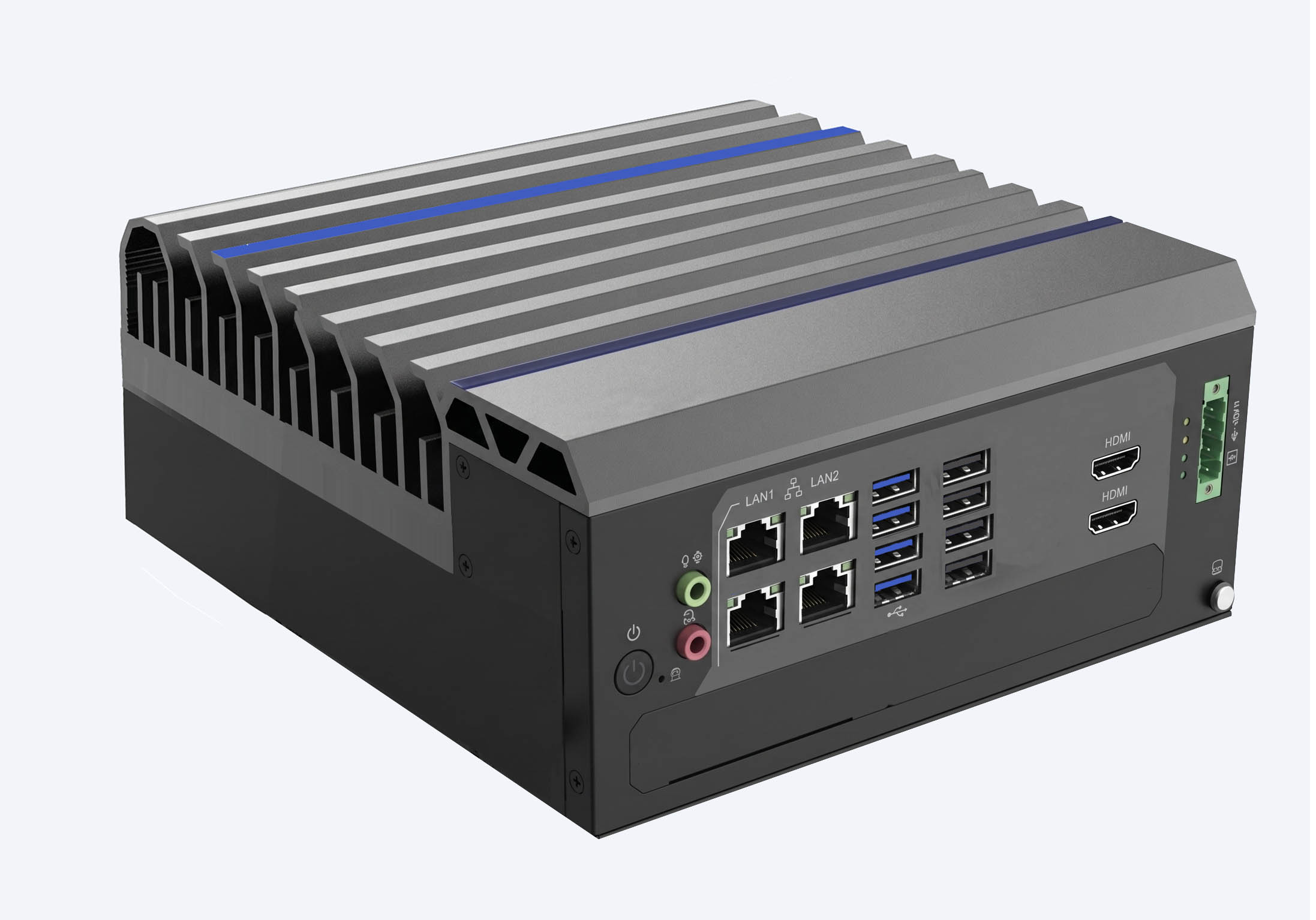
AE-NJ60BT — fanless extruded aluminum unibody with quad GbE and rich industrial I/O.
Product Overview
The AE-NJ60BT is a high-performance industrial Edge AI computer built around the NVIDIA Jetson Orin NX 8GB / 16GB module, delivering scalable AI compute from 70 TOPS up to 157 TOPS (Super mode). Combined with 1024 CUDA cores, 32 Tensor cores, 2× NVDLA v2 and an NVMe storage path, it provides a turn-key platform for production-grade vision, robotics and generative-AI workloads at the edge.
Engineered with a cable-less, jumper-less unibody extruded-aluminum chassis, 4× Gigabit Ethernet(1× SOM + 3× Intel i210-AT), 4-lane MIPI CSI / 4× GMSL2 camera ingress, 2× CAN FD, opto-isolated 8 DI / 8 DO and a DC 9–36V wide-range input, the AE-NJ60BT is JetPack 5.1.2 / 6.0 / 6.2 compatible and rated for -40°C to +70°C deployment.
AE-NJ60BT Workstation-Class Embedded Architecture for Autonomous Infrastructure & Vision AI
157 TOPS NVIDIA Ampere Pipeline with 1024 CUDA Cores
Configurable across Jetson Orin NX 8GB (70/117 TOPS Super) and Orin NX 16GB (100/157 TOPS Super) — 1024 CUDA cores, 32 Tensor cores and 2× NVDLA v2 sustain transformer vision and on-device LLM workloads at the edge.
Multi-Channel Vision Ingress: 4-Lane MIPI CSI & 4× GMSL2 Topography
Adapter board exposes 4-lane MIPI CSI or 4× GMSL2 for stable long-distance HD camera transmission — feeding all four streams directly into the Jetson ISP and 1× 8K30 / 4× 4K30 hardware decoder pipeline.
Independent Quad Gigabit Ethernet Driven by Intel i210-AT MACs
Four independent GbE ports — one from the Jetson SOM and three driven by industrial-grade Intel i210-AT controllers — enable multi-subnet isolation for cameras, PLCs and cloud uplink, with hardware-level network redundancy.
Fail-Safe Power Topography (DC 9-36V Vehicle-Grade Input)
Direct compatibility with 12V / 24V vehicle, AGV and AMR battery systems — no external regulator required. 100W minimum supply with auto power-on and button startup options.
Cableless Unibody Chassis with Dynamic Thermal Management
All internal power and signal connections are board-routed — no internal harnesses to vibrate loose. Unibody extruded-aluminum chassis doubles as the primary heatsink for fanless 100W operation.
4000V Opto-Isolated Industrial I/O & Dual CAN FD Interfaces
8× DI and 8× DO with opto-isolation (selectable 3.3V / 5V / 12V), 2× CAN FD, RS232/RS485, SPI, I²C and 4× GPIO — protect the mainboard from EMI while interfacing directly with sensors, actuators and field bus devices.
AE-NJ60BT Targeted Field Deployment Scenarios for Jetson Architecture
Multi-Camera Autonomous Vision AI & High-Speed Inline AOI Inspection
Aggregate 4× GMSL2 long-distance camera streams into TensorRT-optimized detection / segmentation pipelines for inline AOI, surface inspection and high-speed quality grading.
Autonomous Mobile Robots (AMR / AGV) Navigation & Real-Time SLAM
DC 9–36V wide input and cable-less design tolerate vehicle bus voltage swings and vibration; 157 TOPS + 4× GbE drive SLAM, sensor fusion and Nav2 stacks with sub-100ms perception loops.
Industry 4.0 Smart Factory Edge Gateways & Legacy PLC Bridging
Quad GbE (1× SOM + 3× Intel i210-AT) isolates camera, PLC and cloud subnets; 2× CAN FD and opto-isolated DI/DO bridge field devices to MES/SCADA without congestion.
Energy Infrastructure Monitoring, Substation AI Safety & ESS Site Supervision
Wide -40°C to +70°C envelope, fanless unibody thermals and TPM/TCM secure boot suit unattended substations, PV / wind farms and ESS sites where firmware integrity and 24/7 uptime are required.
Smart City IoT Aggregation, Multi-Protocol Wireless Routing & Edge Sensing
Triple wireless lanes (Wi-Fi 6 + 4G/5G + LoRa) with Nano SIM + eSIM let one unit serve as cellular uplink, LoRa concentrator and local AP — running AI preprocessing before forwarding events upstream.
Core Compute, Memory Subsystem & JetPack Compliance
Configure with Jetson Orin NX 8GB (70/117 TOPS Super) or Orin NX 16GB (100/157 TOPS Super) on the same carrier board — prototype and migrate to production without redesigning integration. The flagship 16GB Super configuration delivers 157 TOPS via 1024 CUDA cores, 32 Tensor cores and 2× NVDLA v2 accelerators.
| AI Module (8GB) | NVIDIA Jetson Orin NX 8GB — 6-core A78 @ 2.0GHz, 70 TOPS / 117 TOPS (Super) |
| AI Module (16GB) | NVIDIA Jetson Orin NX 16GB — 8-core A78 @ 2.2GHz, 100 TOPS / 157 TOPS (Super) |
| GPU | NVIDIA Ampere — 1024 CUDA cores + 32 Tensor cores @ 1173MHz |
| NPU / DLA | 2× NVDLA v2 |
| JetPack | Compatible with JetPack 5.1.2 / 6.0 / 6.2 |
| Operating System | Ubuntu 20.04 (default) |
High-Bandwidth Networking & Wireless Expansion Slots
Four independent Gigabit Ethernet ports — 1× from the SOM and 3× driven by industrial-grade Intel® i210-AT controllers — enable multi-subnet isolation across cameras, PLCs and cloud uplink. Triple wireless lanes (Wi-Fi 6, 4G/5G, LoRa) with Nano SIM + eSIM cover any field deployment.
| Ethernet (SOM) | 1× GbE LAN from SOM (10/100/1000 Mbps) |
| Ethernet (Industrial) | 3× Intel® i210-AT GbE (10/100/1000 Mbps) |
| Wi-Fi / Bluetooth | 1× M.2 KEY-E (PCIe ×1 + USB 2.0, 2230) for Wi-Fi/BT |
| Cellular | 1× M.2 KEY-B (USB 3.0) for 4G/5G modules |
| LoRa | 1× Mini PCIe slot for LoRa modules |
| SIM | 1× Nano SIM + 1× eSIM |
Industrial Fieldbus, Serial Ports & Opto-Isolated DIO
| USB | 4× USB 3.0 Type-A, 4× USB 2.0 Type-A |
| Type-C | 1× Type-C OTG_USB, 1× Type-C Debug |
| Serial Ports | 2× RS232 or 2× RS485, 2× RS485, 1× UART (3.3V level) |
| CAN Bus | 2× CAN FD |
| GPIO | 4× IO, 3.3V level (input/output) |
| Digital I/O | 8× DI + 8× DO with opto-isolation (3.3V / 5V / 12V selectable) |
| SPI / I²C | 1× SPI, 1× I²C (3.3V level) |
| Audio | 1× Dual-channel speaker out (18W 4Ω), 1× headphone (L/R), 2× microphone in |
Display Output, GMSL2 Camera Capture & Video Codecs
| HDMI Output | 1× HDMI Type-A (max 8K @ 30Hz) |
| Camera Input | 4-lane MIPI CSI or 4× GMSL2 (with adapter board) |
| Video Decoding | 1× 8K30, 2× 4K60, 4× 4K30, 9× 1080P, 18× 1080P30 (H.265) |
| Video Encoding | 1× 4K60, 3× 4K30, 6× 1080P30, 18× 1080P30 (H.265) |
System Storage, RTC Configuration & Software Environment
| Storage Slot | 1× M.2 Key-M (PCIe ×4, NVMe SSD, 2242/2260/2280) |
| Storage Module | 1× M.2 2280 NVMe SSD |
| RTC | External RTC backup battery, supports timed power on/off |
| Operating System | Ubuntu 20.04 (BSP + kernel sources provided) |
AE-NJ60BT vs AE-3588BT choosing the Right Edge AI Power
NVIDIA Jetson Orin (157 TOPS) vs Rockchip RK3588J (scalable to 58 TOPS) — pick the right Edge AI class.
Looking for an alternative to Rockchip? AE-NJ60BT offers 2.7x higher AI performance via the NVIDIA Ampere architecture.
| Engineering Factor | AE-NJ60BT | AE-3588BT |
|---|---|---|
| SOM / Processor | NVIDIA Jetson Orin Nano / NX / NX Super | Rockchip RK3588J (4× A76 + 4× A55) |
| AI Compute | Up to 157 TOPS | 6 TOPS NPU, scalable to 58 TOPS via 2× M.2 |
| Camera Ingress | 4-lane MIPI CSI or 4× GMSL2 | MIPI CSI + USB cameras |
| Ethernet | 4× GbE (1× SOM + 3× Intel i210-AT) | 3× GbE |
| CAN / DIO | 2× CAN FD, 8 DI / 8 DO (isolated) | 2× CAN, 4 DI / 4 DO (isolated) |
| Software Stack | NVIDIA JetPack, CUDA, TensorRT | Linux / Android, RKNN, ROS2 |
| Operating Temp | -40°C to +70°C, fanless | -40°C to +80°C, fanless |
| Best Fit | Multi-camera AOI, AMR perception, autonomous driving | Edge gateway, control node, light vision |
Choose this if you need: GMSL2 for long-distance video, 100+ TOPS for transformer models, or native JetPack support.
Benchmarking Matric: Bitech ARM Jetson AE-NJ60BT vs x86 Workstation AE-760EBT
ARM-based dedicated AI inference (157 TOPS) vs x86 workstation-class edge compute (RTX MXM). See which architecture fits your workload.
AE-NJ60BT — ARM AI Inference Node
- NVIDIA Jetson Orin NX up to 157 TOPS
- 4× GMSL2 / MIPI CSI camera ingress
- DC 9–36V, -40°C to +70°C,fanless chassis (optional dynamic internal smart fan for absolute extremes)
- JetPack / CUDA / TensorRT ecosystem
AE-760EBT — x86 Edge Workstation
- Intel i9-13900 + RTX 4060–5090 MXM GPU
- 4× 2.5GbE GigE Vision + USB 3.2
- DC 9–36V, -10°C to +55°C, dual 80 mm fans
- Windows 11 Pro / Ubuntu + CUDA / OpenVINO
Hardened Manufacturing Quality & Supply Chain Compliance
Strict 100% 18-Hour Power-On Full-Load Burn-In Testing
Every unit undergoes an 18-hour full-load power-on burn-in with AQL inspection and per-unit serial number traceability.
Cryptographic Security Layer: Hardware TPM 2.0 / TCM Ready
Optional TPM/TCM encryption module supports secure boot, signed OTA updates and encrypted model storage for fielded fleets.
10 Year Product Lifecycle Commitment & Revision Control
Long-term availability for mainboard, modules, shells and ICs — eliminating EOL supply risk on multi-year deployments.
Lifetime OS Customization & Embedded BSP Engineering Support
OS support, BIOS/firmware updates and CAN/RS485/PLC debugging assistance for the entire product lifetime.