
AI Vision vs Traditional Machine Vision: When Should You Use Each?
Start from the defect, not the technology. Use deterministic rules when the acceptance criterion can be measured, AI when appearance must be learned, and hybrid vision when recognition and exact tolerance decisions belong in the same inspection.
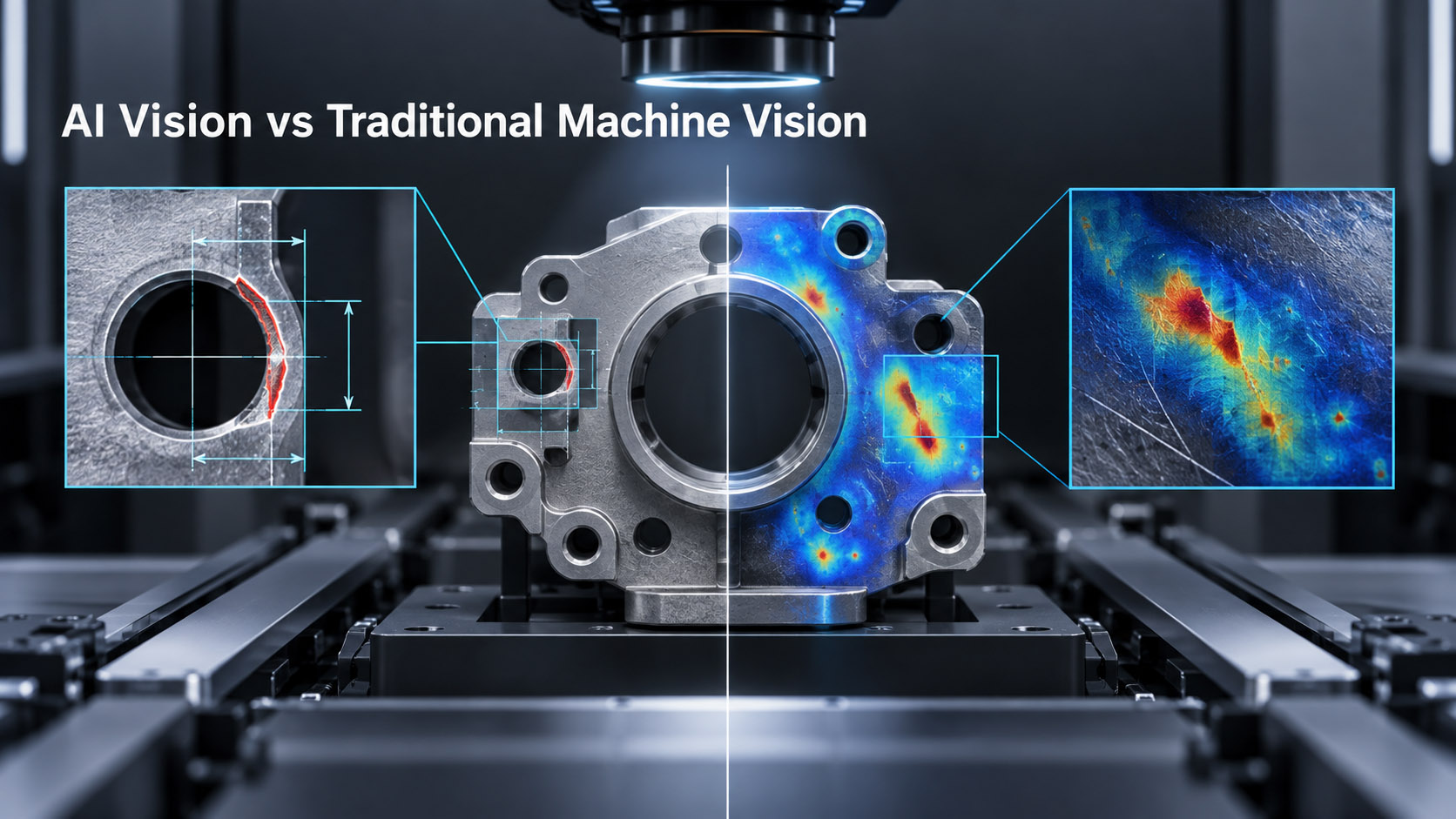
AI vision is not a replacement for traditional machine vision. It is another tool — one that earns its place on inspection problems that are hard to describe with deterministic rules.
If you can describe the defect with a stable geometric, intensity or colour rule, start with traditional vision. If you can recognize it but cannot reliably describe it with rules, AI becomes more valuable.
Most real production lines are not an either-or decision. Traditional vision is best when the defect can be defined. AI is best when it has to be learned. Hybrid vision is often best when it must first be recognized and then measured.
The 30-second answer depends on the inspection task
| Inspection task | Traditional | AI vision | Hybrid |
|---|---|---|---|
| Dimensional measurement | Best | Usually unnecessary | Sometimes |
| Edge, gap or diameter | Best | Usually unnecessary | Sometimes |
| Barcode or Data Matrix | Strong | Usually unnecessary | Sometimes |
| Fixed-position presence or absence | Strong | Usually unnecessary | Sometimes |
| Colour threshold | Strong | Usually unnecessary | Sometimes |
| OCR with stable printing | Strong | Useful for variation | Strong |
| Scratch, stain or cosmetic defect | Hard as variation grows | Strong | Often best |
| Weld appearance | Limited with variation | Strong | Strong |
| Fabric or texture anomaly | Difficult | Strong | Strong |
| Unknown defect types | Weak | Anomaly detection | Strong |
| Exact tolerance decision | Strong | Weak alone | Best |
| High-mix production | Rules get complex | Strong | Often best |
| Auditable measurement | Strong | Needs extra validation | Strong |
The question is not whether AI is more advanced. It is which method gives the most reliable, maintainable and explainable decision for this inspection.
Traditional machine vision wins when acceptance can be measured
A rule-based pipeline is deterministic: image → threshold, edge, blob, pattern, geometry or measurement → decision. It uses tools such as thresholding, blob analysis, line and circle fitting, template matching, colour segmentation, morphology, barcode reading and OCR.
A hole-diameter check is the archetype: detect the circle, measure it and reject above 10.10 mm. The best traditional-vision problem can be written as a formula.
reject if width < 20.00 mm or width > 20.10 mm
reject if red-pixel ratio > 3%
reject if component count != 12
Traditional vision does not need to understand the part when the acceptance criterion can be measured directly.
Rule-based inspection breaks down when normal appearance varies
Rules become difficult when good parts legitimately vary in shade, texture, orientation, reflection or supplier finish. Accommodating every variation can turn a short recipe into dozens of interacting thresholds, each adding maintenance and another possible failure mode.
AI becomes valuable when variation is easier to show than to describe.
AI vision learns visual features from production images
Traditional vision uses features an engineer defines. AI learns features from examples, making it useful for cosmetic defects, scratches, stains, weld appearance, complex textures, deformable objects, foreign objects and natural variation that resists hand-written rules.
Classification, detection, segmentation and anomaly detection solve different problems
- Classification: one GOOD or BAD label per image.
- Object detection: identifies what the defect is and where it appears.
- Segmentation: returns defect pixels for area, length or region analysis.
- Anomaly detection: learns GOOD appearance and flags what differs.
Choosing AI without choosing one of these tasks is an early architecture error because each needs different data, validation and compute.
Rare defect data changes the AI strategy
The better production quality becomes, the harder it may be to collect enough defective samples for supervised AI. The viable method therefore depends on the data that actually exists.
| Strategy | Strength | Risk |
|---|---|---|
| Rule-based | No large defect dataset needed | Hard for complex appearance |
| Supervised AI | Strong for known classes | Requires representative defect samples |
| Synthetic defects | Expands the training set | Synthetic-to-real gap |
| Anomaly detection | Trains mainly from GOOD samples | False positives from normal variation |
| Hybrid | AI finds candidates and rules verify | More system complexity |
Anomaly detection flags difference, not necessarily a defect
anomaly != defect
Dust, lens contamination, part rotation, lighting drift, packaging variation and a new supplier finish can all look anomalous without violating a product requirement. Anomaly inspection only becomes dependable when normal production variation is tightly controlled and false-positive behaviour is validated.
Lighting and imaging still matter more than the model
bad image + better AI != robust inspection
The robust chain is stable lighting + appropriate optics + a suitable camera + the right algorithm. No model can restore information the source image never captured. This imaging-first principle is explored in Machine Vision & AOI: Why Factory Inspection Fails Outside the Lab.
Production quality needs false-reject and false-accept metrics
A false reject scraps good product or creates manual review and line interruption. A false accept ships a defect. Measure precision, recall, false-reject rate, false-accept rate, defects per million, manual-review rate and cycle time rather than a single headline accuracy number.
At 100,000 parts per day, a 1% false-reject rate rejects 1,000 good parts every day. Class imbalance — many good samples and few defects — makes aggregate accuracy especially misleading.
Explainability also differs. A deterministic result can state “10.42 mm exceeds the 10.20 mm limit.” An AI result may only state “defect confidence 0.87.” For auditable or dispute-prone inspection, keep exact measurement deterministic.
AI finds a defect; traditional vision measures its tolerance
AI confidence is not an engineering tolerance. “Scratch longer than 2 mm” is a measurement, not a confidence score.
AI -> segment scratch -> deterministic measurement -> length > 2 mm? -> reject
AI finds it. Traditional vision measures it.
Four hybrid patterns cover most production architectures
- Rule first, AI second: rules resolve easy cases; AI handles the ambiguous remainder.
- AI first, rule second: AI finds the defect; a rule measures whether it exceeds tolerance.
- AI ROI plus traditional measurement: AI locates the object; calipers and geometry measure it.
- Rules plus AI agreement: both run and decision logic combines their evidence.
Commercial vision toolchains increasingly support deterministic and learned methods together. This is an industry direction, not an endorsement of one vendor or runtime.
New SKUs, suppliers and materials create maintenance for both methods
Traditional vision needs recipe and ROI tuning. AI needs dataset-shift handling, retraining and revalidation. AI replaces some rule tuning with data and model management; it does not eliminate engineering.
| Maintenance task | Traditional | AI vision |
|---|---|---|
| New SKU | Rewrite or retune rules | Collect and validate data |
| Lighting change | Retune thresholds | May require retraining |
| New defect | Add a rule | Add data and retrain |
| Debugging | Inspect logic | Inspect data and model |
| Version control | Recipe and software | Model, dataset and runtime |
| Explain a decision | Usually easier | Often harder |
| Skills required | Vision engineering | Vision plus ML and data |
Stabilize the production process before adding AI
unstable position + unstable lighting + unstable trigger + unstable PLC logic
-> add AI -> still unstable
AI vision projects often fail outside the model: lighting, dataset quality, inference latency, PLC timing and thermal throttling cause the practical problems. Industrial AI vision is a system-engineering task, not only a model-selection task.
The algorithm determines whether the system needs a CPU, NPU or GPU
- Traditional vision emphasizes deterministic CPU performance, camera transport, PLC I/O, trigger handling and storage.
- AI vision adds GPU or NPU compute, memory capacity, a supported runtime and sustained thermal performance.
- Hybrid vision usually needs both profiles in one system.
CPUs suit morphology, geometry, edges, barcodes and modest AI. NPUs suit supported, power-efficient fixed models, but TOPS alone is not a deployment benchmark. GPUs suit detection, segmentation and custom multi-model workloads. For multi-camera budgeting, use our industrial PC sizing method; for architecture placement, compare a smart camera with an industrial AI PC.
Choose the accelerator after the inspection pipeline is defined — not before.
Vision-language models are a reasoning layer, not a measurement replacement
Traditional vision answers “what is its size or position?” AI vision answers “what pattern or defect is this?” A VLM may answer “what does this scene mean?” That higher-level context can be useful, but it is not a substitute for a calibrated measurement or validated defect model.
Total cost includes the data and validation lifecycle
TCO = hardware + vision software + data collection + integration
    + validation + maintenance + false rejects + downtime
An AI system that requires data pipelines, retraining and revalidation may cost more than a rule-based system that solves a defined problem. The opposite is true when deterministic rules would expand into an unmaintainable recipe. Cost the lifecycle, not the demonstration.
This decision tree selects the inspection architecture
- Can the acceptance criterion be written as a stable rule? Start with traditional vision.
- Can people see the difference, but it is hard to describe mathematically? Evaluate AI vision.
- Must AI find the defect while an exact measurement decides acceptance? Use hybrid vision.
- Are defective samples scarce? Evaluate anomaly detection and plan explicit false-positive control.
The use case should decide the method
Diameter, gap, component presence, barcode and simple OCR usually suit rules. Variable OCR, scratches, stains and weld appearance increasingly suit AI or hybrid methods. Scratch-length tolerance and auditable measurement point to hybrid or deterministic decisions. Unknown cosmetic defects may justify anomaly detection when normal variation is controlled.
Map the inspection to a hardware platform last
- Classical machine vision: AX-130BT or AX-134BT class with x86 CPU, integrated graphics and deterministic I/O.
- Compact AI inspection: AE-3588BT class with an embedded NPU.
- Robotics vision: AE-NJ60BT with Jetson, CUDA and TensorRT.
- Heavier AI and hybrid AOI: AE-760EBT class with x86 plus RTX MXM compute.
Do not map hardware from a model name or camera count alone. Define camera type, resolution, frame rate, model, latency target, software stack and environment first. If camera transport is undecided, compare GMSL2 and GigE Vision before freezing the platform.
Send the inspection for an architecture review
A useful review request includes the target, acceptable GOOD variation, defect types, smallest defect, cycle time, camera, existing software, number of defect samples, PLC and production environment. BITECH can then map the workload to a rule-based, AI or hybrid architecture; a CPU, NPU or GPU direction; interface requirements; a compute platform; and a sustained validation plan.
Machine Vision · AI vs Rule-Based
Frequently asked questions
-
No. AI handles complex visual variation better; traditional vision handles deterministic measurement and clearly defined rules better. The right choice depends on whether the defect can be defined or must be learned.
-
When defects are visually recognizable but difficult to describe with stable rules — cosmetic defects, scratches, stains, weld appearance and complex textures.
-
Usually yes. Anomaly detection can reduce the need for defective samples, but may introduce more false positives that then need controlling.
-
No. Stable lighting and optics come first — a better model cannot recover a defect signal the image never captured.
-
Not universally. It depends on defect-data availability, how tightly normal variation is controlled, and the acceptable false-positive rate.
-
Yes. Many production systems are best served by a hybrid architecture — AI finds the defect, traditional vision measures whether it exceeds tolerance.
-
No. Different tasks need classification, detection, segmentation, anomaly detection or rule-based measurement — object detection is one tool, not the default.
-
Not always. Classical vision and modest or supported AI models can run on CPU, iGPU or NPU; a discrete GPU is for heavier detection, segmentation and multi-model workloads.
-
No. Also evaluate model compatibility, compiler, operator support, memory, bandwidth and runtime — TOPS alone doesn't determine practical performance.
-
Not as a general rule. A vision-language model is better treated as an emerging reasoning and context layer than as a replacement for deterministic inspection and measurement.
Choose the method that gives the most reliable production decision
Start from the defect. If acceptance can be written as a rule, traditional vision is usually more explainable and maintainable. If a defect can be recognized but not described, evaluate the AI technique that matches the available data. When recognition and measurement are both required, hybrid is often the strongest production architecture. Stabilize imaging and process first, keep measurement deterministic where it matters and choose the accelerator last.
Traditional vision is best when the defect can be defined. AI is best when it has to be learned. Hybrid vision is often best when it must first be recognized and then measured.
Engineering-community discussions and industry publications informed the practical signals in this guide; they are not formal benchmarks. Any accuracy, latency, false-reject or throughput figure that matters to a deployment must be validated on the actual parts, defects, imaging chain and production conditions.
Get an inspection architecture review
Rule-based, AI or hybrid? Send us the inspection.
You don't have to pre-decide the algorithm. Send BITECH engineering the defect and the process, and we'll recommend the architecture that gives the most reliable, maintainable and explainable decision — then size the compute around it.
Send us the inspection
- Inspection target & defect types
- GOOD-appearance variation
- Smallest defect to detect
- Cycle time
- Camera & existing software (e.g. OpenCV)
- Number of defect samples available
- PLC & production environment
We return
- Rule-based / AI / hybrid architecture recommendation
- CPU / GPU / NPU direction — chosen after the pipeline
- Camera & interface considerations
- A compute platform
- Validation considerations
Architecture-neutral advice · matched to your defect data · accelerator chosen last · sustained-load validated
Related products & guides
Once the architecture is chosen, match it to a platform
Rule-based, AI or hybrid each point to a different compute profile — not a fixed GPU. These BITECH platforms map to the algorithm decision, and the guides go deeper on the pipeline around it.