
Vehicle power
Normal operation across 12V and 24V vehicle electrical systems, with a 9–36V DC input range.
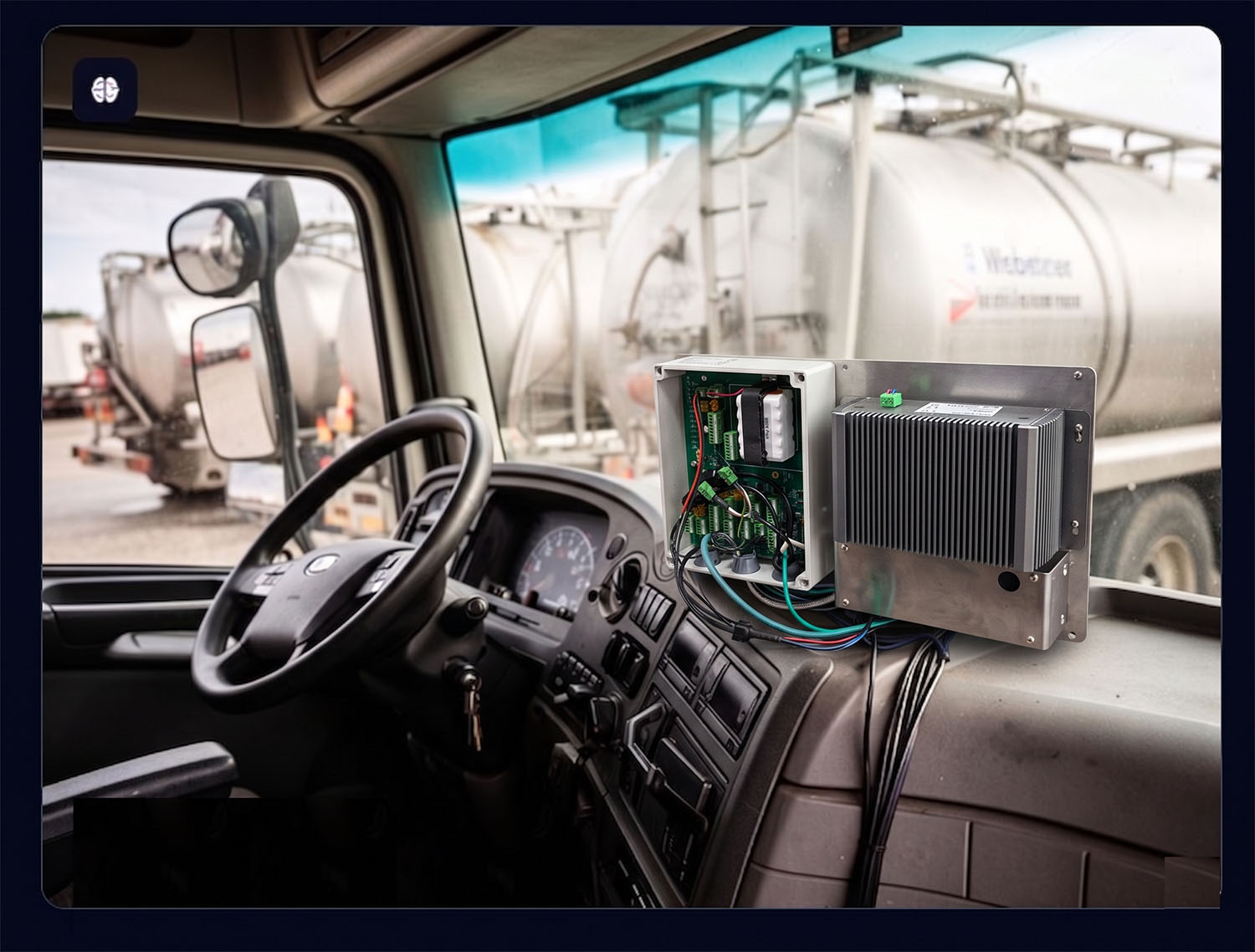
A Danish system integrator deployed the AX-234BT industrial motherboard as the central control unit for fleets of milk transport vehicles and heavy-duty waste management trucks—surviving dirty power, EMI, and continuous vibration.
AX-234BT
In-Vehicle Control Unit

Shenzhen Bitech Co., Ltd Sales Engineer Manager
June, 10th., 2026
01 · Project Snapshot
The supplied hardware was a complete AX-234BT industrial computer configured for this vehicle program. Unverified component SKUs and interface ratings are intentionally not published as facts.
| Item | Project Detail |
|---|---|
| Customer | Danish system integrator |
| Vehicle types | Milk-transport and waste-management trucks |
| Deployment role | Central control and telemetry computer |
| Platform | Complete AX-234BT, project-specific vehicle configuration |
| Production CPU | Not published pending configuration verification |
| Power | 9–36V DC operating input |
| Fieldbus | CAN and serial |
| Isolation | Project-specific configuration; rating not publicly confirmed |
| Deployment year | 2026 |
| Fleet size / field duration | Customer-confidential |
02 · Customer Deployment
The Danish system integrator required a compact industrial computer to connect vehicle-side data, serial equipment and higher-level control or telemetry software. The project did not rely on unrelated AI workloads or generic compute claims.
Normal operation across 12V and 24V vehicle electrical systems, with a 9–36V DC input range.
CAN and serial connectivity for vehicle-side data, controllers and telemetry equipment.
A fanless x86 computer with accessible I/O for installation in a constrained vehicle-control space.
Solid-state storage, secure mounting and enclosure design appropriate to the project’s vibration environment.
03 · Platform Selection
AX-234BT combined x86 compute performance, industrial I/O and a compact fanless enclosure suitable for vehicle integration. Selection did not imply universal protection against every vehicle transient.
04 · Vehicle Integration
The 9–36V DC input supports normal 12V and 24V vehicle operating ranges. Crank, load-dump and conducted-transient qualification must be validated separately against the required electrical profile.
Vehicle power designWith power removed, two 120Ω endpoint resistors typically measure approximately 60Ω across CANH and CANL. This is a bus diagnostic, not a feature or rating of the computer.
CAN 60Ω checkAny isolation rating remains configuration-specific. Isolation does not replace termination, grounding or transient protection. RS-232/422/485 carries digital data; analog sensors require a conversion stage.
Galvanic isolation guide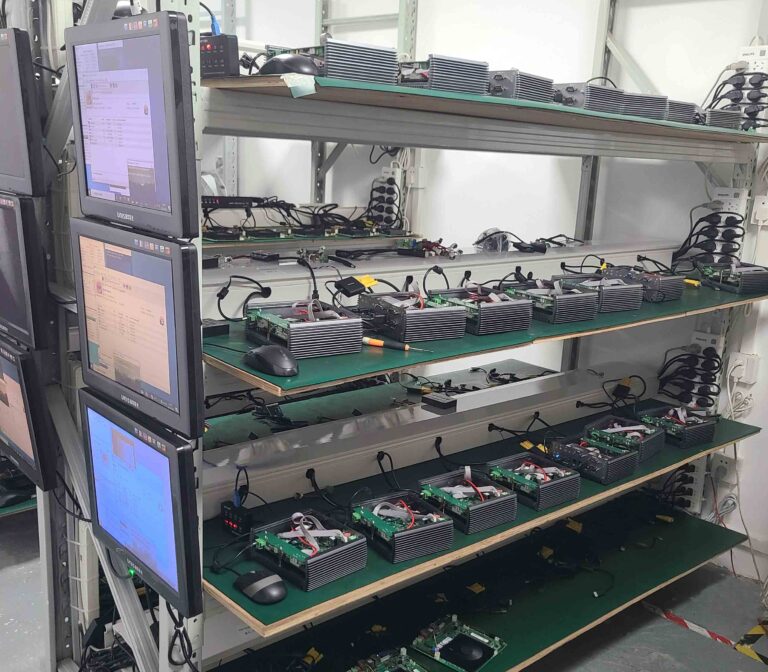 Production validation is recorded separately from field performance.
05 · Factory Validation
Each supplied unit passed production burn-in and full I/O verification. Test duration and configuration remain tied to the controlled manufacturing record; temperature-chamber testing is treated as a separate qualification activity.
Sustained CPU, memory and storage operation on the shipped configuration.
Functional communication and data-integrity checks for configured CAN, serial, Ethernet, USB and display interfaces.
Configuration and test status associated with the production unit.
06 · Evidence Boundary
The table distinguishes what can be tied to this deployment from information that requires a project report or customer approval.
| Evidence Type | This Project |
|---|---|
| Customer deployment | Complete AX-234BT vehicle computer deployed in Danish fleet vehicles |
| Hardware configuration | Project-specific variant; confidential component details retained in the production record |
| Factory burn-in | Production burn-in completed before shipment; exact duration follows the controlled QC record |
| Interface verification | Functional communication and data-integrity checks for configured interfaces |
| CAN / serial isolation | Publishable rating remains pending configuration and test-record verification |
| Temperature chamber | No project-specific condition published without the corresponding test record |
| Vehicle transients | Not inferred from the 9–36V operating range; qualification remains project-specific |
| Field reliability | In field operation; detailed fleet metrics remain customer-confidential |
The systems entered field operation in 2026 across milk-transport and waste-management vehicles in Denmark. Detailed fleet size, operating duration, failure data and maintenance metrics remain customer-confidential.
07 · Similar Projects
Vehicle readiness is defined from the electrical, interface and mechanical environment—not from the CPU model alone.
Vehicle-Mounted Deployment
Tell us the vehicle type, power environment, sensor mix, and connectivity requirements — our engineers will map it against the AX-234BT platform (or scope a custom configuration) before you commit to hardware.
Send us:
Deployment environment
We return:
Engineering FAQ
Technical Q&A — AX-234BT for Heavy-Duty Fleet Deployment
The AX-234BT features integrated power ignition management. It senses the vehicle's ignition state (ACC) and triggers a graceful software shutdown via the OS before physically cutting hardware power. This mechanism effectively prevents file system damage, SSD corruption, and data loss during sudden engine-offs.
Yes. The motherboard strictly utilizes industrial-grade ICs and capacitors rated for an operating temperature threshold of -40°C to 70°C. This guarantees safe, immediate cold boots in extreme winter conditions without relying on failure-prone active heating elements.
Mechanical failure is eliminated by exclusively utilizing industrial-grade NVMe or SATA SSDs. Furthermore, the storage modules are secured using conformal coating and anti-vibration standoffs, ensuring continuous read/write operations even during high-impact events like waste management loading cycles.
The board provides dedicated M.2 Key B and Key E slots with dual SIM card support, allowing seamless integration of 4G/5G cellular modules and high-precision GNSS/GPS. This dual-SIM architecture ensures network carrier redundancy for continuous telemetry streaming across remote logistics routes.
Absolutely. The single-sided I/O layout includes dual 2.5GbE RJ45 ports for high-bandwidth IP cameras or LiDAR, alongside 4000V isolated RS232/422/485 serial interfaces to collect analog data directly from legacy mechanical scales and valve sensors on heavy-duty trucks.
The AX-234BT leverages Intel's embedded roadmap, which guarantees a minimum 10-year hardware lifecycle. Additionally, we enforce strict BOM (Bill of Materials) locking. This ensures that system integrators will not face unexpected component changes that could require costly firmware recertification or mechanical redesigns years after initial deployment.
Related Engineering Resources
The design decisions behind the AX-234BT deployment in this case study — and where to see the full platform spec.
Vehicle Power Design for Industrial PCs
Why wide-voltage DC input and ignition-sense power management are non-negotiable for anything hard-wired to a vehicle's electrical system.
Read the guide → EngineeringGalvanic Isolation Guide for Industrial PCs
How isolated RS-232/422/485 interfaces — like the 4000V-isolated ports on the AX-234BT — protect a system from ground loops and transient spikes.
Read the guide → EngineeringCAN Bus Isolation Engineering
Design practices for isolating CAN interfaces on vehicle and industrial networks against noise coupling and ground-potential differences.
Read the guide → EngineeringHow BITECH Tests Every Unit: QC & Burn-In Process
The validation process referenced in this case study — burn-in testing under load before a unit ships to the field.
Read the guide → SolutionAMR & Mobile Robot Controller Solutions
The same wide-voltage, vibration-tolerant design principles applied to autonomous mobile robot platforms.
Explore the solution → ProductAX-234BT — Vehicle-Mount Industrial AI PC
The platform deployed in this case study — Intel Core i5-1345U, 9–36V DC input, -40°C to +70°C, 4000V isolated I/O.
View product →