
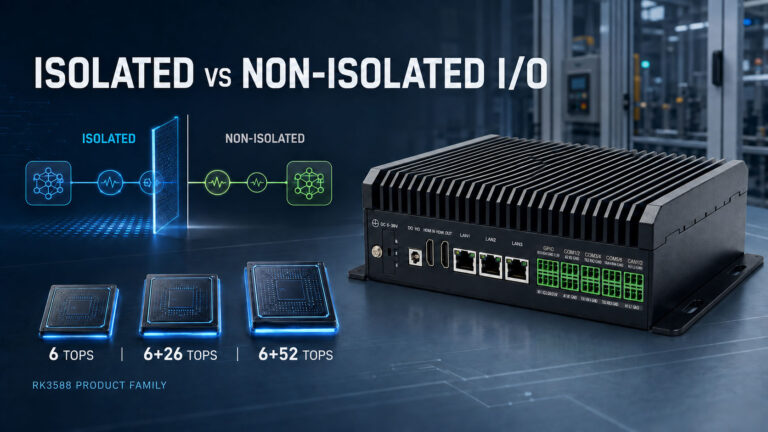

What does “isolated I/O” mean, and when do you need it?
Galvanic (electrical) isolation puts a barrier — optocouplers, digital isolators, isolated DC-DC converters — between your field I/O and the rest of the board. Your digital I/O, RS-485/RS-232 serial lines, CAN bus, and power input no longer share a common ground reference with the field wiring.
Why does that matter? Because the real industrial floor is electrically hostile in ways a lab bench never reveals:
Ground loops
Two machines at slightly different ground potentials push current through your signal lines. Isolation breaks the loop.
Surges and transients
Motor drives, contactors, and inductive loads dump voltage spikes onto nearby wiring. Isolation gives them somewhere to go that isn’t your CPU.
Long cable runs
Sensors 50+ meters away pick up noise and potential differences. Isolation tolerates them.
EMI from VFDs and welders
A variable-frequency drive is a broadband noise generator. Non-isolated I/O next to one is a coin flip.
Choose isolated I/O when the box lives on a real plant floor, talks to motor drives or PLCs over RS-485/CAN, runs long sensor cabling, sits outdoors or in a vehicle, or shares power with heavy inductive loads. This is exactly why the BITECH AE-3588BT ships with 4000V isolated CAN / RS-232 / RS-485 / GPIO and targets energy and semiconductor environments.
Non-isolated is fine when the environment is clean and benign: digital signage, retail kiosks, an HMI inside a well-grounded cabinet with conditioned power, or a product where the I/O never leaves the enclosure. That’s the niche the AE-3588NBT (cost-optimized gateway) and the low-latency AE-3588LBT fill — they deliberately drop isolation to save cost and shave fieldbus latency where the environment allows it.
A useful rule: isolation is cheap insurance, and field failures are expensive. And “isolated” isn’t a single number — always ask which ports are isolated and to what withstand voltage. “4000V isolated CAN/RS-485/GPIO” is a specific, verifiable claim; “isolated I/O” alone is not.
How many TOPS does an RK3588 have — and where does 58 come from?
The RK3588’s integrated NPU delivers 6 TOPS at INT8, with support for INT4/INT8/INT16/FP16 precisions. That number is more capable than it sounds: in real deployments it handles multi-stream video analytics (think 16 channels of 720p license-plate and vehicle detection) at sub-10W. For a large share of industrial “detect-and-act” vision tasks, 6 TOPS is the sweet spot — enough headroom, tiny power budget, no fan.
So where do 32 and 58 TOPS come from? Not the SoC — from M.2 NPU accelerator modules added over PCIe:
Onboard NPU only
AE-3588NBT
6 + 26 M.2
AE-3588LBT
6 + 52 M.2
AE-3588BT
The “6 to 58 TOPS” range is really a product-family spectrum: same 8-core RK3588 brain, scalable AI muscle bolted on as the workload demands.
The mistake is treating TOPS as the thing to maximize
- TOPS is peak INT8. Drop to FP16 and effective throughput falls sharply. A poorly quantized model never sees the headline number.
- Architecture beats raw TOPS. CNNs (YOLO, ResNet, SSD) map beautifully onto these NPUs; Transformer/ViT models need real optimization.
- The real budget is streams × model complexity × latency target. Work backward from that, not forward from a TOPS figure.
- More silicon means more heat. Every accelerator eats into the fanless, wide-temperature envelope that made the RK3588 attractive.
RK3588 industrial computer comparison: 6 vs 32 vs 58 TOPS
| Factor | AE-3588NBT | AE-3588LBT | AE-3588BT |
|---|---|---|---|
| AI compute | 6 TOPS (onboard NPU) | 32 TOPS (6 + 26 M.2) | 58 TOPS(6 + 52 M.2) |
| I/O isolation | Non-isolated | Non-isolated, low-latency fieldbus | 4000V isolated CAN/RS232/RS485/GPIO |
| Operating temp | −10°C to +60°C | −40°C to +80°C | −40°C to +80°C (RK3588J) |
| Thermal | Fanless | Fanless | Fanless |
| Video | HDMI 2.1 8K out + HDMI 2.0 4K in | Vision-ready I/O | Vision-ready I/O |
| Best-fit | Gateway, light vision, smart infrastructure | AOI, AGV/AMR, smart city | Energy, semiconductor, harsh/high-EMI sites |
The two axes are independent. A signage or gateway node can be non-isolated and 6 TOPS (NBT). An AGV running multi-camera perception in a reasonably clean plant can be non-isolated and 32 TOPS (LBT). A semiconductor or energy installation surrounded by drives and transients should be isolated and high-compute (BT). There’s no single “best” RK3588 box — only the one matched to your environment and your workload.
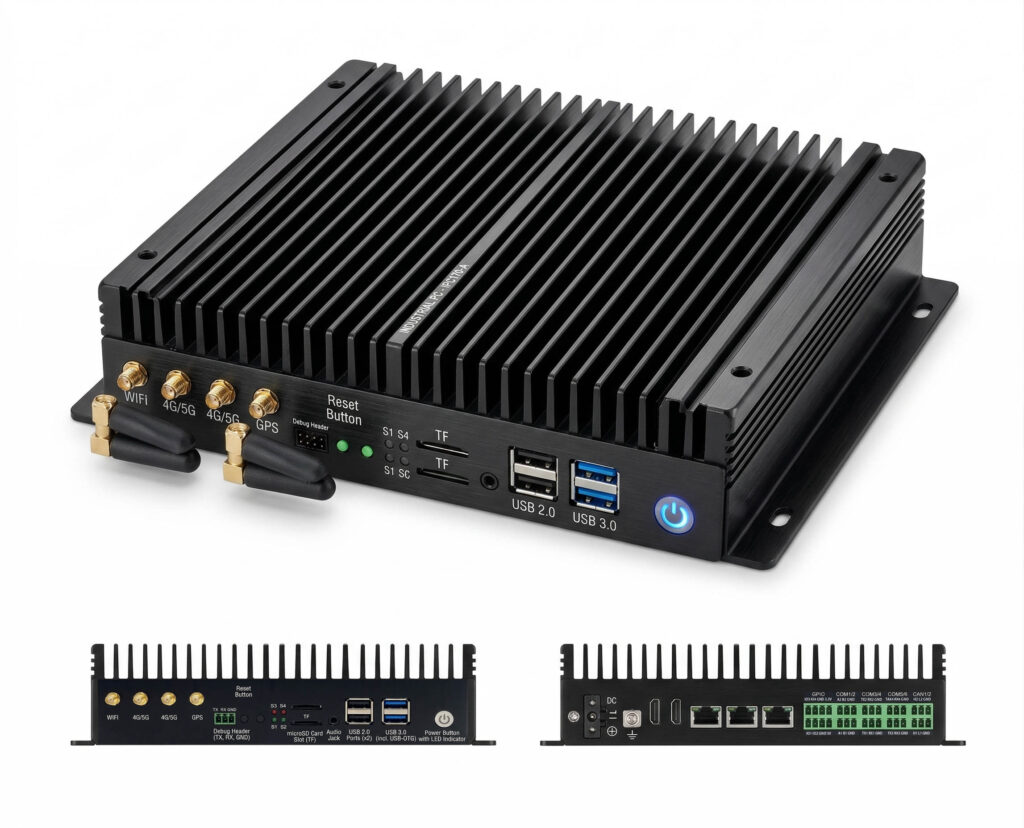
AE-3588BT — 58 TOPS RK3588 edge AI platform with 4000V isolated industrial I/O.