
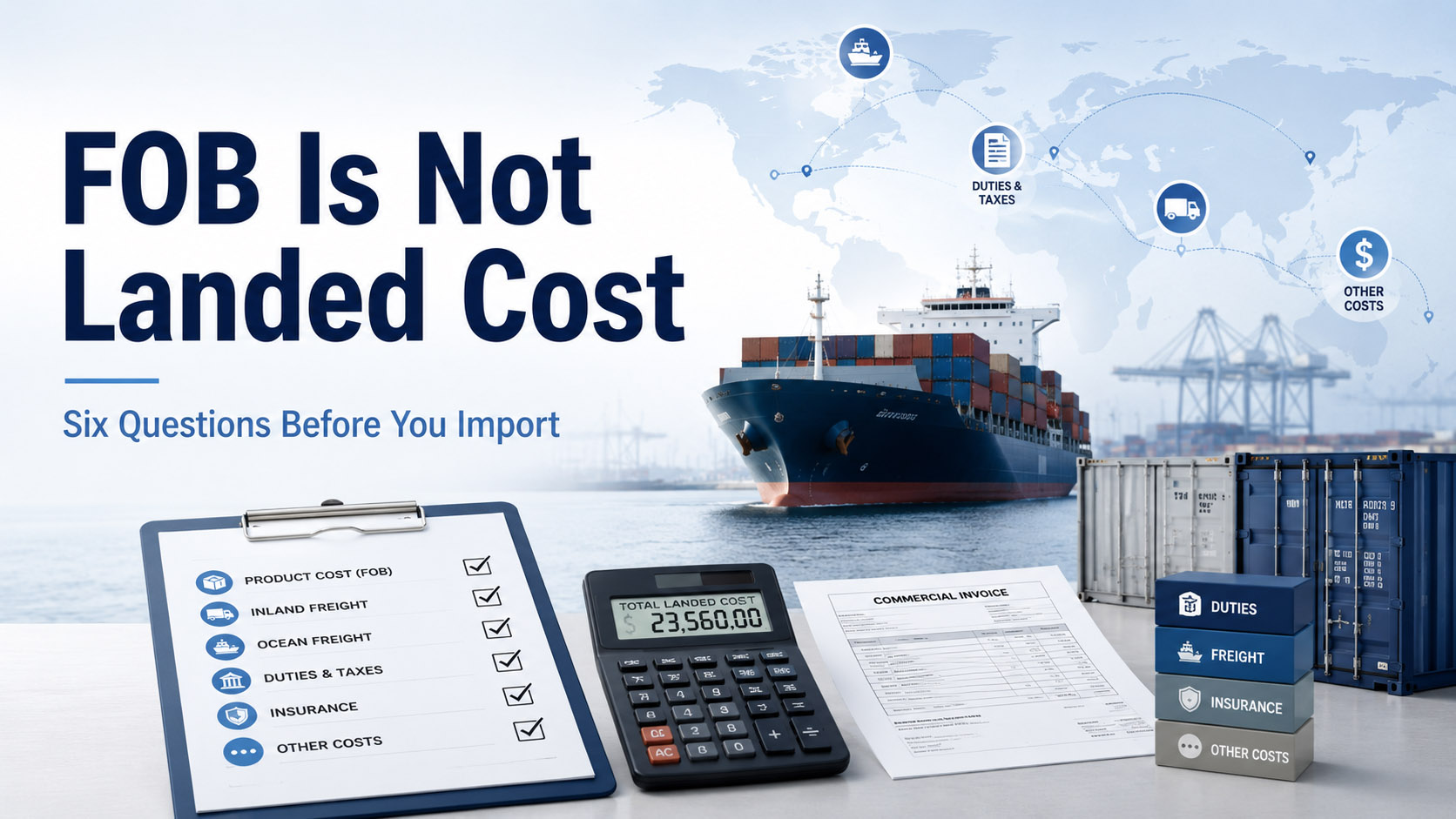
Two quotations arrive for the same specification. One is $612 a unit. One is $684. The cheaper one costs more — not because of quality or hidden fees, but because the two suppliers quoted different things, answered to different obligations, and one of them will hand you a repair problem in eighteen months that never appeared on either quotation.
Below are the six questions that decide whether an overseas supplier is actually cheaper. Ask them of every vendor you evaluate — BITECH included.
1. Which Incoterm is that price quoted under?
An Incoterm is the single line that determines what the number in front of you includes. Under Incoterms 2020, the common ones for hardware are:
The goods, sitting on the supplier’s floor. Everything after — export clearance, haulage, freight, insurance, import clearance, duty, delivery — is yours.
Supplier clears for export and hands the goods to your nominated carrier.
Supplier delivers on board a vessel. FOB is a sea-freight term. “FOB Shenzhen Airport” is loose usage — you are probably looking at FCA.
Supplier covers freight and insurance to the destination port. Import duty and clearance remain yours.
Delivered to your address, but import duty and taxes are still yours.
Everything, including duty, to your door. The maximum obligation on the seller.
The $612 quotation was EXW. The $684 was DAP. Once freight, insurance, brokerage and inland haulage are added, the first is the more expensive of the two — and it also consumed a week of someone’s time arranging them.
What to ask: “Which Incoterm, and to which named place?” An Incoterm without a named place is incomplete. Normalise every quotation to the same term before you compare anything else.
2. Who classifies the goods, and who is liable if it’s wrong?
Every imported item needs a tariff classification — an HS code, extended nationally (HTS in the United States, TARIC in the EU). The code drives the duty rate, and it drives whether the shipment sails through or gets held.
Industrial computers typically fall under heading 8471 — automatic data-processing machines — but the correct subheading depends on the configuration, and panel PCs with integrated displays are not always classified where a box PC is. Devices with wireless modules can attract additional considerations.
In almost every jurisdiction, classification is the importer’s legal responsibility, not the exporter’s. If the code is wrong, it is your company that pays the back-duty and the penalty. The supplier who suggested it is not on the hook.
What to ask: “What classification do you use for this product, and can you put the reasoning in writing?” A supplier who sends you a code with no explanation has given you a liability. A supplier who sends the code, the configuration it assumes, and the reasoning has given your customs broker something to verify.
3. Who absorbs a duty change between order and arrival?
Tariff schedules move. A programme placed today may arrive under a schedule that did not exist when the PO was signed — and on a three-month manufacturing lead time plus five weeks at sea, that gap is real.
Any supplier who quotes you a firm duty rate for a shipment months away is quoting something they cannot control. The honest position is that duty is assessed against the schedule in force on the date of import.
What can be agreed is who absorbs a change. On DDP terms the supplier has taken that exposure — one reason DDP pricing carries a premium. On FOB or DAP, it is yours.
What to ask: “If the applicable duty changes between PO and arrival, who bears it?” Get the answer before you sign. For multi-year programmes, ask whether the contract can be repriced on a duty change rather than left ambiguous.
4. Will the compliance file still exist in year eight?
Most buyers check certification at the point of purchase. Almost nobody asks the harder question.
For hardware going into industrial deployment, the compliance file matters most years later — during a re-audit, a customer’s supply-chain review, a market-surveillance query, or an insurance investigation. At that point you need the original Declaration of Conformity, the test reports it rests on, and the exact configuration they were issued against.
The realistic pack for an industrial computer sold into Europe and the UK:
- CE and UKCA Declarations of Conformity, naming the applicable directives
- EMC test reports — typically EN 61000-6-2 (immunity) and EN 61000-6-4 (emissions) for industrial environments
- RoHS declaration and REACH SVHC statement
- Radio Equipment Directive documentation if the unit ships with a wireless module — a separate regime with its own cybersecurity requirements
- WEEE and battery-regulation obligations — and when you import, you frequently become the “producer” for these purposes
Regulatory scope has been widening — the EU’s Cyber Resilience Act brings products with digital elements into a new obligation set on a phased timeline. Confirm the current position with your notified body rather than with any vendor’s marketing page, this one included.
What to ask: “How long do you retain the test reports and DoCs, and can you reissue them against a specific serial or build revision?” A manufacturer who archives against build revisions can answer an audit in a day. A trading company reselling someone else’s box usually cannot answer at all.
5. What actually happens when one fails in the field?
 This is the question that most often separates the real cost of two suppliers, and it is the one least likely to appear on a quotation.
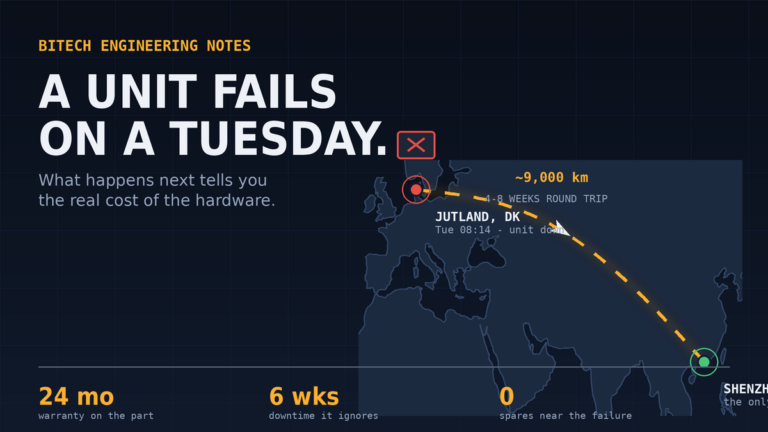
“24-month warranty” tells you nothing useful. The operational question is: a unit fails in a vehicle in Jutland on a Tuesday. What happens next?
If the answer is ship it to Shenzhen, then the honest cost of that failure is four to eight weeks of round-trip transit and customs on both legs — for a device that may be holding a production line or a vehicle out of service. The warranty covered the part. It did not cover the six weeks.
Advance replacement
A replacement ships before the failed unit is returned, so downtime is a courier’s transit rather than a repair cycle.
A regional return point
A repair or swap address inside your own customs territory, removing the international leg entirely.
A consigned spare pool
For fleet and infrastructure deployments, spares held at your site or your integrator’s, replenished on consumption. Downtime becomes minutes.
Board-level diagnosis
Whether the supplier can actually analyse a returned unit and tell you the root cause, or only swap it. On a fleet, that difference is whether you find out failures share a cause.
What to ask: “Describe the physical route a failed unit takes, and how long each leg is.” Not the warranty period — the route. The answer tells you whether the supplier has ever supported hardware at distance, or has only ever shipped it.
6. What happens when the CPU goes end-of-life?
Industrial programmes outlive silicon. A processor with a seven-year supply window will reach end-of-life inside a deployment that runs fifteen years, and at that point one of two things happens.
Either the product was designed so the compute module can be replaced without touching the carrier board, the enclosure, the I/O layout or the certifications — in which case the change is a module swap and a firmware revalidation. Or the compute is soldered to a single board, in which case CPU end-of-life is product end-of-life, and you are re-qualifying and re-certifying a new machine.
Neither approach is wrong. Single-board designs are cheaper and entirely appropriate where the deployment is shorter than the silicon. But you should know which one you are buying, and you should know it before the EOL notice arrives.
What to ask: “What is the platform lifecycle, what is the lifecycle of this specific configuration, and are those the same number?” If a supplier gives one figure for both, press. On a modular architecture they are genuinely different — the carrier and certifications outlive the CPU module. Ask, too, whether you will receive a formal PCN with a last-time-buy window before any component change.
Related reading: SOM + Carrier: Decoupling Compute from I/O
The short version
Copy these into your next RFQ. They take a supplier ten minutes to answer, and the quality of the answers will separate the field faster than the pricing will.
- 1Which Incoterm, to which named place?
- 2What tariff classification do you use, and what is the reasoning?
- 3If duty changes between PO and arrival, who bears it?
- 4How long do you retain DoCs and test reports, and can you reissue against a build revision?
- 5Describe the physical route and duration for a failed unit returning from my territory.
- 6What is the platform lifecycle versus this configuration’s lifecycle, and do I get a PCN with last-time-buy?
A supplier who answers all six quickly and specifically is one who has shipped into your market before. A supplier who answers three of them, vaguely, is one whose learning curve you are about to fund.
The unit price is the easiest number to compare and the least likely to be the one that matters.