
AX-238BT — 4-Display Fanless Industrial PC
Four independent displays. Two CAN buses. Six serial ports. One fanless box.
- 4 genuinely independent displays — LVDS 24-bit, DisplayPort 1.4, HDMI 2.0 and 2× USB4 Type-C with DP Alt Mode, each with its own framebuffer
- Port density as the design goal — 2× CAN, up to 5× COM (COM1/2 BIOS-selectable RS-232/485), 2× 2.5GbE i226-V, 8-bit GPIO
- Dual USB4 at 40 Gbps and 9–36V DC input — display, data and power on one cable; locking Phoenix terminal and remote power on/off for in-vehicle use
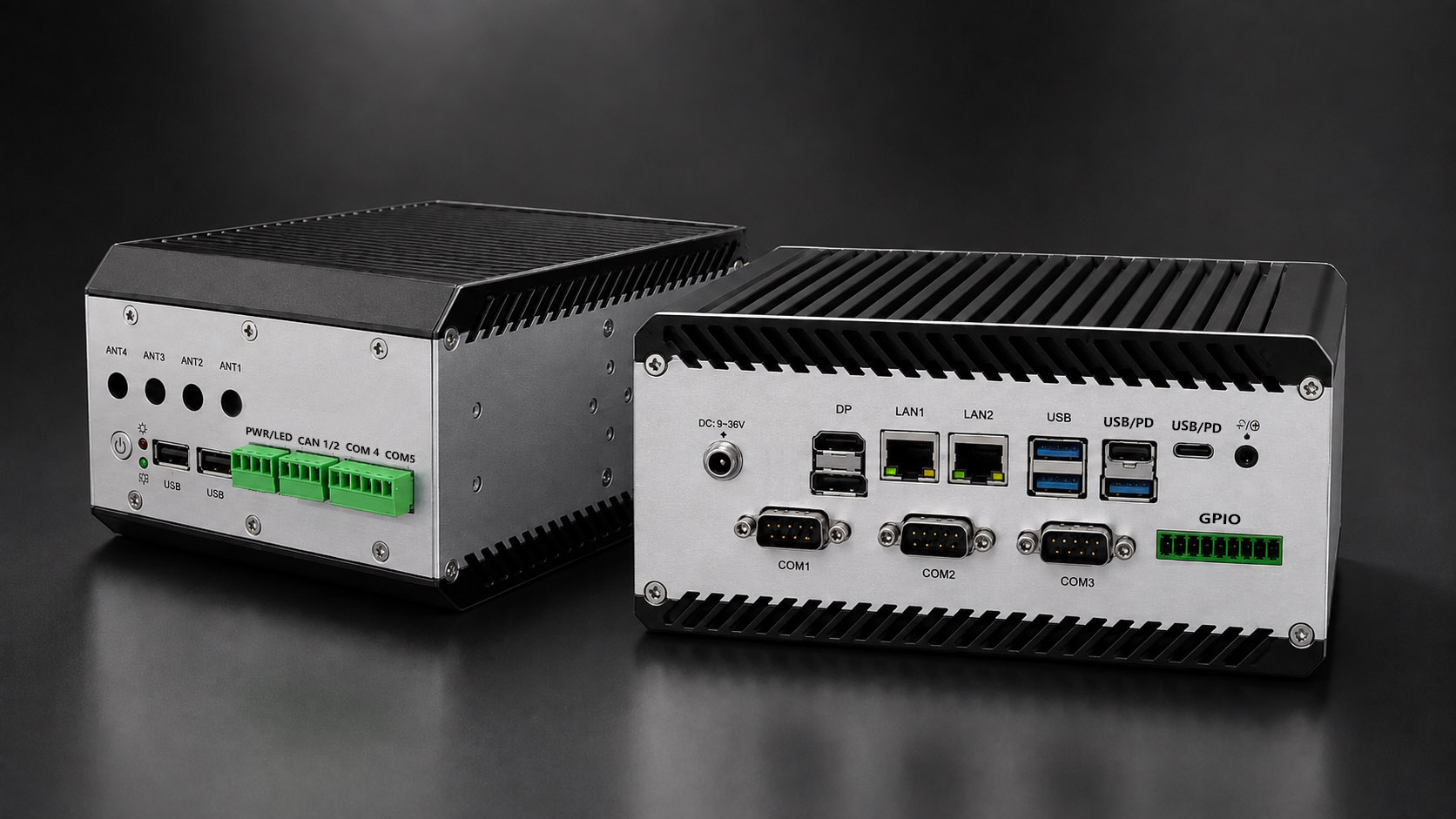
Four screens lit simultaneously — visual evidence of the core capability.
What This Platform Is For
When a single deployment needs to drive an operator HMI, a status wall, a vehicle cockpit display and a diagnostic screen — and talk to a motor bus, a safety controller, and four legacy serial devices at the same time — port count stops being a spec-sheet line and becomes the whole design constraint.
Most industrial box PCs give you two display outputs and call it multi-display. That works until the deployment actually needs four independent screens — and then you are looking at a second PC, a video splitter that breaks independence, or a USB display adapter that adds latency and a failure point.
The AX-238BT is a compact 3.5″ SBC platform in a fanless extruded-aluminium chassis. Each of its four outputs carries its own framebuffer — no mirroring, no splitting, no software compositing overhead.
LVDS/eDP selectable — for an integrated panel
For a high-resolution operator screen
For a standard monitor or signage output
DP Alt Mode — additional screens or a single-cable dock
Where It Fits
Vehicle cockpit and mobile equipment
Wide 9–36V DC input (120W) with a locking Phoenix terminal and remote power on/off covers 12V and 24V vehicle systems directly. Two CAN channels let you separate the drivetrain bus from a body/telemetry bus rather than sharing one and hoping the arbitration works out.
The four display outputs map naturally to a driver display, a task-specific operator screen, a rear-view or camera feed, and a diagnostic terminal — without a second computer in an already-crowded cabin.
For vehicles that see real weather — unheated cabins in winter, sun-loaded dashboards in summer — the extended-temperature configuration (-40°C to +80°C) is chamber-verified per unit before shipment. Fanless construction means there is no air intake to pull in road dust and no fan bearing to fail under continuous vibration.
Multi-screen HMI and control rooms
A single fanless unit replaces two or three separate PCs at an operator station. Six serial ports connect legacy PLCs, barcode scanners, weighing terminals and instrument controllers on one box, with dual 2.5GbE keeping OT and IT traffic on separate controllers.
Machine vision with high-throughput peripherals
Dual USB4 at 40 Gbps is the differentiator here. USB4 carries display, data and power on one connector — a single cable to a camera dock or a capture device that would otherwise need three separate connections. With PCIe 5.0 ×4 M.2 storage and DDR5 up to 96GB (13th Gen), the platform handles high-bitrate capture without the storage becoming the limit.
Digital signage and interactive kiosks
Four independent outputs from one fanless, cable-less unit. No fans means no dust ingress and no bearing failures in an enclosure you would rather not open again for five years.
Key Engineering Highlights
4 Independent Displays
LVDS 24-bit, DP 1.4, HDMI 2.0 and 2× USB4 Type-C — separate framebuffers from Intel Iris Xe 80 EU.
2× Independent CAN
Split motion-control traffic from diagnostics/BMS. Isolated CAN available as an ODM configuration.
5× COM as Standard
COM1/2 BIOS-selectable RS-232/485, COM3–5 RS-232 — no USB-to-serial adapters required.
Dual USB4 40 Gbps
Display, data and power on one connector for camera docks and external NVMe capture.
12th/13th Gen Core U/P
i5-1235U baseline (10C/12T, up to 4.4 GHz), 2× DDR5 SO-DIMM up to 96GB on 13th Gen.
9–36V Wide DC
120W input via Φ5.5×2.5 mm jack or locking Phoenix terminal, plus remote power on/off.
Extended-Temp Option
-20°C to +60°C standard; -40°C to +80°C configuration chamber-verified per unit.
Fanless · Cable-less · Jumper-less
Unibody extruded aluminium heatsink chassis with heavy-duty metal — no fans, no vents, no bearings.
2× 2.5GbE Intel i226-V
Separate controllers keep OT and IT traffic on independent network paths.
Product Photos (For Engineering Evaluation)
Real photos to verify port layout, display outputs, and mounting.
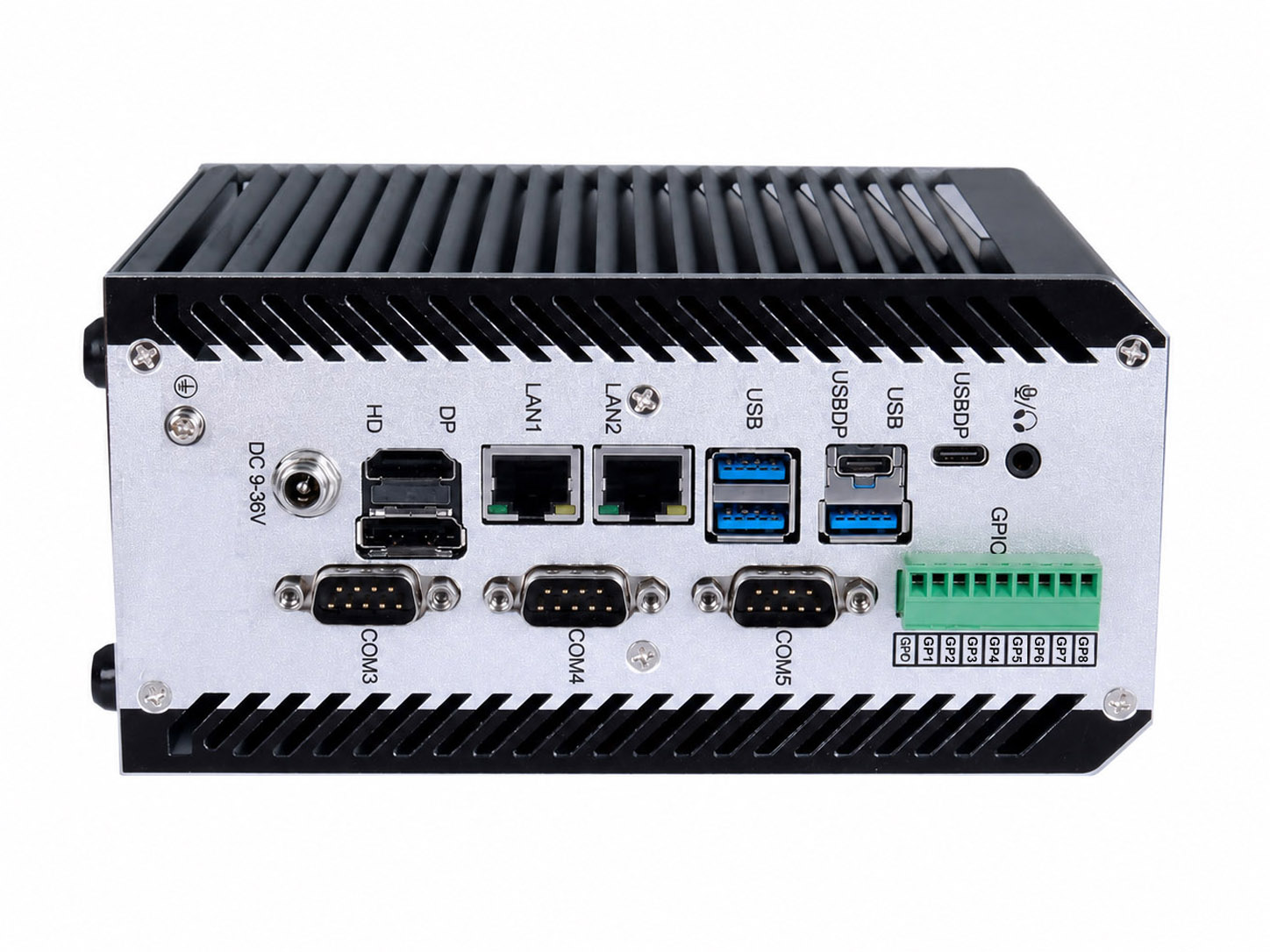
Front I/O Panel (5× COM + 2× CAN)
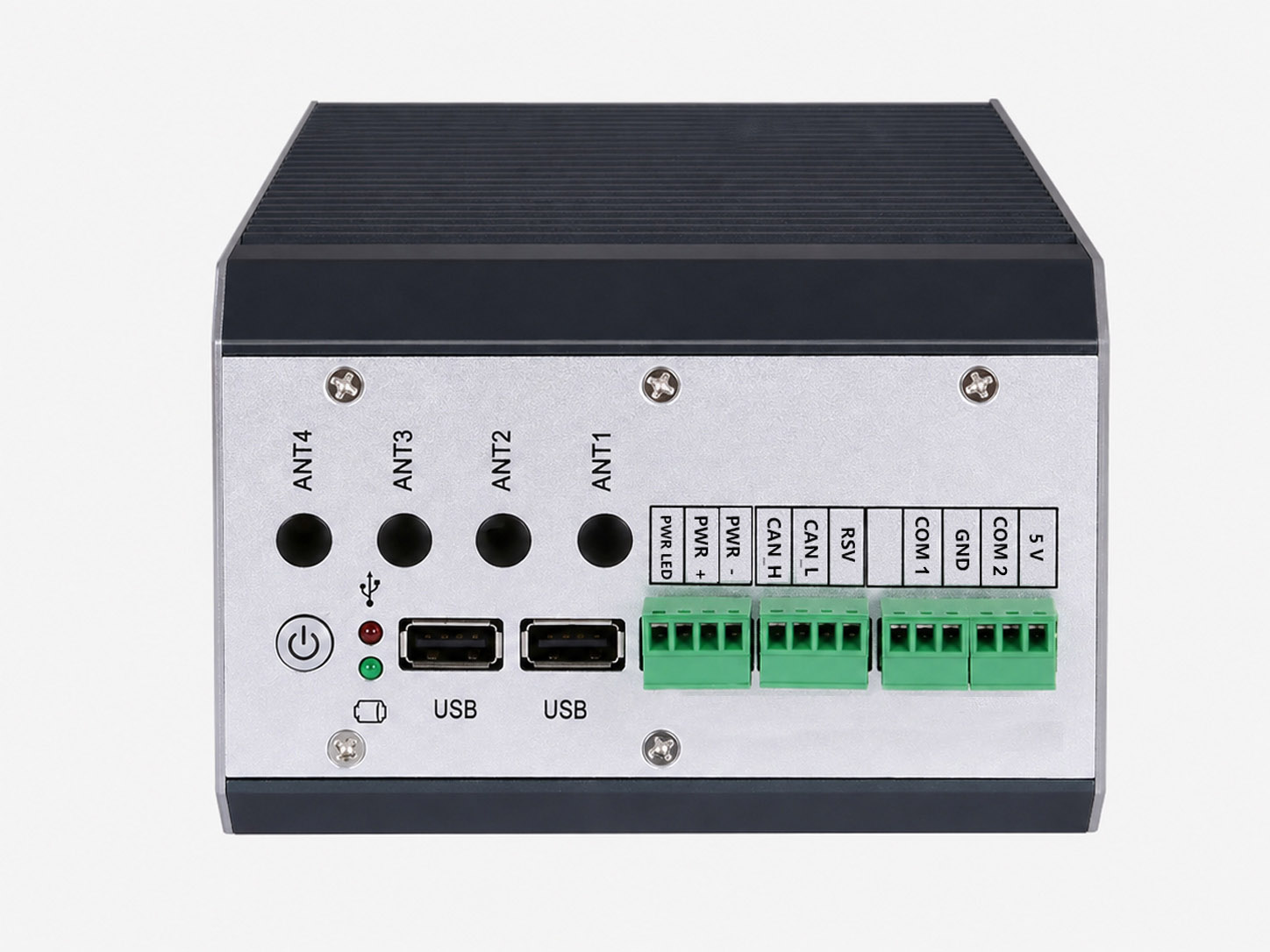
Side Panel (4 Display Outputs)
18-hours Burn-in
Platform Specifications
Processor and Memory
| CPU | Intel Core i5-1235U (12th Gen, 10C/12T, 12MB L3, up to 4.4 GHz Turbo). 12th and 13th Gen Intel Core U and P series supported |
| Base TDP | 15W, configurable 12–28W |
| Max Turbo Power | Up to 55W package peak |
| Graphics | Integrated Intel Iris Xe 80 EU |
| Memory | 2× DDR5 SO-DIMM — up to 64GB (12th Gen) / up to 96GB (13th Gen) |
| Storage | 1× M.2 2280 (PCIe 5.0 ×4) + 1× SATA 3.0 (with 2-pin 5V power) |
| BIOS | AMI BIOS |
| TPM | External TPM 2.0 — optional, not fitted by default |
| OS | Windows 10, Windows 11, Linux |
Display — 4 Independent Outputs
| Output 1 | LVDS 24-bit — LVDS/eDP selectable, build-time option |
| Output 2 | DisplayPort 1.4 |
| Output 3 | HDMI 2.0 |
| Output 4 | 2× USB4 Type-C — DisplayPort Alt Mode + 40 Gbps data |
| Independence | All four outputs use separate framebuffers — no mirroring or splitting required |
Industrial I/O
| CAN | 2× CAN (2.0 mm pitch header) |
| COM | COM1/2: RS-232/485 BIOS-selectable · COM3/4/5: RS-232 |
| LAN | 2× 2.5GbE, Intel i226-V |
| USB | 2× USB 3.0 Type-A + 2× USB4 Type-C (40 Gbps + DisplayPort) |
| GPIO | 1× 8-bit GPIO, expandable |
| Audio | Line-out / mic via codec |
| Expansion | 2× USB 2.0 pin headers (2×5-pin, 2.0 mm pitch) |
Wireless and Expansion
| 4G / 5G | 1× M.2 B-Key (USB 2.0 + USB 3.0 + PCIe) — 4G/5G modem or SSD |
| Wi-Fi / BT | 1× M.2 E-Key (USB 2.0 + PCIe) |
Power
| Input | DC 9–36V, 120W |
| Connectors | Φ5.5×2.5 mm DC jack + 1× Phoenix terminal |
| Remote control | 1× remote power on/off, 2-pin terminal block |
Environment and Mechanical
| Operating temperature | Standard: -20°C to +60°C, verified at 100% CPU and 2D/3D graphics load (PassMark BurnInTest) with no thermal throttling Extended-temperature configuration: -40°C to +80°C, chamber-verified per unit |
| Storage temperature | -40°C to +85°C |
| Humidity | 5–90% operating; 95% RH @ 70°C non-condensing |
| Shock | 15G, 11ms |
| Vibration | 5–500Hz, 1 Grms |
| Dimensions | 210 x 150 x 70 mm |
| Weight | 1.8kg |
| Mounting | Wall / Side / DIN-Rail / VESA |
| Construction | Fanless, cable-less, jumper-less unibody extruded aluminium with heavy-duty metal |
| Certification | CE, FCC, RoHS, ISO 9001. Conforms to IEC 61000-3-2 and IEC 61000-3-3 |
Specifications reflect the AX-238BT engineering datasheet. Field-testing and configuration validation are recommended for every new deployment; request the engineering package for mechanical drawings and test reports.
Quality and Lifecycle
Every AX-238BT passes 100% 18-hour power-on burn-in under load with full serial-number traceability, plus AQL-audited assembly consistency.
- Warranty — 24 months for the complete unit
- Technical support — lifetime support for OS, BIOS and firmware updates, and CAN / RS-485 / PLC debugging
- Platform lifecycle — 7+ years for the AX series modular x86 platform, backed by Fixed BOM Control (no silent component substitutions) and formal Product Change Notification with a 6-month notice period and last-time-buy window
OEM / ODM
| MOQ | 100 units for light customization |
| NRE | Quoted upfront, refundable at 2,000 units |
| Lead time | 35 days for light customization; NRE projects quoted per requirement |
Light customization scope: I/O layout changes, wireless module pre-integration, storage upgrades, front-panel branding, preloaded system images for volume projects.
Platform: scalable 3.5″ SBC (102 \times 146mm) with optional SDK and OS customization for faster system integration.
Build-time options configured per project: TPM 2.0 module, LVDS/eDP selection, wireless modules, isolated CAN / COM, extended-temperature configuration.
Product FAQ
Frequently asked questions
Display independence, CAN topology, voltage range, thermal envelope and lifecycle — the questions integrators ask before spec-in.
Can the AX-238BT really drive four displays independently?
Yes. The four outputs — LVDS 24-bit, DisplayPort 1.4, HDMI 2.0, and USB4 Type-C with DisplayPort Alt Mode — each carry an independent framebuffer from the Intel Iris Xe 80 EU graphics engine. There is no mirroring, splitting, or software compositing: each screen runs its own resolution and content.
Note that LVDS/eDP is a build-time selection, and the second USB4 port can be used for data instead of display if the deployment needs three screens plus a high-throughput peripheral.
What is the difference between the two CAN channels on the AX-238BT?
Both are full CAN channels on 2.0 mm pitch headers and they are electrically independent. The typical deployment pattern is to dedicate one channel to the safety-critical or motion-control bus and the other to diagnostics, battery management, or body electronics — keeping non-real-time traffic from adding jitter to the control path.
For deployments where the CAN bus crosses ground references — vehicle chassis segments, motor drives, or long cable runs — galvanically isolated CAN rated to 4000V withstand is available as an ODM configuration.
Why does an industrial PC need USB4?
Two reasons. First, bandwidth: 40 Gbps handles high-bitrate camera capture or external NVMe storage that would saturate USB 3.2.
Second, cable count: USB4 Type-C carries display, data and power on one connector, so a docking station or camera module that would otherwise need three separate cables runs on one. In a vehicle cabin or a cramped control cabinet, cable count often matters more than raw bandwidth.
What voltage range does the AX-238BT accept, and is it suitable for vehicles?
DC 9–36V at 120W, via either a Φ5.5×2.5 mm jack or a locking Phoenix terminal, with a 2-pin remote power on/off terminal block. This covers 12V and 24V vehicle systems across their full charge and discharge range.
For 48V systems — where charging can spike to 58V — an external DC-DC step-down or an ODM variant with a higher-tolerance input stage is required. A 9–36V module cannot ride through 48V charging transients.
How many serial devices can the AX-238BT connect?
Five. COM1 and COM2 are BIOS-selectable between RS-232 and RS-485, so they can serve either a point-to-point instrument or a multi-drop RS-485 network. COM3 through COM5 are RS-232.
This covers deployments integrating legacy PLCs, barcode scanners, weighing terminals, printers and instrument controllers on a single unit — without USB-to-serial adapters. Galvanically isolated COM is available as an ODM configuration.
Is the AX-238BT fanless?
Yes, fanless as standard. The unibody extruded-aluminium chassis acts as the heatsink — no fans, no vents to admit dust, no bearings to fail. The platform is verified at 100% CPU and 2D/3D graphics load with no thermal throttling in this configuration.
The 3.5-inch SBC does carry fan headers on the board (1× 4-pin PWM CPU, 1× 3-pin system) for OEM customers integrating the SBC into their own actively-cooled enclosure. These are unpopulated in the standard boxed AX-238BT.
What operating temperature range does the AX-238BT support?
Two configurations:
- • Standard: −20°C to +60°C — verified at 100% CPU and 2D/3D graphics load with no thermal throttling under PassMark BurnInTest. Suits temperature-controlled cabins, indoor HMI stations and general industrial deployment.
- • Extended-temperature: −40°C to +80°C — industrial-grade storage and extended-range peripherals, chamber-verified per unit with cold-soak boot at −40°C and sustained full-load operation at +80°C.
Storage range is −40°C to +85°C in both configurations. Extended temperature is a build-time selection, not a field upgrade.
What is the memory ceiling on the AX-238BT?
Two DDR5 SO-DIMM slots supporting up to 64GB with 12th Gen Intel Core processors and up to 96GB with 13th Gen.
The higher ceiling on 13th Gen suits in-memory workloads such as large vision buffers, multi-stream video capture, or virtualized OT and IT separation on a single box.
How does the AX-238BT differ from the AX-234BT?
They are different branches, not upgrade steps.
The AX-234BT is the edge AI platform: 13th Gen i5-1345U with Iris Xe for OpenVINO inference, one CAN channel and two COM ports, sized for vision and AOI workloads.
The AX-238BT is the multi-display and multi-port platform: four independent displays, two CAN channels, six COM ports, dual USB4 at 40 Gbps, and DDR5 up to 96GB, sized for HMI walls, vehicle cockpits and legacy serial integration.
Choose the AX-234BT when the workload is inference-heavy; choose the AX-238BT when port count and display count are the binding constraint.
What is the platform lifecycle and OEM minimum order quantity?
The AX series modular x86 platform carries 7+ years availability, backed by Fixed BOM Control with no silent component substitutions, and formal Product Change Notification issued 6 months in advance with a last-time-buy window.
Light customization — I/O layout changes, wireless module pre-integration, storage upgrades, front-panel branding and preloaded system images — is supported from MOQ 100 units, with NRE quoted upfront and refundable at 2,000 units, and approximately 35-day lead time.
Question not answered here? Our hardware engineers reply within 2 business days.
Ask an engineerRelated
Platforms, deployments and engineering behind this spec
Compare the adjacent platform, see where four displays and dual CAN actually deploy, and dig into the engineering that makes the numbers hold.
AX-234BT Edge AI Computer
13th Gen i5-1345U with Iris Xe for OpenVINO inference. Fewer ports, more compute — the other branch of this platform. Choose it when the workload is vision, not integration.
Compare platforms Product RangeAll Industrial Box PCs
The full AX and AE range: modular x86 with 7+ year availability, ARM edge AI platforms, and GPU-accelerated systems for heavier inference workloads.
Browse the range SolutionVehicle-Mounted & Fleet Computing
Where four displays and two CAN channels earn their keep: driver display plus task screen plus camera feed, on separate drivetrain and telemetry buses.
Explore vehicle platform SolutionMachine Vision & AOI
USB4 at 40 Gbps carries capture, display and power on one cable. Six COM ports handle triggers, lighting controllers and reject actuators without USB-serial adapters.
Explore vision platform EngineeringPowering an Industrial PC in a Vehicle
What 9–36V wide input actually has to survive: cranking droop, load dump to ISO 7637-2, and ignition control that stops the PC before it drains the battery.
Read the guide EngineeringIsolated vs Non-Isolated I/O
The AX-238BT ships non-isolated as standard, with isolated CAN and RS-485 as an ODM option. This is the decision framework for which one your deployment needs.
Read the guideNeed a configuration that is not on this page?
Isolated CAN, extended temperature (−40°C to +80°C), custom I/O layout, preloaded system images. MOQ 100 units, 35-day lead time for light customization.