
Fanless Compute Zone · Intel Core i7 · RTX MXM · Remote Radiator
AE-960EBT: Liquid-Cooled MXM Edge AI Computer
AE-960EBT uses a fanless compute-zone architecture. Heat from the CPU and MXM GPU is captured directly by liquid cold plates and transported through the coolant loop to an external radiator, where external fans reject the heat to the environment.
This architecture avoids fan-driven airflow passing directly through the motherboard, CPU, GPU, memory and other compute electronics, making it suitable for mobile, enclosed and airflow-constrained industrial systems running sustained Edge AI workloads.
AE-960EBT does not eliminate fans — it moves them out of the compute zone and into the external heat-rejection zone.
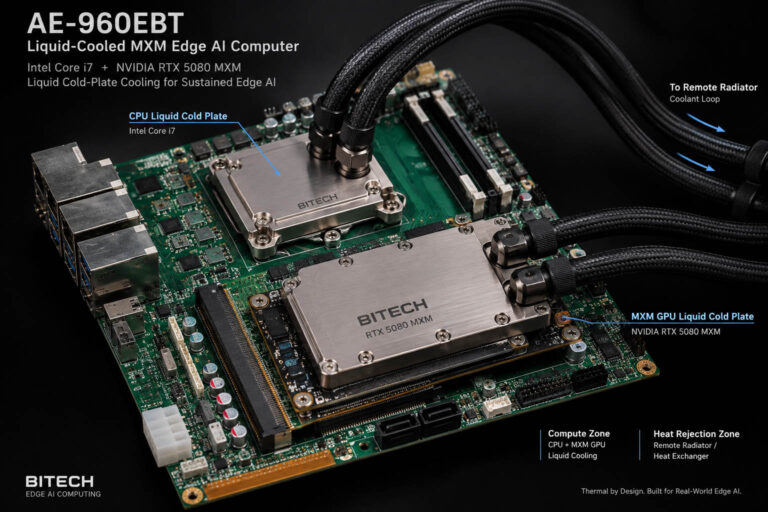
Reserved for a verified product photo. Current cooling visuals are engineering concepts; final hardware may vary.
Confirmed Architecture and DVT Status
The base compute and liquid-cooling architecture is confirmed. Final GPU TGP, industrial I/O configuration, radiator specification, operating temperature and mechanical dimensions remain under DVT validation.
| Item | Status / configuration |
|---|---|
| CPU platform | Intel Core i7 Platform — exact model under final platform validation |
| GPU architecture | NVIDIA RTX MXM |
| Launch validation target | RTX 5080-class MXM Module — 16GB GDDR7 |
| Maximum validated GPU TGP | 140W |
| Memory | 64GB DDR5 5600MHz |
| Storage | 512GB M.2 2280 NVMe 4.0 |
| LAN / PoE | 6x 2.5GbE LAN, POE option |
| USB | 4x USB4.0 |
| Serial / CAN / DIO | 4 x COM, 2 x CAN FD, 8x DIO |
| Power input | Under engineering validation for the complete CPU, GPU, pump and fan load |
| Compute-zone cooling | Fanless; CPU and GPU liquid cold plates |
| Heat rejection | Remote radiator / heat exchanger with external fans |
| Operating temperature | 0 °C to +50 °C |
| Dimensions | 300 x260 x 110 mm |
| OS support | Windows 11 Pro, Ubuntu |
How AE-960EBT Implements Liquid Cooling
The CPU and MXM GPU transfer heat into dedicated liquid cold plates. A coolant loop moves that heat out of the fanless compute zone to a remote radiator, where external fans reject it.
Fanless compute zone + remote heat rejection
Fanless compute zone
Intel Core i7 + NVIDIA RTX MXM · no internal cooling fan
CPU / GPU cold plate
Coolant loop moves the thermal load
Remote heat-rejection zone
Radiator / heat exchanger + external cooling fans
Engineering concept — prototype under validation
Cooling direction by deployment condition
| Project requirement | Cooling direction |
|---|---|
| Clean airflow available | Active air cooling may be simpler |
| No internal airflow desired | Conduction or liquid cooling |
| High sustained GPU load + remote heat rejection | AE-960EBT liquid architecture |
Intel Core i7 and NVIDIA RTX MXM Form One Validated System
MXM is modular, but it is not universally plug-and-play. The module, power budget, BIOS, cold-plate contact and sustained thermal capacity must be qualified together.
Intel Core i7
Exact CPU, cores, frequency and power settings require confirmation.
NVIDIA RTX MXM
GPU options, VRAM and maximum validated TGP require confirmation.
Memory & Storage
Memory type, capacity and storage interfaces require confirmation.
Validated Configuration
BIOS, driver, power, mechanical contact and sustained load are released together.
Configuration qualification chain
Where AE-960EBT Fits in Industrial Edge AI
Agricultural Machinery
Multi-camera crop, weed and obstacle detection where dust and limited clean airflow complicate GPU cooling.
Autonomous & Heavy Machinery
GPU perception and machine automation inside mobile or enclosed equipment.
Vehicle & Mobile AI
Multi-camera inference and sensor processing under sustained GPU load in compact installations.
Machine Vision & AOI
RTX-accelerated detection, segmentation and inspection over long production cycles.
Roadside & Transportation Vision
Continuous local detection, classification and event analytics in enclosed cabinets.
Maritime & Remote Equipment
Vision analytics where the computing and heat-rejection zones need physical separation.
For aviation positioning, use Airport / Ground Equipment unless aircraft onboard certification requirements have been addressed for the project.
Size the Complete Vision Data Path, Not the GPU Alone
Camera count, resolution, FPS, decode load, model complexity, inference throughput and end-to-end latency all belong in the sizing decision.
Industrial I/O requires final hardware verification
Networking
Ethernet port count and speeds · PoE option and exact port count — pending engineering confirmation.
Camera & Peripheral
USB configuration · Connector functions · PCIe expansion — pending engineering confirmation.
Industrial Communication
RS232 · RS485 · CAN / CAN FD · Digital I/O · Isolation level — pending engineering confirmation.
Display
HDMI · DisplayPort · USB-C display — pending engineering confirmation.
Wireless
Wi-Fi / Bluetooth · 4G / 5G · GNSS — pending engineering confirmation.
What We Will Validate During DVT
A short benchmark does not show behavior after hours of inference. CPU, MXM GPU, cold plates, coolant loop, radiator, external fans and the application workload must be tested together.
Sustained CPU + GPU load
Production-equivalent combined workload, not a short peak benchmark.
GPU thermal behavior
GPU temperature, clock stability and thermal throttling.
Coolant loop
Inlet and outlet temperatures, flow stability and cold-plate contact.
Remote heat rejection
Radiator performance and external-fan operation at the specified ambient.
Sustained AI throughput
Inference throughput at test start and after thermal stabilization.
Camera and network load
Concurrent acquisition, decode and transfer where applicable.
Power stability
Complete CPU, GPU, pump and radiator-fan load.
Recovery behavior
Unattended restart, watchdog and recovery requirements where supported.
DVT results will be published after the liquid-cooled prototype completes validation.
AE-760EBT or AE-960EBT: Start with the Thermal Environment
Two GPU-class Edge AI computers begin from different heat-rejection strategies.
| Engineering factor | AE-760EBT | AE-960EBT |
|---|---|---|
| CPU | Core i9-13900 | Intel Core i7 Platform |
| GPU | RTX MXM | RTX MXM |
| Cooling | Active chassis air cooling | Fanless compute zone + liquid cold plates |
| Heat rejection | At the computer chassis | Remote radiator / heat exchanger |
| Primary goal | High-performance general Edge AI | Thermal / machine integration |
| Typical environment | Factory / cabinet / control room | Mobile / enclosed / airflow-constrained machinery |
| Main selection factor | Compute workload | Compute workload + thermal environment |
If reliable clean airflow is available around the computer, AE-760EBT is generally the simpler architecture. AE-960EBT is intended for projects where fan-driven airflow should be kept away from the compute electronics and heat can be rejected remotely.
OEM / ODM Thermal and Mechanical Design
Liquid cooling is a system design, not a standalone CPU cooler. GPU power, CPU power, enclosure volume, mounting orientation, ambient temperature, coolant path and radiator location must be reviewed together.
Request an AE-960EBT Engineering ReviewGet an AE-960EBT engineering review
High-GPU workload inside a difficult thermal environment?
Don't start from the GPU module. Send us the CPU/GPU workload, camera topology, ambient temperature, enclosure constraints and duty cycle, and BITECH engineering reviews the compute and thermal architecture together — as one system, not a board plus a cooler.
Send us the project
- Application & AI model / framework
- CPU-side software (OS, comms, logging)
- Camera count, resolution & FPS
- Ambient operating temperature
- Installation location & radiator mounting space
- Duty cycle & sample / annual quantity
We review and return
- MXM GPU recommendation & power budget
- Cold-plate / radiator / coolant-loop architecture
- Sustained thermal validation plan
- Industrial I/O configuration
- A sample configuration — or AE-760EBT if liquid cooling isn't needed
Compute + thermal reviewed as one system · sustained-load validated · OEM/ODM cold-plate & enclosure customization · sample evaluation available
AE-960EBT · Liquid-Cooled MXM
Frequently asked questions
-
AE-960EBT is designed for Edge AI applications that combine discrete MXM GPU computing with constrained airflow or machine-integration requirements — sealed compartments, mobile machines and dusty environments where conventional fans struggle.
-
Liquid cooling moves CPU and GPU heat toward a remote heat exchanger, reducing dependence on airflow directly around the computing electronics — useful when the compute zone can't get clean, sufficient airflow.
-
The compute-side cooling architecture uses liquid cold plates. Whether the complete system uses radiator fans depends on the final thermal configuration for the project.
-
Not claimed by default. IP protection depends on the final enclosure, connectors, cable interfaces and project validation. An IP rating should only be specified for a validated mechanical configuration.
-
MXM GPU support depends on module dimensions, power requirement, firmware and cold-plate compatibility. BITECH validates the selected MXM configuration before production — it isn't a fixed universal list.
-
Yes. The x86 CPU and discrete NVIDIA MXM GPU architecture is suitable for CUDA/TensorRT-based machine vision workloads, subject to camera bandwidth, model and latency requirements.
-
The cooling architecture can be designed with remote heat rejection. Final tube length, radiator position, pump/loop design and mounting arrangement should be reviewed for the specific project.
-
Yes. OEM/ODM options can be reviewed according to project volume, I/O requirements, thermal architecture and mechanical constraints.
Compare & Go Deeper
Where the AE-960EBT fits against other BITECH edge-AI platforms, the deployments it's built for, and the engineering reasoning behind its design.
Compare platforms
AE-760EBT — Air-Cooled Core i9 + RTX MXM
Dual-fan active cooling instead of a liquid loop — the platform to compare against when the enclosure allows airflow.
Compare platform → ProductAE-NJ60BT — Jetson Orin NX, Unified Memory
When a discrete MXM GPU module is more than the workload needs — a lower-power, unified-memory alternative.
Compare platform → CategoryEdge AI Industrial Computers — Full Range
RK3588, Jetson, and RTX MXM platforms side by side — browse the full edge-AI lineup.
View category →Where it deploys
AMR Controller Solutions
GPU-class onboard compute for autonomous mobile robot navigation and perception.
Explore the solution → SolutionVehicle-Mounted Industrial PC
Sealed, thermally-managed compute for GPU workloads running inside a vehicle enclosure.
Explore the solution → SolutionMachine Vision & AOI
Multi-camera inspection lines where GPU headroom and sustained thermal performance decide throughput.
Explore the solution → SolutionIndustrial ODM
Custom GPU-class platform development when the AE-960EBT's baseline configuration needs to be engineered around your enclosure.
Explore the solution →Engineering & insights
MXM vs Desktop GPU for Edge AI Computers
Why the AE-960EBT uses an MXM module rather than a desktop card — the form-factor and thermal-path trade-off.
Read the guide → InsightsAir vs Liquid Cooling for Edge AI Computers
When sustained GPU thermal load pushes past what an air-cooled chassis can hold — the case for the AE-960EBT's liquid loop.
Read the guide → InsightsThermal Throttling in Edge AI Systems
How to recognize and diagnose throttling under sustained inference load — the failure mode liquid cooling is engineered to avoid.
Read the guide → InsightsHow to Size an Industrial PC for Multi-Camera Vision
A data-path sizing method for matching camera count and throughput to GPU memory and compute headroom.
Read the guide → EngineeringIndustrial PC Design Guide: EMC, Standards and Environmental Ratings
The EMC, environmental, and conformal-coating standards a GPU-class platform is validated against before it ships.
Read the guide → EngineeringDVT Validation Lab
How the AE-960EBT's current DVT-stage testing works — the process behind every spec on this page still marked pending.
Read the guide → EngineeringIndustrial PC OEM / ODM: How a Custom Program Runs
Requirement review through EVT/DVT/PVT to mass production — the same process gating the AE-960EBT's own release.
Read the guide →