
Edge AI Industrial Computers
Industrial-Grade AI Platforms for Real-Time Inference at the Edge
Edge AI computers are designed for real-time AI inference close to machines and sensors—where latency, reliability, and data privacy matter. Built for continuous operation in industrial environments with fanless thermal design, isolated I/O, and validated NPU performance.
Scalable Edge AI Platforms: RK3588, NVIDIA Jetson & RTX GPU MXM series
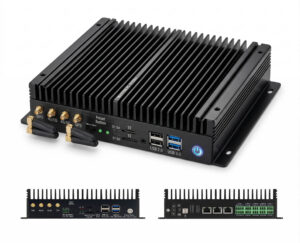
AE-3588BT
58 TOPS Scalable Industrial Edge AI Computer for Energy & Semiconductor
- Up to 58 TOPS (6 onboard + 52 expansion)
- 4000V isolated CAN/RS232/RS485/GPIO
- Wide temp: -40°C to +80°C
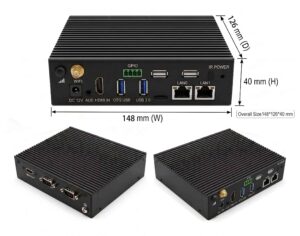
AE-3588LBT
32 TOPS Scalable Edge AI for AOI, AGV/AMR & Smart City
- Up to 32 TOPS (6 onboard + 26 expansion)
- Non-isolated low-latency fieldbus I/O
- Fanless design: -40°C to +80°C
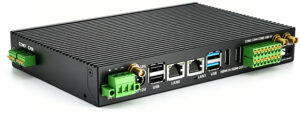
AE-3588NBT
6 TOPS RK3588 Gateway for Vision Automation & Smart Infrastructure
- 6 TOPS onboard NPU, INT4/INT8/INT16/FP16
- HDMI 2.1 8K Out + HDMI 2.0 4K In
- Cost-effective: -10°C to +60°C
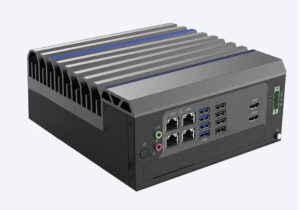
AE-NJ60BT
157 TOPS NVIDIA Jetson Orin NX Super Edge AI for Multi-Camera Vision & AMR
- Up to 157 TOPS (Jetson Orin NX Super 16GB)
- 4-lane MIPI CSI or 4× GMSL2 camera ingress
- 4× GbE + 2× CAN FD, -40°C to +70°C fanless
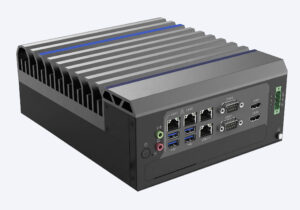
AE-760EBT
x86 Edge AI Box PC — Intel i9-13900 + NVIDIA RTX MXM Discrete GPU
- Up to 80+ TFLOPS (RTX 4060/4070/4090/5080/5090 MXM)
- 4× 2.5GbE + 2× CAN FD + isolated DIO/COM
- 9–36V wide voltage, dual 80 mm industrial fans
Edge AI Compute Platform Comparison: RK3588 vs NVIDIA Jetson Orin vs NVIDIA RTX MXM GPU
Three dominant silicon classes power industrial Edge AI today. The right choice depends on AI compute class (TOPS / TFLOPS), software ecosystem, power envelope, and operating temperature. Use this engineer-oriented matrix to match your inference workload to the correct platform before specifying I/O and chassis.
| Engineering Factor | Rockchip RK3588 / RK3588J (ARM) | NVIDIA Jetson Orin (ARM + GPU) | NVIDIA RTX MXM Discrete GPU (x86) |
|---|---|---|---|
| Architecture | 8-core ARM (4× A76 + 4× A55) + 6 TOPS NPU | ARM Cortex-A78AE + Ampere CUDA GPU + Tensor Cores | Intel Core i7/i9 (12th–14th Gen) + RTX 4060/4070/4090/5080/5090 MXM |
| AI Compute | 6 TOPS onboard, scalable to 32–58 TOPS via M.2 NPU | 40 / 100 / 157 / 275 TOPS (Orin Nano → AGX Orin 64GB) | Up to 80+ TFLOPS FP16 / 1300+ TOPS INT8 (RTX 5090 class) |
| Software Ecosystem | Linux / Android, RKNN Toolkit, ROS2, OpenCV | NVIDIA JetPack, CUDA, TensorRT, DeepStream, Isaac | Windows / Linux, full CUDA, TensorRT, PyTorch, Triton, LLM stacks |
| Typical Power | 8–25 W (fanless) | 15–60 W (fanless or low-noise) | 120–450 W (active cooling required) |
| Thermal Design | Fanless, -40°C to +80°C | Fanless, -40°C to +70°C | Industrial fans, -20°C to +60°C |
| Vision Ingress | MIPI CSI + USB cameras | MIPI CSI + GMSL2 (long-distance, EMI-resistant) | GigE Vision / 10GbE / USB3 Vision via PCIe |
| Best-Fit Workload | Edge gateway, lightweight vision, control + light AI, HMI | Multi-camera vision, AMR/AGV perception, autonomous driving | Generative AI, edge LLM, heavy multi-stream AOI, SCADA + AI |
| OS / Legacy Support | Linux / Android only | Ubuntu Linux (JetPack) | Windows 10/11 IoT, Linux — full legacy x86 compatibility |
| BITECH Models | AE-3588BT, AE-3588LBT, AE-3588NBT | AE-NJ60BT | AE-760EBT |
Choose RK3588 when
Cost, power budget, and long ARM Linux lifecycle dominate. Workload ≤ 32 TOPS — field gateways, control nodes, HMI + light vision.
Choose Jetson Orin when
Multi-camera vision, GMSL2 ingress, CUDA / TensorRT toolchain, and fanless wide-temp deployment for AMR / AGV / autonomous systems.
Choose RTX MXM GPU when
Workload requires Windows compatibility, edge LLM / generative AI, or 80+ TFLOPS for heavy multi-stream AOI and SCADA + AI convergence.
Why Industrial Environments Require Dedicated Edge AI Hardware?
Edge AI industrial computers are engineered for specific workloads—not generic compute.
Machine Vision & Inspection
Task: Run multi-camera defect detection at production speed
Why it matters: Inspection cycles require deterministic latency—cloud round-trips introduce unacceptable variance.
Platform benefit: Stable USB3/GigE bandwidth, NPU-optimized inference, and vision-ready I/O layout.
Real-Time AI Inference at the Edge
Task: Make decisions in milliseconds, not seconds
Why it matters: Robotics, AGVs, and safety systems cannot tolerate network delays or cloud outages.
Platform benefit: Sub-100ms inference latency with no dependency on external connectivity.
Isolated I/O and Fieldbus Integration (CAN, RS485)
Task: Connect AI to PLCs, sensors, and legacy equipment
Why it matters: AI systems must coexist with existing fieldbus infrastructure, not replace it.
Platform benefit: Isolated CAN, RS232/485, and industrial Ethernet for direct equipment integration.
Fanless Thermal Design for 24/7 Reliability
Task: Run inference workloads around the clock without degradation
Why it matters: Consumer hardware throttles under sustained load; production lines cannot afford downtime.
Platform benefit: Fanless thermal design validated for continuous AI inference at full load.
Long Lifecycle & Scalable Deployment
Task: Deploy the same platform across hundreds of sites
Why it matters: OEM projects require BOM stability and availability commitments, not consumer product cycles.
Platform benefit: 10 year availability, PCN/EOL management, and configuration freeze support.
Edge AI Industrial Computers vs Standard Industrial Box PCs
Edge AI Industrial Computers
- Designed specifically for AI inference workloads
- Validated thermal design for sustained NPU/GPU operation
- Vision- and sensor-optimized I/O layout
- Stable AI performance under continuous 24/7 load
- Pre-validated AI framework support (TensorFlow, ONNX, PyTorch)
Best for: Machine vision, inspection, robotics, edge analytics
Standard Industrial Box PCs
- General-purpose control and gateway tasks
- AI capability is optional or add-on based
- I/O optimized for automation, not vision
- Not validated for sustained inference workloads
- May require additional software integration
Best for: PLC control, data acquisition, industrial gateways
Typical Edge AI Applications
Automated Optical Inspection (AOI)
Real-time defect detection on production lines with multi-camera integration.
Robotics & Autonomous Systems
Low-latency perception and decision-making for AGVs and robotic arms.
Intelligent Transportation
Vehicle recognition, traffic analysis, and fleet monitoring at the edge.