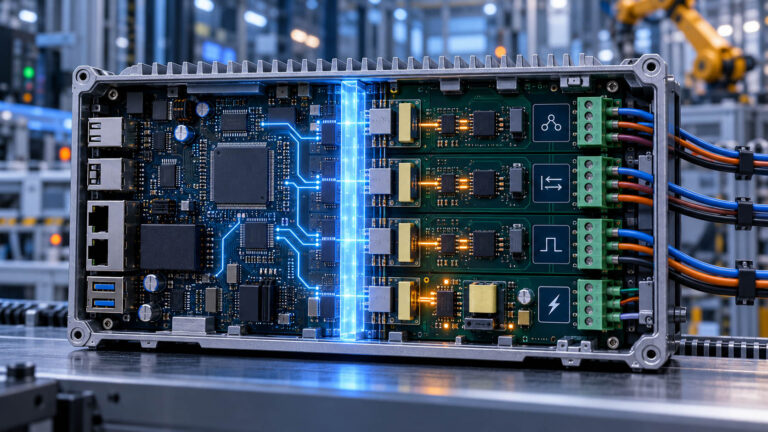
Galvanic Isolation in Industrial PCs: The Signal Integrity Firewall
Protecting Mission-Critical RS-485, CAN Bus, and Edge AI Controllers from Ground Loops & 2.5kV Surges.
A comprehensive technical reference for engineers specifying industrial interface protection in transportation, energy, and manufacturing deployments. This guide covers isolation principles, method comparisons, rating selection, and real-world case studies.
3.75kV
DIO Isolation
2.5kV
Serial / CAN
100K+
MTBF Hours
Table of Contents
What is Galvanic Isolation?
The Electrical Firewall Principle
Galvanic isolation is the principle of separating functional sections of electrical systems to prevent direct current flow while still allowing power or data transfer. In industrial computing, this creates an electrical “firewall” between field-side interfaces (sensors, actuators, networks) and the protected controller circuitry.
The isolation barrier is achieved through three primary mechanisms: magnetic coupling (transformers or coupled inductors), optical coupling (LED-phototransistor pairs in optocouplers), or capacitive coupling (high-voltage ceramic capacitors)—each method transferring signals across a physical gap without galvanic connection. The choice of isolation method depends on signal characteristics, required voltage withstand ratings, and data rates.
Blocks DC and low-frequency AC currents while allowing signal transmission
Eliminates common-mode noise and ground-referenced interference
Withstands transient voltage events from lightning and switching
Understanding Ground Loops
The Silent Killer of Industrial Systems
Ground loops occur when two or more devices share a common signal ground but have different earth ground potentials—a condition that is virtually unavoidable in industrial facilities with distributed equipment. The resulting potential difference (often 2-50V in factories, up to several hundred volts during transient events) drives unwanted current through signal cable shields and ground wires.
This circulating ground current superimposes noise onto data signals, causing bit errors, communication timeouts, and—in severe cases—permanent damage to I/O interface chips. The insidious nature of ground loops is that damage is often cumulative: systems may operate normally for months before failures begin appearing, making root cause analysis extremely difficult.
Ground Potential Differences
When two devices share a common signal ground but have different earth ground potentials (often 2-50V in industrial settings), unwanted current flows through the signal cable ground, corrupting data and potentially damaging I/O chips. This is especially problematic in facilities with multiple electrical panels or buildings connected by long cable runs.
EMI/RFI Interference in Edge AI
Variable Frequency Drives (VFDs) and motor starters generate high-frequency noise that couples into unshielded cables. This is particularly devastating for modern high-performance platforms (such as the RK3588J executing neural networks at 32 TOPS), where high-frequency internal processing must be absolutely shielded from external ground-referenced interference to prevent calculation errors and data corruption.
Transient Voltage Events
Lightning strikes (even indirect coupling), motor inrush currents, and arc welding create voltage transients that can reach several kilovolts. These events travel through cables and destroy unprotected interface chips through gate oxide breakdown. Even sub-damaging transients cause cumulative degradation of semiconductor junctions.
Engineering Insight: The cumulative effect of these stressors is progressive degradation of I/O circuitry through Time-Dependent Dielectric Breakdown (TDDB). Systems may operate for months before experiencing intermittent failures that are extremely difficult to diagnose in the field. Galvanic isolation eliminates all three degradation pathways.
Isolation Methods Comparison
Optical vs. Magnetic vs. Capacitive
Each isolation method has distinct characteristics that make it suitable for different interface types and application requirements. Understanding these trade-offs is essential for proper system design. The choice affects not only isolation voltage but also signal integrity, power consumption, long-term reliability, and cost.
Optical Isolation
Light transmission through air gap via LED-phototransistor pair
Voltage Range
2.5kV – 5kV
Speed Limit
Up to 25 Mbps
Best For
Digital I/O, low-speed serial, safety-critical discrete signals
Advantages
- Highest isolation voltage
- Low power consumption
- No magnetic interference
Limitations
- Speed limited by LED switching
- LED aging affects long-term reliability
Magnetic Isolation
Signal coupling through miniature transformers or coupled inductors
Voltage Range
1.5kV – 5kV
Speed Limit
Up to 1 Gbps
Best For
RS-485, Ethernet, power-over-isolation applications
Advantages
- Excellent for analog signals
- Power transfer capability
- No aging degradation
Limitations
- Larger footprint
- Susceptible to external magnetic fields
Capacitive Isolation
Signal coupling through high-voltage ceramic capacitors
Voltage Range
2.5kV – 5kV
Speed Limit
Up to 150 Mbps
Best For
CAN Bus, SPI, high-speed digital interfaces
Advantages
- Highest speed capability
- Small footprint
- Low latency
Limitations
- Limited common-mode transient immunity
- Requires differential signaling
Interface Isolation Ratings
Standard Ratings for Industrial PC Interfaces
Different interfaces require different isolation methods based on signal characteristics, typical exposure risks, and industry standards. The table below summarizes standard isolation ratings for industrial PC interfaces, including test standards and typical applications.
| Interface | Rating | Method | Standard | Application |
|---|---|---|---|---|
| RS-232 / RS-485 | 2.5kV | Magnetic Coupling | UL 1577 | Industrial MODBUS, Serial sensors |
| Gigabit Ethernet | 1.5kV | Magnetic Isolation | IEEE 802.3 | Industrial networking, Vision systems |
| Digital I/O (DIO) | 3.75kV | Optical Isolation | IEC 60747-5-5 | PLC interfacing, Safety interlocks |
| CAN Bus (2.0B) | 2.5kV | Capacitive Coupling | ISO 11898 | Vehicle systems, Industrial automation |
| USB 2.0/3.0 | 2.5kV | Magnetic + Capacitive | IEC 60950-1 | Peripheral connectivity, Programming ports |
Key Insight: Higher isolation ratings (3.75kV+) are recommended for interfaces exposed to outdoor environments or connected to high-power equipment such as VFDs, inverters, or inductive loads. For safety-critical applications, specify isolation ratings with adequate margin above expected transient levels.
CAN Bus Engineering Insight: Achieving theoretical 2.5kV isolation requires meticulous physical layer configuration. For instance, when deploying edge devices like the AX-660EBT that support standard CAN Bus natively, engineers must configure specific internal jumper settings to activate terminal resistance. Relying merely on default open lines or external indicators compromises the integrity of the isolated network.
Real-World Application Scenarios
Case Studies from Transportation, Energy, and Manufacturing
The following case studies demonstrate how proper galvanic isolation solved critical reliability issues in demanding industrial deployments. Each scenario describes the environmental context, the problem encountered, the isolation solution implemented, and the measurable impact achieved.
Smart Transportation (ETC & Traffic Control)
Outdoor gantries face lightning risks and inductive loop interference from embedded sensors. Cable runs from roadside cabinets to gantry-mounted cameras often exceed 100 meters, creating significant ground potential differences between equipment locations.
Lightning-induced surges couple into long signal cables, while inductive vehicle detection loops generate high-frequency noise that corrupts license plate recognition data. Standard non-isolated RS-485 interfaces experience bit errors and occasional permanent damage.
Optically isolated DI/DO ports (3.75kV) protect the CPU from voltage spikes induced by lightning strikes and inductive coupling. Magnetic-isolated RS-485 (2.5kV) ensures clean MODBUS communication with remote sensors despite ground potential differences.
Achieved 99.2% License Plate Recognition Accuracy and 0.2s ETC Fast Pass speeds by eliminating signal noise. System uptime improved from 94% to 99.8% with zero I/O board replacements over 24-month deployment period.
Results derived from field testing conditions (device count, network topology, camera resolution, model version) for engineering reference only.
Renewable Energy (Photovoltaic / Wind Farms)
Inverters generate massive high-frequency switching noise (10kHz-100kHz) that corrupts data lines. Desert and offshore installations experience extreme temperature cycling and significant ground impedance variations across distributed equipment.
PWM switching transients from grid-tie inverters couple into monitoring cables, causing MODBUS communication failures and false fault alarms. Ground potential differences between string inverters and central monitoring stations can exceed 50V.
Isolated RS-485 (2.5kV magnetic coupling) ensures clean MODBUS data transmission for energy optimization algorithms. Galvanically isolated CAN Bus enables reliable communication between battery management systems (BMS) and central controllers.
Maximized power generation efficiency with real-time MPPT optimization. Reduced maintenance costs by 40% through reliable remote monitoring in unmanned desert and offshore installations.
Automated Manufacturing (24/7 Assembly Lines)
Variable Frequency Drives (VFDs) controlling conveyor motors create ground potential differences up to 50V that crash standard PCs with shared ground references. High-power servo systems generate conducted EMI that propagates through facility grounding.
Ground loop currents flow through serial cables connecting PLCs to HMI controllers, causing intermittent communication failures and occasional I/O chip burnout. The problem intensifies during motor start/stop cycles when transient currents peak.
Full galvanic isolation on all COM ports prevents ground loop current from entering the controller. 2.5kV isolation on CAN Bus ensures reliable communication with distributed servo drives despite varying ground potentials across the factory floor.
Zero downtime due to electrical interference in 24/7 assembly lines. Eliminated quarterly I/O board replacements that previously cost $15,000/year in parts and labor.
Isolation Selection Decision Matrix
When to Specify Isolated vs. Non-Isolated Interfaces
Not every deployment requires full galvanic isolation. The decision depends on environmental factors, cable routing, and the presence of high-power equipment. Use the following decision matrix to determine isolation requirements for your specific application.
| Factor | Isolation Required | Isolation Optional | Rationale |
|---|---|---|---|
| Cable Length | > 30 meters | < 10 meters (same cabinet) | Longer cables accumulate more ground potential difference |
| Power Equipment Nearby | VFDs, Inverters, Motors > 5HP | Low-power sensors only | High-power equipment generates significant EMI and ground noise |
| Outdoor Deployment | Yes (always) | Indoor, controlled environment | Lightning and ground impedance variations require protection |
| Multiple Ground References | Different buildings / panels | Same electrical panel | Separate ground references create potential differences |
| Safety-Critical I/O | E-stop, Interlocks | Status indicators only | Safety functions require guaranteed signal integrity |
AX-130BT / AX-134BT (Modular X86 Architecture)
Recommended for complex deployments requiring extreme reliability. These specific X86 models feature an exclusive modular mainboard design, allowing engineers to implement native, board-level isolated I/O configurations (RS485/CAN/DIO) without relying on external DIN-rail dongles.
View SpecificationsAE-3588LBT (Non-Isolated)
A streamlined, non-isolated configuration perfect for indoor, single-cabinet deployments with short cable runs and stable electrical environments, offering maximum compute efficiency where ground loops are not a threat.
View SpecificationsEngineering Specifications FAQ
Why is galvanic isolation (e.g., 4000V) required for CAN bus in industrial environments?
Industrial environments frequently suffer from ground potential differences. Galvanic isolation breaks the electrical path between the bus and the controller, preventing ground loops and voltage surges from causing damage or logic errors.
What is the 60-ohm rule in CAN bus termination?
A CAN bus requires 120Ω termination resistors at each end. When connected in parallel, the total bus impedance is 60Ω. Deviating from this value causes signal reflections, which lead to data frame corruption.
Can I mix isolated and non-isolated nodes on the same CAN network?
It is not recommended. A single non-isolated node subjected to a surge can create a fault path that bypasses the isolation protection of other nodes, risking system-wide failure.
How does differential signaling on CAN bus improve noise immunity?
CAN uses CAN_H and CAN_L. The logic is based on the voltage difference between them (common-mode rejection). External EMI affects both lines equally, so the difference remains stable, rejecting common-mode noise.
What are the common symptoms of poor CAN bus signal integrity?
Symptoms include intermittent comms loss, high CRC error rates, controller Bus-Off states, and communication failures correlating with the activation of high-power machinery.
Should I use a shielded twisted pair cable for CAN bus?
Yes, specifically in high-EMI areas. Shielded Twisted Pair (STP) provides protection against radiated interference, provided the shield is properly grounded at one end to avoid creating a ground loop.
Recommended Isolated Hardware Configurations
AX-130BT / AX-134BT
X86 Architecture
Features an exclusive modular mainboard design that allows for customized, board-level isolated I/O configurations (RS232/485) without relying on external dongles.
AE-3588BT
32 TOPS Edge AI
Powered by the RK3588J platform delivering 32 TOPS of neural processing power, encased in a fully isolated architecture to protect internal high-frequency compute from VFD and motor EMI.
AX-660EBT
Fieldbus Ready
Engineered for robust automation, supporting standard CAN Bus natively. Designed to maintain absolute signal integrity via specific jumper settings for terminal resistance.
Stop Losing Compute Nodes to
Ground Loops & Surges.
Don't let invisible wiring events take down your critical infrastructure. Talk directly to our L3 engineers about implementing 2.5KV/4000V isolated architectures for your next deployment.
- Custom isolated I/O mapping (CAN, RS-485, DIO)
- EMI/EMC mitigation strategies for high-voltage sites